


Have you started a new business in custom apparel decoration, and are stuck with how to use DTF transfer film? You have landed on the right place. This guide is for you, whether you are a beginner or experienced with DTF printing. It will give you the insights you need for smooth printing.
Direct to Film (DTF) printing is a versatile technology widely adopted by print businesses today, thanks to its application across a variety of fabrics and materials. Be it nylon, fleece, blend, or even classic cotton, you can apply DTF prints on any substrate. Besides, you can also apply it to hard-surfaced materials like glass, wood, metal, and more with UV DTF transfers.
But using DTF transfer films to apply prints on t-shirts or other apparel can be tricky if you don’t know the right process. It isn’t just about putting and pressing the DTF transfer film; there is a lot to learn about temperature, pressing time, and more.
Let’s discuss the process of using DTF transfer film, no fluff, simplified approach to avoid confusion and mistakes.
Prerequisites for Using DTF Transfer Films
First things first, before you start applying your DTF transfer to your shirt or other garment, there are some essential prerequisites you must understand. This helps you prepare your DTF transfer film for printing that offers a retail-ready finish and longer durability. Whether you are a hobbyist or running a high-volume shop, these essential requirements help in quality decoration.
A Professional Heat Press
An iron simply won't cut it. For DTF transfers, you need consistent, heavy pressure and even heat distribution across the entire plate.
The Right Fabric Prep (Pre-Press)
Always press your garment for 5–10 seconds before applying the transfer. This removes moisture and flattens fibers, ensuring the adhesive powder bonds directly to the fabric rather than trapped water vapor.
Accurate Temperature & Timer
Most custom DTF transfers require a temperature range of 150°C to 160°C (300°F–320°F). Using an external infrared thermometer to verify your heat press's actual temperature can save you from ruined inventory.
Parchment or Teflon Sheets
To protect your garment and the heating element, always use a protective barrier. A second "finishing press" with parchment paper after the film is peeled is the secret to achieving that soft-hand feel and maximum durability.
Pressure Calibration
You need medium-to-firm pressure (roughly 60 psi). If the pressure is too light, the adhesive won't "bite" into the fabric; if it's too heavy, you risk "ghosting" or flattening the fabric grain too much.
Knowledge of Peel Type
Know your film! Some are Hot Peel (remove immediately), while others are Cold Peel (wait until the garment is completely cool to the touch). Peeling a cold-peel film while hot is the fastest way to ruin a print.
Anti-Migration Awareness
If you are pressing onto 100% polyester or dark synthetic blends, ensure your transfers have an anti-migration underbase to prevent the garment's dye from bleeding through the white ink of your design.
Pro-Tip from the DTFS Team: Even the best gear can't save a bad file. Before you even get to the heat press, ensure your artwork has been through a human artwork review to check for stray pixels or transparency issues that could result in "glue halos" around your print.
What are the Essential Supplies for DTF Printing?
To master the direct to film printing process, having the right arsenal of professional DTF supplies is the difference between a garment that fades and one that lasts for years.
To understand what is direct to film printing at its core, you must view it as a chemical bond between specialized ink, adhesive powder, and heat. Below are the essential components required to produce retail-quality results.
Premium PET Film
This is the carrier for your design. High-quality films feature a specialized coating that holds the ink without "bleeding" and allows for a smooth, clean release during the peeling process.
DTF-Specific Inks
Unlike standard inkjet inks, DTF requires high-pigment CMYK and a high-opacity White ink. The white layer acts as a foundation, allowing colors to pop even on the darkest black garments.
TPU Adhesive Powder
This is the "glue" that makes the direct to film printing process so durable. This heat-activated powder is applied to the wet ink and cured to create a flexible, stretchable bond with the fabric.
Commercial Heat Press
Knowing how to use DTF transfer film effectively requires a press that provides edge-to-edge heat and heavy, consistent pressure. A standard home iron cannot provide the 60 psi of pressure needed for a permanent bond.
Curing Oven or Heat Station
Before pressing, the powder on the film must be "gelled." A specialized curing oven or a heat press with a hovering function is necessary to melt the adhesive into the ink.
Gang Sheet Printing Capabilities
One of the biggest advantages of this technology is gang sheet printing. This allows you to arrange multiple designs on a single large roll or sheet of film, maximizing your material usage and significantly lowering the cost per print.
How to Use DTF Transfer Film (Step-by-Step Process)
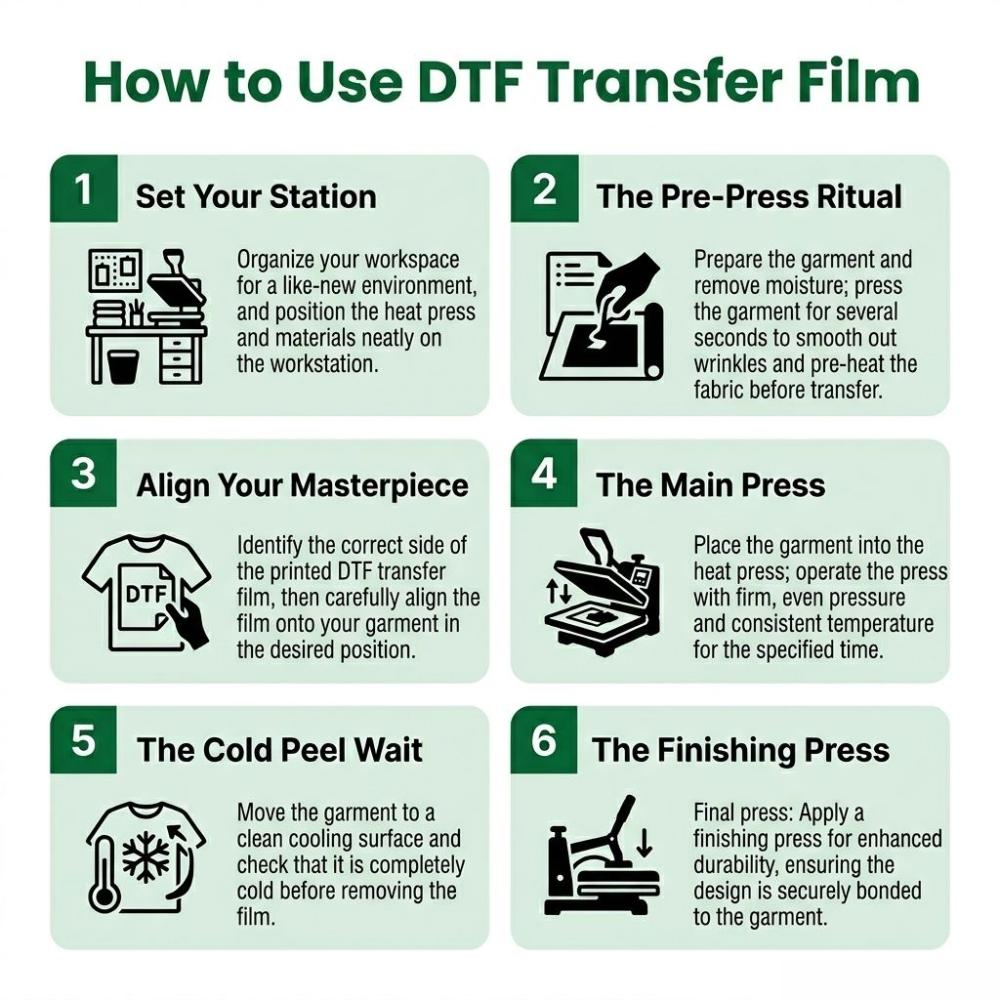
Step 1: Set Your Station
Crank your heat press to exactly 155°C (310°F). Let the heat build up fully for ten minutes. Never start with a luke-warm plate. Consistency is the most important part of the job. You need to master how to use DTF transfer film to get high-quality results every single time. Check your pressure settings now. It should be quite hard to close the handle.
Step 2: The Pre-Press Ritual
Lay your shirt on the platen. No wrinkles allowed. Press the empty garment for exactly 8 seconds. This step is vital. It sucks out all the hidden moisture from the cotton. Moisture creates tiny steam bubbles. Bubbles make the print peel off later. A dry shirt is a happy shirt. It ensures the adhesive bonds to the fabric thread, not the water vapor.
Step 3: Align Your Masterpiece
Grab your custom transfer. The frosted ink side goes down. The glossy plastic side faces up toward you. Center it on the chest area. If it moves during the press, the job is ruined. Use a bit of heat-resistent tape on the corners. Make sure the alignment is perfect. Double check the spacing from the collar before you lock that press down.
Step 4: The Main Press
Clamp the press down hard. Use firm pressure. Set your digital timer for 15 seconds. Don't guess the time. The high heat activates the glue powder on the back of the film. This is the core of the direct to film printing process. If you are too light with the pressure, the wash durability will be very poor.
Step 5: The Cold Peel Wait
This is the hardest part. You must wait. Take the shirt off the heat press. Let it cool down completly on a flat table. Most of these films are cold peel. If you peel while it is still warm, the edges will lift. You will see the designe pull away from the shirt. Just wait two minutes. Be patient.
Step 6: The Finishing Press
Peel the film off in one smooth motion. Now, put the shirt back on the press. Cover it with parchment paper. Press for another 5 seconds. This is the secret. It pushes the ink deep into the fabric fibers. It makes the print soft and flexable. No one wants a thick, plastic-feeling shirt. Now you are finished. Your custom shirt is ready for 100 washes.
Common Mistakes to Avoid When Using DTF Transfer Film
Mastering the art of garment decoration is a journey of trial and error, but in the world of professional printing, errors can be expensive. Even if you have the best equipment, failing to understand the nuances of how to use DTF transfer film can lead to peeling, cracking, or dull colors. To ensure your production stays profitable and your 100+ wash durability remains intact, avoid these common pitfalls.
The Moisture Trap (Skipping the Pre-Press)
The most frequent mistake is neglecting the pre-press. Every fabric, especially 100% cotton, holds hidden moisture. When you hit that fabric with a 155°C (310°F) heat press without pre-pressing, that moisture turns into steam. This steam becomes trapped between the garment and the adhesive, preventing a permanent bond. Always press your garment for 5–10 seconds to dehydrate the fibers before placing your transfer.
Pressure Pitfalls
A common misconception is that "heat does all the work." In reality, the direct to film printing process relies heavily on mechanical pressure. If your pressure is too light, the adhesive powder won't "bite" into the weave of the fabric. Conversely, overly heavy pressure can cause "ghosting" or scorch the garment. Aim for a firm, consistent pressure (around 60 psi on pneumatic presses) to ensure the design is truly embedded.
The "Peel Panic"
Peeling is a high-stakes moment. Most high-durability films are Cold Peel, meaning you must wait until the film is completely cool to the touch before removing the carrier sheet. Peeling while the ink is still semi-liquid or the adhesive hasn't set will result in jagged edges or partial lifting. If you’re in a rush, use a cooling block or a fan—never force a hot peel on a cold-peel film.
Neglecting the Finishing Press
If your design feels like a "plastic sticker" on the shirt, you probably skipped the finishing press. After peeling the carrier film, you must press the design again for 5 seconds with a parchment sheet. This final step "kills the shine," softens the hand-feel, and locks the ink into the fibers for maximum longevity.
Low-Resolution Artwork
No amount of technical skill can save a low-quality file. "Glue halos" or blurry edges often stem from stray pixels or poor transparency in the original artwork. Ensuring your files are 300 DPI and have undergone a manual artwork review before printing is the only way to guarantee the industrial-grade precision your brand deserves.
To Wrap Up
While DTF printing is easy and versatile, doing it the wrong way can ruin your apparel. You can face issues like DTF transfer cracking after a few washes, print come off after production, dull prints, and other quality issues. As a result, you may even have to remove the transfer.
Hence, it is essential to understand how to use DTF transfer film correctly before jumping on the bandwagon. From the process of DTF printing to the supplies required for it, there are several things you must be aware of to make it a successful endeavor.
The art of direct to film printing requires an understanding of the right temperature, pressure, curing, and peeling method to get the best results. All in all, DTF transfer film offers a cost-efficient and simple way to put designs on t-shirts, sweatshirts, and other garments. But knowing how to use it plays a vital role in determining the quality of that print.
FAQs
Can I use a household iron for these transfers?
You can, but it’s not recommended. Irons have uneven heat. They can't provide the heavy pressure you need. Your print will fail after one wash. Use a professional heat press. Consistency is king here.
What fabrics can I print on?
Almost anything. Cotton, polyester, nylon, and blends. It's very versatile. For dark synthetics, we use an anti-migration underbase. It keeps colors bright. No dye bleeding through the white ink.
Why did my transfer peel off after pressing?
Usually, it's moisture or weak pressure. Did you skip the pre-press? That’s a big mistake. Also, check your heat press settings. It needs to be firm. Not weak. And wait for the cold peel.
Do I have to order one design at a time?
No. Use a gang sheet. Put as many designs as you can fit. It lowers your cost per piece. Perfect for small runs or huge batches. Be efficient. Save your margins.