
September 1, 2026 · Connor McDonnell
How to Start a Custom Baby Apparel Business with DTF Transfers: A Step-by-Step Guide
Starting a custom baby apparel business can be an exciting opportunity for entrepreneurs who want to sell personalized, gift-worthy clothing without building a large manufacturing operation from day one.
From newborn announcement bodysuits and first-birthday shirts to personalized baby shower gifts and matching family outfits, custom baby clothing gives sellers plenty of opportunities to create products around meaningful occasions. The challenge is finding a production model that keeps startup costs manageable while still allowing flexibility.
That is where DTF transfers can fit into the process.
With the right blank garments, original designs, a reliable heat press, and professionally produced transfers, you can start a custom baby apparel business without immediately purchasing a full DTF printing setup. Instead, you can focus on developing products, building your brand, testing customer demand, and improving your sales process.
This guide walks through how to choose a niche, create products, understand the DTF workflow, calculate costs, launch your store, and scale as demand grows.
Choose a Profitable Niche for Your Custom Baby Apparel Business
One of the biggest mistakes when starting a new business is trying to sell everything to everyone.
"Custom baby clothes" is a broad category. A clearer niche can make it easier to decide what designs to create, how to position your brand, and where to find potential customers.
For example, instead of offering random designs for every possible occasion, you might focus on one or two areas.
Custom Baby Apparel Niches to Consider
Popular niche ideas include:
-
Newborn announcement outfits
-
Personalized name bodysuits
-
Baby shower gifts
-
First-birthday shirts
-
Monthly milestone outfits
-
Sibling announcement apparel
-
Matching parent-and-baby clothing
-
Holiday and seasonal baby collections
-
Funny or cute baby sayings
-
Personalized daycare or milestone shirts
A business focused on first-birthday apparel, for example, can create a collection around birthday shirts, matching family apparel, personalized names, and gift bundles.
The goal is not to limit your future business forever. It is to give your first collection a clear direction.
How to Validate Your Product Idea
Before purchasing a large amount of inventory, research the market.
Look at businesses selling similar products and pay attention to:
-
The types of products they offer
-
Common design themes
-
Personalization options
-
Customer reviews
-
Seasonal products
-
Typical price ranges
-
Product gaps you may be able to fill
You can also look at search trends, social media discussions, and marketplace listings to understand what customers are actively looking for.
A focused niche makes it easier to test demand because you are comparing a specific product idea against a specific customer need.
Once you know who you want to serve, you can build a small product line around that audience.
Decide What Your Baby Clothing Business Will Sell
You do not need 100 products to launch a custom baby clothing business.
Starting with a smaller catalog gives you the opportunity to test designs without investing heavily in inventory that may not sell.
A simple starting collection might include:
-
5 to 10 bodysuit designs
-
5 to 10 baby T-shirt designs
-
Several personalized name options
-
A few occasion-based products
-
Seasonal or holiday designs
You can add products based on what customers actually buy.
Choose Products That Work Well With Personalization
Personalization can be one of the strongest ways to differentiate a baby clothing business.
Instead of selling only a standard shirt design, you can offer options such as:
-
Baby's name
-
Age
-
Birthday
-
Family role
-
Short custom message
-
Event date
-
Selected color combinations
For example, a basic baby shirt becomes more specific when offered as a personalized first-birthday shirt with the child's name and age.
This can make the product feel more meaningful and gift-oriented.
Build Your Catalog Around Important Occasions
Baby apparel is often purchased for a particular moment rather than just as everyday clothing.
Consider building collections around:
-
Baby showers
-
Birth announcements
-
Coming-home outfits
-
First birthdays
-
Holidays
-
Family photo sessions
-
Pregnancy or sibling announcements
Occasion-based products can also make it easier to plan seasonal launches throughout the year.
Understand How DTF Transfers Fit Into a Baby Clothing Business
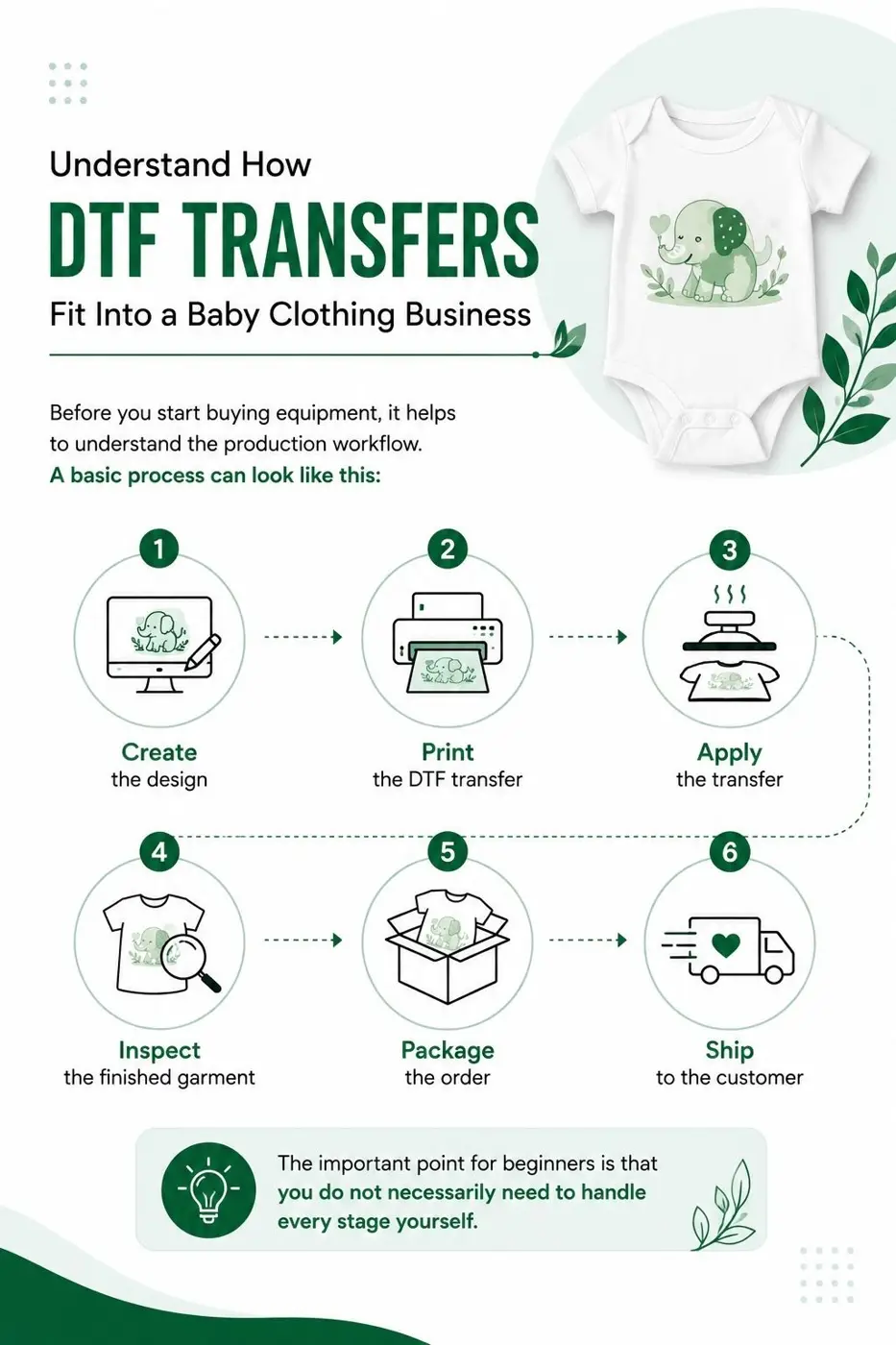
Before you start buying equipment, it helps to understand the production workflow.
A basic process can look like this:
Create the design → Print the DTF transfer → Apply the transfer → Inspect the finished garment → Package the order → Ship to the customer
The important point for beginners is that you do not necessarily need to handle every stage yourself.
You can create your designs and order ready-to-press custom DTF transfers, then apply them to blank garments using a heat press. This allows you to build products without immediately managing a DTF printer and the complete printing workflow.
Why Outsourcing DTF Transfers Can Make Sense for Beginners
Operating DTF printing equipment involves more than simply owning a printer. Depending on the production setup, businesses may need to manage equipment, consumables, maintenance, printing workflows, and production processes.
For a new business, outsourcing transfers can simplify the starting model.
Your workflow may be:
-
Create the artwork.
-
Prepare the design for production.
-
Order ready-to-press transfers.
-
Source blank baby apparel.
-
Apply the transfer with a heat press.
-
Inspect, package, and ship the finished product.
This approach can help you test products and customer demand before deciding whether a larger in-house printing investment makes business sense.
For a deeper comparison, you can also explore in-house vs outsourced dtf production.
When DTF Gang Sheets Can Be Useful
A new baby apparel business may use multiple small designs, names, logos, or product graphics.
When you have several designs to print, DTF gang sheet printing can be useful for organizing multiple graphics on a single sheet, depending on the supplier's workflow and your production needs.
This can be especially practical when you are testing a collection containing different designs rather than ordering a large quantity of one graphic.
As your catalog grows, efficient artwork organization can become increasingly important.
Outsourced DTF vs. In-House Printing
There is no single right production model for every business.
Outsourcing may be more suitable when you want to start lean and focus on product development and sales. In-house production may become more relevant when consistent order volume, turnaround requirements, and operational capacity justify the investment.
|
Factor |
Outsourced Transfers |
In-House Printing |
|
Initial equipment investment |
Generally lower |
Generally higher |
|
Printer maintenance |
Managed by supplier |
Managed by your business |
|
Production control |
Depends on supplier workflow |
Greater direct control |
|
Setup complexity |
Simpler starting process |
More operational requirements |
|
Best starting use |
Testing and lower-volume production |
Established, consistent production needs |
The right choice depends on your sales volume, budget, available workspace, and long-term business plans.
Essential Equipment and Supplies to Start a Custom Baby Apparel Business
A lean setup does not mean ignoring quality.
The products you choose and the consistency of your production process can affect customer satisfaction and repeat orders.
A Reliable Heat Press
If you are applying transfers yourself, the heat press is one of your most important pieces of equipment.
Look for features such as:
-
Consistent temperature performance
-
Even and adjustable pressure
-
A platen size appropriate for your products
-
Easy operation
-
Reliable build quality
-
Suitable safety features
Inconsistent temperature or pressure can affect application results. Before selling a product, test the specific transfer and garment combination you plan to use.
Blank Baby Apparel
Your finished product is only as good as the garment you start with.
When choosing blanks, consider:
-
Fabric composition
-
Softness and comfort
-
Garment construction
-
Sizing consistency
-
Print area
-
Color availability
-
Supplier reliability
Potential products include:
-
Bodysuits
-
Rompers
-
Baby T-shirts
-
Toddler shirts
-
Sweatshirts
Review the garment specifications carefully and select products appropriate for the market and age range you intend to serve.
Ready-to-Press DTF Transfers
When ordering transfers, consider factors such as:
-
Design dimensions
-
Garment size
-
Artwork details
-
Number of designs needed
-
Expected order volume
-
Supplier turnaround requirements
As production increases, bulk and wholesale DTF printing may become relevant when your business has larger or more consistent transfer requirements.
Basic Production Accessories
You may also need basic items such as:
-
A lint roller
-
Heat-resistant tape when required
-
Protective pressing sheets
-
Alignment tools
-
Packaging materials
-
Labels or tags
Keep your production area organized so every order can move through the same repeatable workflow.
Create Original Designs Customers Will Want to Buy
Your designs can become one of the biggest reasons customers choose your brand instead of another seller.
Rather than building a store around copied trends, develop a recognizable design style that fits your chosen niche.
Create a Consistent Design Style
Consider the personality of your brand.
You might focus on:
-
Minimalist typography
-
Playful illustrations
-
Cute phrases
-
Modern personalized designs
-
Seasonal graphics
-
Neutral gift-oriented designs
A consistent style can help your products look like part of the same brand rather than a collection of unrelated designs.
Baby Apparel Design Ideas
You can build products around concepts such as:
-
Personalized names
-
Birth years
-
First birthdays
-
Family announcements
-
Milestone moments
-
Short humorous phrases
-
Seasonal celebrations
-
Matching family themes
For example, original phrases such as "Tiny Explorer," "Milk. Cuddles. Repeat." or "Future Big Sister" can inspire product concepts without relying on protected third-party characters.
Prepare Artwork Properly for DTF Printing
Before submitting artwork for production, make sure it meets your supplier's file requirements.
Depending on the artwork and production process, this may involve considering:
-
File resolution
-
Design dimensions
-
Transparent backgrounds when required
-
Fine-detail visibility
-
Text readability
-
Color accuracy
Always check the specifications provided by your transfer supplier before ordering.
Avoid Copyright and Trademark Problems
Do not assume that artwork found online is available for commercial use.
Businesses should avoid reproducing protected characters, logos, celebrity images, sports-team artwork, and other intellectual property without appropriate rights or permission.
A better long-term strategy is to create original artwork or use properly licensed designs.
Original designs can also help your brand develop a stronger identity.
How to Apply DTF Transfers to Baby Apparel
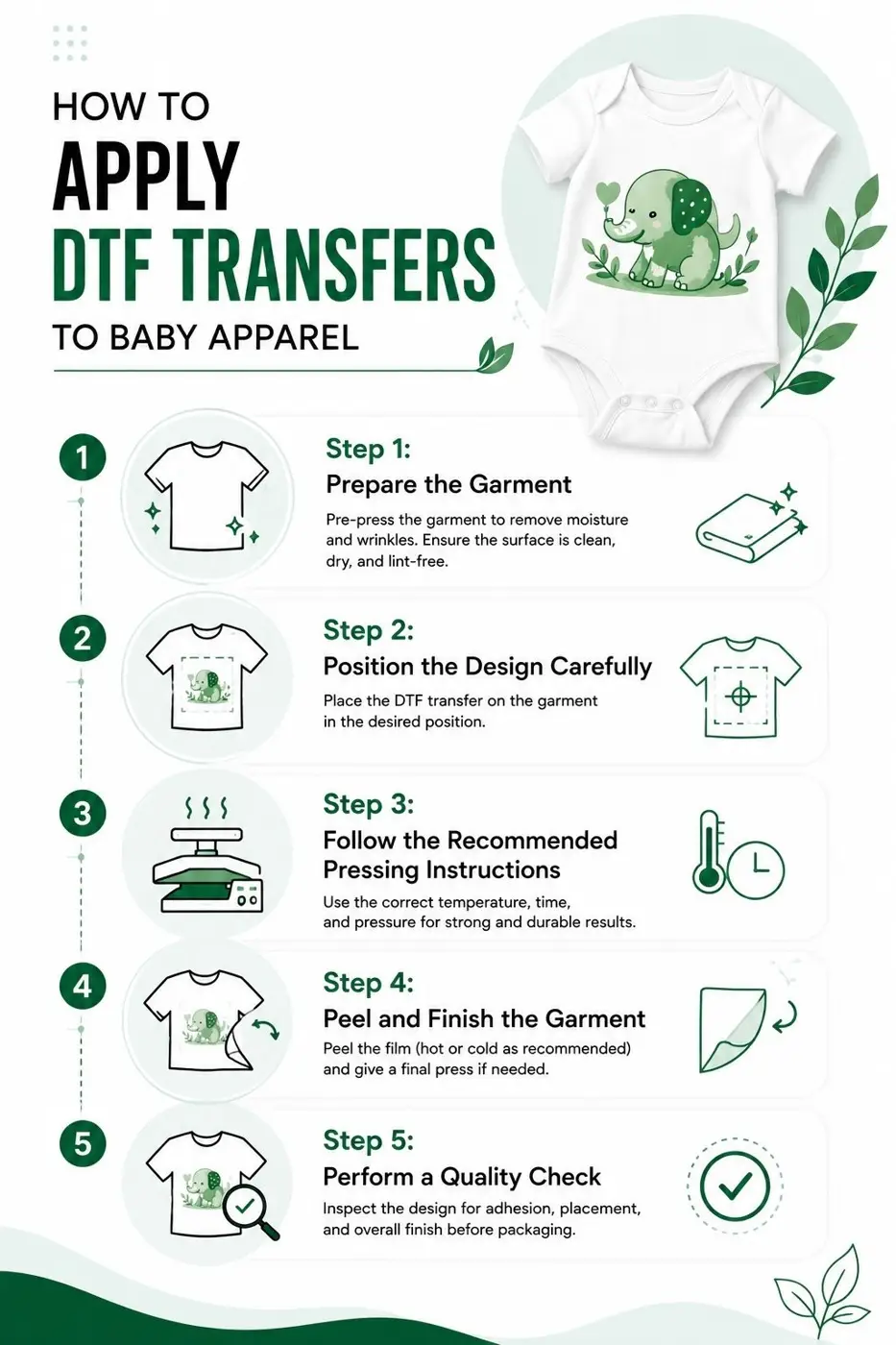
Once you have your blank garments and ready-to-press transfers, create a consistent application process.
The exact instructions can vary based on the transfer, film, garment, and supplier. For that reason, always follow the pressing recommendations provided for your specific transfer product.
Step 1: Prepare the Garment
Start by inspecting the garment.
Remove lint or debris from the print area and follow the appropriate preparation instructions for the garment and transfer you are using.
Consistency matters. Small issues can become more noticeable on personalized products where customers expect careful production.
Step 2: Position the Design Carefully
Baby apparel has a smaller print area than many adult garments.
Take time to position the transfer appropriately for the size and style of the garment. If you offer multiple sizes, test your placement process across those sizes rather than assuming one position will work for every product.
Step 3: Follow the Recommended Pressing Instructions
Temperature, pressing time, pressure, and peel method can vary.
Use the instructions supplied for your particular transfer and test the specific garment-transfer combination before producing customer orders.
This is more reliable than applying one universal setting to every fabric and transfer.
Step 4: Peel and Finish the Garment
Peel the carrier according to the transfer supplier's instructions.
If a finishing press is recommended, follow the applicable guidance for the product. Then inspect the design for proper adhesion and overall appearance.
Step 5: Perform a Quality Check
Before packaging, check:
-
Design alignment
-
Print appearance
-
Edge adhesion
-
Garment condition
-
Personalization accuracy
-
Overall presentation
A clear quality-control step can help catch errors before the order reaches the customer.
Calculate the Real Cost of Starting a Baby Clothing Business
One of the most important steps when you start a baby clothing business is understanding your real cost per product.
Do not price a product based only on the cost of the blank garment.
Your total cost may include:
-
Blank apparel
-
DTF transfers
-
Packaging
-
Labels and tags
-
Heat pressing
-
Labor
-
Payment processing fees
-
Marketplace or platform fees
-
Shipping supplies
-
Marketing costs
-
Reprints or damaged products
Use a Simple Cost Formula
A basic starting formula is:
Total product cost = Materials + Production costs + Packaging + Selling costs + Marketing allocation
For example, if you know the complete cost of producing and selling one personalized bodysuit, you can make more informed pricing decisions.
Remember that gross margin is not the same as final profit. Labor, taxes, returns, overhead, and other business expenses can still affect your results.
Price for Sustainable Margins
Your pricing should account for more than materials.
Consider:
-
Time spent producing each order
-
Personalization work
-
Customer service
-
Reprints caused by errors
-
Discounts and promotions
-
Returns where applicable
-
Business overhead
Review your numbers regularly as supplier prices and selling costs change.
Why Personalization Can Add Value
Personalized products often provide a clearer reason for customers to choose one seller over another.
For example, a standard baby shirt can become a more specific gift product when customers can add a name, age, or special date.
The goal is not simply to charge more. It is to create a product with meaningful customization and a clear customer benefit.
Use a Made-to-Order Model to Reduce Inventory Risk
A made-to-order model can be particularly useful for personalized baby apparel.
Instead of producing every possible name, size, color, and design combination in advance, the process can be:
Customer orders → Personalization is confirmed → Product is produced → Quality checked → Shipped
This can reduce the amount of finished inventory sitting unsold.
Benefits of Made-to-Order Production
Potential benefits include:
-
Less finished-goods inventory
-
Fewer unsold personalized products
-
Greater flexibility
-
Easier product testing
-
More customization options
-
Simpler catalog updates
You may still choose to keep blank garments, packaging, and other frequently used materials available based on expected demand.
The key is balancing inventory availability with the risk of buying too much before sales are proven.
Build a Brand Parents and Gift Buyers Can Trust
A strong brand does not require an expensive launch.
However, it should create a consistent experience.
Start with the basics:
-
A memorable brand name
-
A simple logo
-
A consistent visual style
-
Clear product photography
-
Attractive packaging
-
Easy-to-understand product information
Make Product Information Clear
Customers should be able to quickly understand:
-
Available sizes
-
Fabric details
-
Customization options
-
Care instructions
-
Processing times
-
Shipping information
Clear information can reduce confusion before an order is placed.
Create Clear Customization Policies
Personalized products require a clear ordering process.
Explain how customers should provide:
-
Names
-
Dates
-
Ages
-
Custom text
-
Color selections
Also make it clear how you handle spelling mistakes, incorrect customer information, order changes, and personalized items that may not be suitable for resale.
Create Product Photos That Help Customers Buy With Confidence
Baby apparel is a highly visual product category.
Your photos should help customers understand what they are purchasing without relying on guesswork.
Include:
-
Front product views
-
Close-ups of design details
-
Images showing garment texture
-
Size information
-
Personalization examples
-
Packaging images
Show Exactly What Customers Can Customize
If your product allows customization, demonstrate it clearly.
For example, show sample fields for:
-
Name
-
Age
-
Garment color
-
Design color
-
Size
This can make the ordering process easier to understand and reduce avoidable mistakes.
Use Images to Demonstrate Product Quality
Good product images can show customers details such as:
-
Print appearance
-
Design clarity
-
Garment construction
-
Overall presentation
Consistent photography can also strengthen your brand across your website, marketplaces, and social media.
Where to Sell Your Custom Baby Apparel
A new business can begin with one sales channel and expand over time.
The best choice depends on your audience, budget, technical resources, and marketing strategy.
Sell Through Your Own Online Store
An independent store can give you greater control over:
-
Branding
-
Product presentation
-
Customer experience
-
Product organization
You can build the site around your specific niche and create collections for occasions, seasons, and personalized products.
Use Online Marketplaces
Marketplaces may offer access to existing shoppers, although sellers should consider factors such as:
-
Competition
-
Fees
-
Platform requirements
-
Product differentiation
Make sure your listings clearly communicate what is personalized and what customers will receive.
Use Social Media to Test Demand
Social media can help you demonstrate your products and collect feedback.
Content ideas include:
-
New design launches
-
Personalization examples
-
Behind-the-scenes production
-
Product packaging
-
Seasonal collections
-
Gift ideas
-
Customer photos, where appropriate permission has been obtained
Explore Local and Wholesale Opportunities
As your business develops, you may also explore opportunities with:
-
Baby boutiques
-
Gift shops
-
Event vendors
-
Baby shower planners
-
Local markets
If order volumes become larger or more consistent, reviewing bulk and wholesale DTF printing options may help you plan your transfer sourcing around your production requirements.
You can also refer to a wholesale DTF transfers buyer's guide when evaluating larger transfer orders.
A 30-Day Plan to Start Your Custom Baby Apparel Business
A structured launch can help prevent you from trying to do everything at once.
Week 1: Research Your Niche and Audience
Focus on:
-
Choosing your target niche
-
Reviewing competitors
-
Identifying product opportunities
-
Researching blank apparel suppliers
-
Evaluating transfer production options
-
Defining your brand direction
Week 2: Develop and Test Products
Use this week to:
-
Create original designs
-
Order sample transfers
-
Purchase selected blank garments
-
Test your application process
-
Inspect product results
-
Photograph successful samples
Testing before launch can help you identify issues before they affect customer orders.
Week 3: Build Your Sales Foundation
Prepare:
-
Product listings
-
Product descriptions
-
Pricing
-
Product photography
-
Customization instructions
-
Order processes
-
Shipping information
-
Relevant store policies
Keep the first catalog manageable.
Week 4: Launch and Learn
Launch with a focused selection rather than every design idea you have.
Then track:
-
Which products receive attention
-
Which designs generate orders
-
Common customer questions
-
Popular personalization options
-
Products that may need improvement
Use the results to make decisions based on actual customer behavior.
When Should You Scale Your DTF Transfer Business?
Growth does not always mean purchasing more equipment immediately.
First, identify what is creating the production bottleneck.
You may need a more scalable strategy when you experience:
-
Increasing order volume
-
More repeat designs
-
Larger wholesale opportunities
-
Consistent demand for certain products
-
Faster turnaround requirements
Use Bulk Ordering as Production Grows
As order volume becomes more predictable, you may be able to plan transfer purchasing more efficiently.
Consider:
-
How frequently you reorder
-
Which designs sell repeatedly
-
Expected production volume
-
Supplier turnaround times
-
Available storage
The right ordering approach will depend on how predictable your sales are.
Consider White Label Production for Ecommerce Growth
Some ecommerce businesses may eventually want to expand product offerings without building every part of the printing operation internally.
A white label DTF printing service can be worth evaluating when your business model requires production support while maintaining your own customer-facing brand.
For more information about this approach, see benefits of white label DTF fulfillment for ecommerce businesses.
Know When In-House Printing Makes Sense
Bringing production in-house should be based on business requirements rather than simply assuming that owning equipment is automatically cheaper.
Consider your:
-
Consistent production volume
-
Equipment budget
-
Available workspace
-
Maintenance capacity
-
Staffing
-
Turnaround requirements
The decision should be based on a realistic comparison between your current outsourced costs and the total operational cost of managing production yourself.
The DTF transfers for print shops guide can also help businesses understand how transfer production may fit into a broader growth strategy.
Common Mistakes to Avoid When Starting a Baby Clothing Business
A few early mistakes can create unnecessary costs.
Avoid:
Buying Too Much Inventory Too Early
Start with enough products to test demand rather than filling storage with unproven designs and sizes.
Launching With Too Many Designs
A smaller, focused catalog is easier to manage and evaluate.
Failing to Test Products
Test your selected garment and transfer combination before selling it. Review the finished appearance and follow applicable supplier instructions.
Pricing Without Calculating Every Cost
Include production, selling, packaging, marketing, and other relevant expenses.
Copying Protected Artwork
Build original designs or use properly licensed artwork.
Creating an Unclear Personalization Process
Customers should know exactly what information they need to provide and how their product will be customized.
Ignoring Quality Control
Inspect every finished product before it is packaged.
Choosing Suppliers Based Only on Price
Low cost is only one factor. Consider quality, consistency, communication, turnaround, and reliability.
Buying Expensive Equipment Before Validating Demand
Prove that customers want your products before making major investments that your sales volume may not yet support.
Is Starting a Custom Baby Apparel Business With DTF Transfers Worth It?
A custom baby apparel business can be started with a relatively simple production model when you take a focused approach.
Begin by choosing a niche, creating original designs, sourcing suitable blank apparel, and testing a manageable collection. Instead of immediately investing in a complete printing operation, you can evaluate ready-to-press DTF transfers as part of a leaner starting workflow.
The process can be summarized as:
Choose a niche → Create original designs → Source blank apparel → Order DTF transfers → Apply designs → Quality check → Sell → Learn → Scale
For a new baby clothing business, this approach can make it easier to test customer demand before expanding inventory or production capabilities.
As orders grow, you can reassess your needs and explore options such as DTF gang sheet printing, larger-volume transfer orders, and other production solutions.
If you are ready to turn your artwork into finished products, DTFS.co offers options for custom DTF transfers, DTF gang sheet printing, bulk and wholesale DTF printing, and a white label DTF printing service to support different stages of business growth.
Understanding the advantages of DTF printing can also help you decide whether this production method fits your product goals and workflow.
Start Small, Test Your Products, and Scale With Demand
You do not need to build a large production operation before launching your first products.
Start with a focused idea. Create original designs, test your products, develop a repeatable production process, and learn what customers actually want.
For many new sellers, combining quality blank garments with professionally produced DTF transfers and made-to-order production can provide a practical path to entering the custom baby apparel market.
As demand grows, your production strategy can grow with it.
FAQs About Starting a Custom Baby Apparel Business
How much does it cost to start a custom baby apparel business?
Startup costs vary based on your business model, equipment, initial inventory, transfer sourcing, packaging, and selling channels. A lean made-to-order approach can reduce the need to invest heavily in finished inventory.
Do I need a DTF printer to start a baby clothing business?
No. You can outsource ready-to-press DTF transfers and apply them to selected blank garments with an appropriate heat press. You can evaluate in-house printing later if your business volume and operational needs justify the investment.
What products can I sell in a custom baby clothing business?
You can sell products such as bodysuits, baby T-shirts, rompers, milestone outfits, first-birthday apparel, personalized gifts, sibling announcement shirts, and seasonal clothing.
Can I start with made-to-order personalized baby clothing?
Yes. A made-to-order model allows you to produce personalized products after receiving the customer's order details, which can help reduce the amount of finished inventory you need to keep on hand.
How can I make my custom baby apparel business stand out?
Focus on a clear niche, original designs, useful personalization options, consistent branding, clear product information, quality control, and a reliable customer experience.
When should I buy my own DTF printer?
Consider in-house printing when your order volume is consistently high enough to justify the investment and you have the resources to manage equipment, supplies, maintenance, workspace, and production operations.