


The custom apparel industry is evolving fast, and Direct to Film printing has become one of the most popular solutions for producing vibrant, durable designs on demand. From startup clothing brands to established print shops, businesses are constantly looking for smarter ways to improve production while protecting profit margins.
One of the biggest decisions today is choosing between in-house vs outsourced DTF printing. Both options offer unique advantages, but the right choice depends on your business goals, production volume, available budget, and operational experience.
Some brands prefer full production control with an in-house setup, while others choose outsourced DTF printing to avoid expensive equipment and maintenance. Businesses looking to simplify production can also explore professional bulk dtf printing services for scalable order fulfillment and consistent transfer quality.
In this guide, we will break down everything you need to know about in-house vs outsourced DTF printing, including costs, production speed, maintenance requirements, scalability, and long-term profitability. If you are planning to buy custom dtf transfer products for your apparel business, understanding these production models can help you choose the most cost-effective solution.
Understanding In-House vs Outsourced DTF Printing
Before comparing costs and production efficiency, it is important to understand how both models actually work.
What Is In-House DTF Printing?
In-house DTF printing means your business owns and operates the entire printing setup internally.
This usually includes:
-
DTF printer
-
RIP software
-
PET film
-
Powder shaker or curing oven
-
Heat press
-
Ventilation setup
Your team handles every step of production, from artwork preparation to transfer printing and curing.
Many growing apparel businesses choose in-house DTF printing because it gives them complete control over turnaround time, color consistency, and production scheduling. Businesses that frequently handle rush orders or high-volume production often prefer this setup.
However, running production internally also means taking responsibility for machine maintenance, ink management, and operator training.
What Is Outsourced DTF Printing?
Outsourced DTF printing works differently. Instead of printing transfers yourself, you send artwork files to a professional transfer supplier. The supplier prints the transfers and ships them ready to press.
This approach is extremely popular among:
-
Startup apparel brands
-
Etsy sellers
-
Small print shops
-
Side hustlers
-
Businesses testing new product ideas
With outsourced production, you only need a heat press and blank garments. The supplier handles printing, curing, and quality control.
For businesses with inconsistent order volume, outsourced DTF printing reduces risk and keeps operations simple.
Why Businesses Compare Both Models
The debate around in-house vs outsourced DTF printing is growing because both options solve different business problems.
Some companies prioritize flexibility and low startup costs. Others focus on long-term savings and faster fulfillment.
Here is where each model usually performs best:
|
Business Need |
Outsourcing |
In-House Printing |
|
Low startup investment |
Excellent |
Expensive |
|
Fast production control |
Limited |
Excellent |
|
Maintenance-free workflow |
Excellent |
Requires daily upkeep |
|
High-volume profitability |
Moderate |
Excellent |
|
Easy scalability |
Good |
Better long-term |
Choosing the wrong production method can slow growth and reduce profitability. That is why many apparel businesses carefully evaluate both models before investing heavily.
In-House vs Outsourced DTF Printing: Cost Breakdown for Growing Brands
Cost is often the biggest deciding factor in the DTF printing comparison process.
At first glance, outsourcing seems cheaper because there is almost no equipment investment. But over time, per-print costs can add up quickly.
On the other hand, in-house production requires a large upfront investment but lowers long-term production costs.
Initial Equipment Costs for In-House Production
A basic DTF setup can cost anywhere from $3,000 to $10,000 or more depending on equipment quality and production size.
Typical expenses include:
-
Printer purchase
-
Powder shaker and curing unit
-
RIP software
-
Ventilation system
-
Heat press
-
Maintenance supplies
Industrial production setups can cost significantly more.
For many startups, this investment creates financial pressure before sales become stable.
That is one reason many businesses start with outsourced production first.
Cost Per Print Comparison
The long-term math changes once order volume increases.
With outsourced transfers, businesses often pay:
-
Cost per transfer sheet
-
Shipping charges
-
Rush order fees
-
Setup fees in some cases
With in-house printing, production costs can drop significantly after setup costs are recovered.
Average in-house production costs may fall between:
-
$0.50 to $1.50 per transfer sheet
This is where in house printing vs outsourcing becomes an important financial conversation for scaling brands.
A business producing high transfer volumes weekly may eventually save thousands annually by bringing production internally.
Hidden Costs Businesses Often Ignore
Many new businesses underestimate the hidden operational costs involved with in-house production.
These include:
-
Daily printhead cleaning
-
Ink waste
-
Failed prints
-
Staff training
-
Humidity management
-
Equipment downtime
White DTF ink especially requires constant circulation and maintenance. If printers sit unused for too long, clogged printheads can become expensive to repair.
Outsourcing eliminates most of these operational headaches.
That simplicity is why many growing brands continue using professional transfer suppliers even after scaling.
Pros and Cons of Outsourced DTF Printing
As the apparel industry becomes more competitive, many businesses are turning toward outsourced production to simplify operations and reduce risk. For startups and small shops, outsourcing often provides a faster and more affordable path into custom apparel printing.
Still, outsourced production is not perfect for every business model. Understanding both the advantages and limitations can help you make a smarter long-term decision.
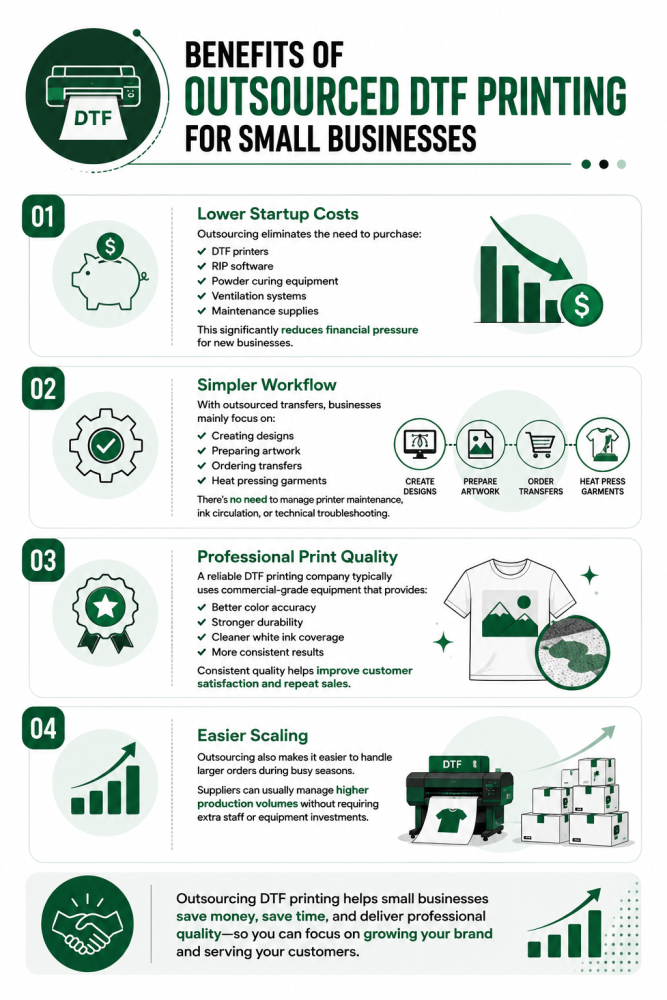
Benefits of Outsourced DTF Printing for Small Businesses
One of the biggest reasons businesses choose outsourced DTF printing is the low barrier to entry.
Instead of investing thousands of dollars into equipment, businesses can start selling immediately with minimal overhead. This allows new brands to focus more on marketing, customer acquisition, and product development rather than machine maintenance.
Some major advantages include:
Lower Startup Investment
Outsourcing removes the need to purchase:
-
DTF printers
-
RIP software
-
Powder curing equipment
-
Ventilation systems
-
Maintenance supplies
For many entrepreneurs, this dramatically reduces financial pressure during the early growth stage.
Easier Production Workflow
When using outsourced transfers, your workflow becomes much simpler.
You mainly focus on:
-
Creating designs
-
Preparing artwork
-
Ordering transfers
-
Heat pressing garments
There is no need to monitor ink circulation, troubleshoot printer issues, or spend hours maintaining equipment.
This simplicity is especially valuable for small teams with limited production experience.
Access to Professional Print Quality
A reliable dtf printing company often uses commercial-grade equipment that delivers highly consistent results.
Professional suppliers typically offer:
-
Better color calibration
-
Stronger print durability
-
Cleaner white ink coverage
-
Higher production consistency
For brands trying to build customer trust, consistent print quality plays a huge role in repeat sales.
Flexible Scaling Without Extra Equipment
Outsourcing also makes scaling easier during seasonal demand spikes.
Whether you need 10 transfers or 1,000, a reliable supplier can usually handle the increased production volume without forcing you to hire additional staff or buy more equipment.
This flexibility helps businesses grow gradually without taking major operational risks.
Common Challenges With Outsourced DTF Printing
Although outsourcing offers convenience, it also comes with limitations that can affect customer experience and profit margins.
Slower Turnaround Times
One of the biggest disadvantages of outsourced production is delayed fulfillment.
Most suppliers require:
-
Production processing time
-
Shipping transit time
-
Possible queue delays during busy seasons
This can make same-day or emergency orders difficult to fulfill.
Businesses that rely heavily on fast local fulfillment may struggle with these delays.
Less Production Control
When another company handles production, you lose some control over:
-
Color accuracy
-
Print sizing
-
Film alignment
-
Packaging consistency
Even high-quality suppliers can occasionally produce errors, and resolving reprints may take additional time.
This is one reason many growing brands eventually revisit the in-house vs outsourced DTF printing debate as they scale.
Higher Long-Term Per-Print Costs
Although outsourcing avoids large equipment investments, transfer pricing remains higher over time.
As order volume increases, the cost difference between outsourced and internal production becomes more noticeable.
Businesses producing large quantities every week often find that in-house production offers better long-term margins.
To overcome these common outsourcing challenges, many apparel businesses choose reliable production partners like DTFS. With fast turnaround support, consistent transfer quality, professional Artwork Setup, and scalable bulk dtf printing services, DTFS helps reduce delays, improve print consistency, and simplify production management for growing brands.
In-House vs Outsourced DTF Printing: Which Offers Better Production Control?
Production control is one of the biggest differences in the DTF printing comparison process.
Some businesses value operational simplicity, while others prioritize speed, consistency, and flexibility.
Speed and Fulfillment Advantages of In-House Printing
With in-house DTF printing, businesses can produce transfers immediately without waiting for supplier turnaround or shipping.
This creates major advantages for:
-
Rush orders
-
Local same-day delivery
-
Custom one-off designs
-
Last-minute production changes
A customer can place an order in the morning and receive the finished garment later the same day.
For many established print shops, this speed becomes a major competitive advantage.
Better Quality Control
Internal production also allows businesses to monitor every detail of the printing process.
This includes:
-
Ink density adjustments
-
Color profile corrections
-
Powder application
-
Print alignment
-
Test printing
Instead of depending on a third party, your team can make immediate changes whenever issues appear.
This level of control is especially important for premium apparel brands focused on consistency.
Inventory and Workflow Flexibility
Another major benefit of internal production is inventory flexibility.
With outsourced production, businesses often need to plan around shipping schedules and supplier deadlines.
In-house setups allow you to:
-
Print only what you need
-
Reduce excess inventory
-
Handle custom orders faster
-
Test designs instantly
This flexibility helps businesses react more quickly to market trends and customer demand.
Maintenance, Workspace, and Learning Curve Explained
While in-house production offers more control, it also introduces technical responsibilities that many beginners underestimate.
Daily Maintenance Requirements
DTF printers require regular maintenance to stay operational.
White ink especially can settle quickly and clog printheads if not properly circulated.
Typical maintenance tasks include:
-
Daily nozzle checks
-
Printhead cleaning
-
Ink agitation
-
Humidity monitoring
-
Waste ink management
Ignoring maintenance can lead to expensive repairs and production downtime.
This is one reason some businesses continue outsourcing even after reaching higher sales volume.
Workspace and Ventilation Needs
DTF production also requires dedicated workspace planning.
Most setups need:
-
Stable room temperature
-
Controlled humidity
-
Ventilation systems
-
Safe powder curing areas
-
Storage for films and inks
Businesses operating from small apartments or shared workspaces may find outsourcing far easier to manage.
Is Outsourcing Easier for Beginners?
For many beginners, yes.
Businesses with little technical experience often prefer outsourced workflows because they avoid the operational learning curve associated with printer management.
This allows them to focus on:
-
Branding
-
Sales
-
Customer service
-
Marketing
-
Product testing
As sales increase, many businesses gradually transition toward hybrid or fully internal production models.
In-House vs Outsourced DTF Printing for Scaling Apparel Businesses
As apparel businesses grow, production decisions become more important. What works for a startup may not work for a brand processing hundreds of orders every week.
That is why the discussion around in-house vs outsourced DTF printing often changes as businesses scale.
The right production strategy depends heavily on:
-
Weekly order volume
-
Available capital
-
Production speed requirements
-
Staffing capacity
-
Long-term business goals
When Outsourcing Makes More Sense
Outsourcing is usually the better option for businesses that are still testing demand or operating with inconsistent sales volume.
It works especially well for:
-
Startup clothing brands
-
Etsy shops
-
Small businesses
-
Side hustles
-
Influencer merchandise brands
If your business prints fewer than 30–50 transfers weekly, outsourced production often remains more cost-effective and operationally simple.
Instead of worrying about equipment maintenance, businesses can focus on building brand awareness and attracting customers.
This approach also reduces financial risk during the early growth stage.
Signs Your Business Has Outgrown Outsourcing
At some point, growing brands may notice that outsourcing starts limiting profitability and flexibility.
Some common signs include:
-
Increasing transfer costs every month
-
Frequent rush orders
-
Delays caused by shipping timelines
-
Large repeat orders
-
Higher demand for same-day fulfillment
If your business consistently spends large amounts on transfers monthly, investing in internal production may eventually lower operating costs.
This is where the in house printing vs outsourcing decision becomes more strategic rather than simply budget-focused.
Why Many Brands Continue Choosing Outsourced DTF Printing
Interestingly, many successful apparel businesses continue relying on outsourced production even as they grow.
Instead of investing heavily in equipment, staffing, and maintenance, they scale their operations with trusted transfer partners that can handle increasing production demands efficiently.
An outsourced production workflow often looks like this:
-
Ready-to-press transfers ordered on demand
-
Large bulk orders handled by professional suppliers
-
Complex or oversized designs printed externally
-
Seasonal production spikes managed through scalable outsourcing support
-
Fast reordering without additional equipment investment
This approach offers flexibility while reducing operational pressure and production overhead.
For growing apparel brands, outsourced DTF printing often provides the ideal balance between scalability, lower risk, and simplified production management. Working with reliable partners like DTFS also helps businesses maintain consistent print quality, faster turnaround support, and professional White-Label Production Services without the challenges of managing full in-house production.
Best Solution Based on Your Business Type
There is no universal answer in the DTF printing comparison debate because every business operates differently.
The best solution depends on where your business currently stands.
Best Option for Startups and Side Hustles
For beginners, outsourced production is usually the safest path.
You avoid:
-
Large equipment investments
-
Technical maintenance
-
Production troubleshooting
-
Ventilation setup costs
This allows you to launch faster and validate demand before investing heavily.
Many startups begin by ordering ready-to-press transfers while focusing on branding and audience growth.
If you are looking to buy custom dtf transfers products without managing production internally, outsourcing can dramatically simplify operations.
Best Option for Growing Print Shops
Mid-sized print shops often benefit from hybrid production.
At this stage, businesses usually need:
-
Faster turnaround
-
Better profit margins
-
More production flexibility
However, they may not yet want to move every order internally.
Using outsourced suppliers for Gang Sheet Printing and oversized bulk orders can help maintain production efficiency while internal equipment handles urgent jobs.
This creates a more balanced workflow without overwhelming staff or production capacity.
Best Option for High-Volume Apparel Brands
Established brands processing high weekly order volume often gain the most from in-house DTF printing.
Internal production helps them:
-
Lower per-print costs
-
Increase production speed
-
Improve quality consistency
-
Handle rush fulfillment
-
Maximize long-term profitability
However, even large brands frequently maintain relationships with reliable suppliers for overflow production and seasonal demand spikes.
How DTFS Helps Businesses Simplify DTF Production
Choosing the right production partner can make a major difference in workflow efficiency and customer satisfaction.
DTFS helps apparel businesses simplify production with reliable, ready-to-press transfer solutions designed for brands of all sizes.
Whether you are launching a new clothing line or scaling an established print operation, professional transfer support can reduce operational stress while improving turnaround consistency.
Flexible Production for Small and Large Orders
One major advantage of working with an experienced supplier is production flexibility.
DTFS supports:
-
Small custom orders
-
High-volume production
-
Bulk fulfillment workflows
-
Scalable transfer ordering
Businesses looking for dependable bulk dtf printing services can streamline production without investing heavily in additional equipment.
Reliable Print Quality Matters
Consistent print quality directly impacts customer retention.
Poor transfers can lead to:
-
Peeling issues
-
Color inconsistency
-
Customer complaints
-
Expensive reprints
Professional suppliers help maintain consistency across every order, especially for brands focused on premium garment decoration.
Proper artwork Setup also plays a major role in achieving sharp, vibrant, and durable transfers.
White-Label Production for Growing Brands
Many growing businesses also prefer outsourcing because it simplifies fulfillment.
Professional White-Label Production Services allow brands to expand operations without building a large internal production department.
This creates opportunities to scale faster while maintaining a professional customer experience.
Final Verdict on In-House vs Outsourced DTF Printing
The debate around in-house vs outsourced DTF printing ultimately comes down to your business priorities.
If you want low startup risk and operational simplicity, outsourced production is often the smarter choice.
If your business handles consistent high-volume orders and requires faster fulfillment, in-house production may provide better long-term profitability.
Both models offer advantages, and many successful businesses eventually combine both approaches to maximize flexibility.
Before investing in expensive equipment, evaluate:
-
Your weekly production volume
-
Available workspace
-
Technical experience
-
Budget flexibility
-
Turnaround expectations
The best production strategy is the one that supports sustainable business growth without creating unnecessary operational pressure.
FAQs
1. What are the benefits of outsourced DTF printing?
Outsourced DTF printing helps businesses avoid large equipment investments, printer maintenance, and production setup costs. It also allows brands to order ready-to-press transfers on demand while focusing more on sales, branding, and customer service.
2. Is outsourced DTF printing good for startup clothing brands?
Yes, outsourced production is one of the best options for startup apparel brands and small businesses. Since you only need a heat press and garments, you can start selling custom apparel without investing thousands of dollars in DTF equipment.
3. How do I choose a reliable outsource DTF printing company?
When selecting an Outsource dtf printing company, look for consistent print quality, fast turnaround times, strong customer support, durable transfers, and flexible order quantities. Reading reviews and ordering sample transfers can also help evaluate print consistency before placing large orders.
4. Is outsourced DTF printing cheaper than in-house printing?
For low-volume businesses, outsourced DTF printing is usually more affordable because there are no equipment, maintenance, or staffing expenses. However, high-volume businesses may eventually reduce costs with in-house production as order volume grows.
5. Can outsourced DTF printing handle bulk orders?
Yes, professional suppliers can easily manage large production runs and bulk dtf printing services for growing apparel brands, print shops, and promotional businesses. Outsourcing large orders also helps businesses scale without purchasing additional equipment or hiring extra production staff.