
August 18, 2026 · Connor McDonnell
DTF Transfers for Print Shops: A Complete Guide to Growing Your Business
Running a successful print shop means being able to handle different customer needs without making every order expensive or time-consuming. Customers increasingly want full-color artwork, personalized apparel, small quantities, and fast turnaround times. Traditional printing methods can handle many of these jobs, but they are not always the most efficient choice for short runs or highly detailed designs.
That is where DTF transfers for print shops can make a significant difference. Direct-to-Film (DTF) technology allows businesses to produce or source ready-to-press designs that can be applied to a wide range of garments using a heat press. For print shops, this creates an opportunity to expand services, accept more types of orders, and build new revenue streams without completely changing their existing production model.
This guide explains how DTF transfers work, where they fit into a modern print shop, how they compare with other decoration methods, and how businesses can use them to grow profitably.
Short Answer
DTF transfers give print shops a flexible way to produce full-color, detailed, and personalized apparel without the setup required by traditional printing methods. By combining outsourcing, gang sheets, accurate pricing, efficient workflows, and targeted B2B sales, print shops can use DTF to expand services, improve production flexibility, and grow revenue.
Why DTF Transfers for Print Shops Are Changing Apparel Production
DTF printing has become popular because it combines digital printing flexibility with a relatively straightforward heat-press application process. Instead of printing directly onto a finished garment, the design is printed onto a special PET film. Adhesive powder is then applied and cured before the transfer is ready to be pressed onto the garment.
For a print shop, the important point is that the transfer and garment can be handled as separate parts of the workflow. A business can either produce transfers itself or purchase ready-to-press transfers from a supplier.
What Are DTF Transfers?
A typical DTF workflow involves several stages:
-
Artwork is prepared digitally.
-
The design is printed onto PET film using DTF inks.
-
A white ink layer provides opacity where needed.
-
Hot-melt adhesive powder is applied to the printed design.
-
The powder is cured.
-
The finished transfer is applied to the garment using a heat press.
Unlike some traditional decoration processes, DTF does not require screen preparation for every design. This makes it particularly useful when a customer wants a detailed, colorful graphic but does not need hundreds of identical garments.
DTF transfers can also work across many common apparel materials, including cotton, polyester, and blends, provided the transfer and garment manufacturer’s application recommendations are followed.
Key Benefits of DTF Transfers for Print Shops
The biggest advantage is flexibility. A print shop can accept jobs that might otherwise be difficult to produce efficiently.
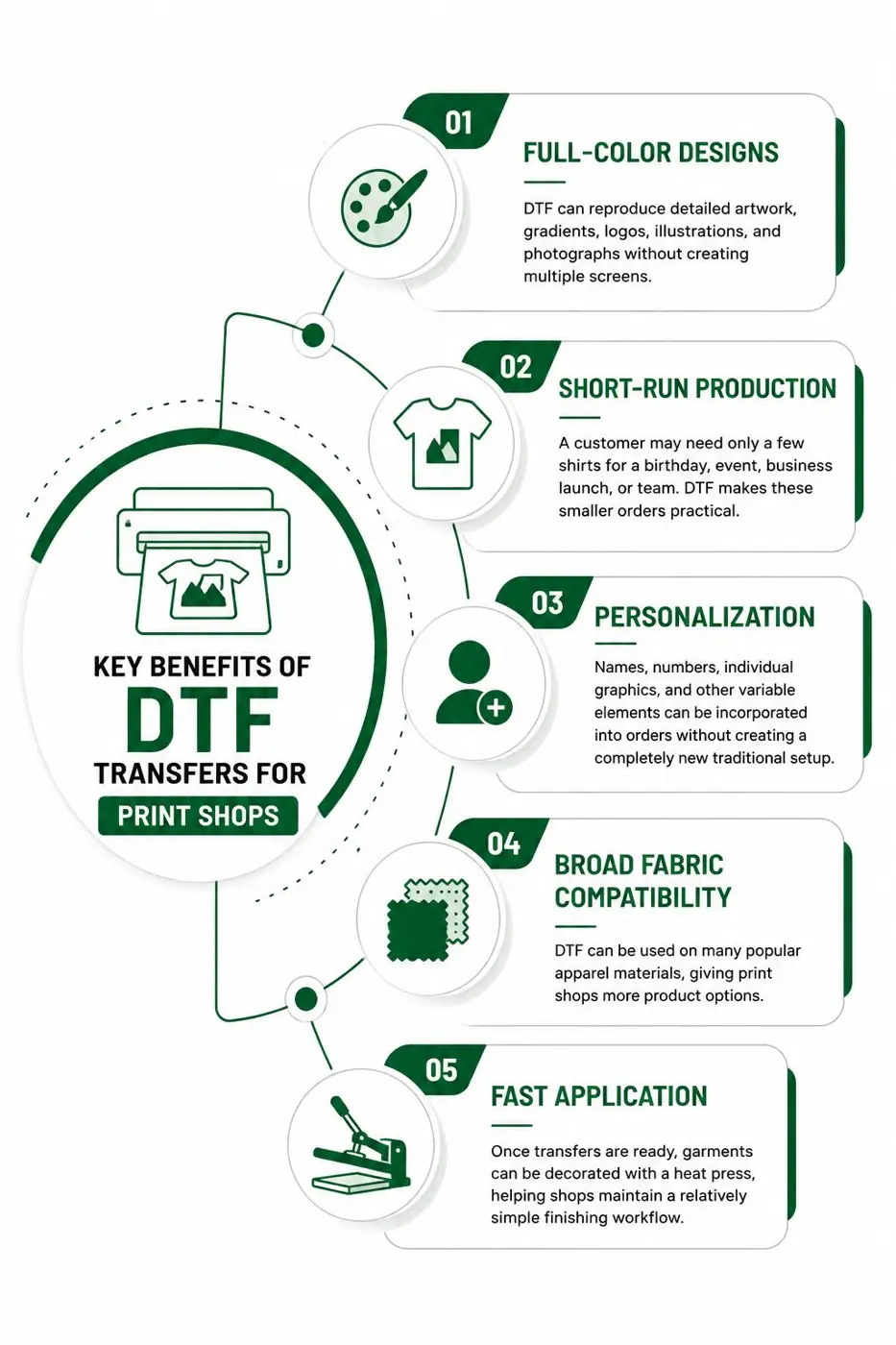
- Full-color designs: DTF can reproduce detailed artwork, gradients, logos, illustrations, and photographs without creating multiple screens.
- Short-run production: A customer may need only a few shirts for a birthday, event, business launch, or team. DTF makes these smaller orders practical.
- Personalization: Names, numbers, individual graphics, and other variable elements can be incorporated into orders without creating a completely new traditional setup.
- Broad fabric compatibility: DTF can be used on many popular apparel materials, giving print shops more product options.
- Fast application: Once transfers are ready, garments can be decorated with a heat press, helping shops maintain a relatively simple finishing workflow.
Which Print Shop Orders Are a Good Fit for DTF?
DTF is not necessarily the best choice for every order. However, it can be especially useful for jobs where flexibility and customization are more important than extremely high-volume production.
Good applications include:
-
Small business uniforms
-
Event and promotional shirts
-
Team apparel
-
Custom family shirts
-
Creator merchandise
-
Limited-edition apparel
-
Personalized garments
-
Small branded clothing collections
-
Local organization apparel
For example, a local restaurant might need 15 employee shirts with its logo, while a sports team could need different names and numbers on individual garments. These jobs can be easier to manage with DTF than with a production method that requires substantial setup.
How DTF Transfers for Print Shops Compare With Other Printing Methods
A print shop does not have to choose one decoration method for every customer. In many cases, DTF works best as an additional service that complements screen printing, DTG, sublimation, and heat transfer vinyl.
DTF vs. Screen Printing
Screen printing remains an excellent option for larger orders, especially when customers want relatively simple designs printed across many garments. However, setup requirements can make small, highly customized jobs less attractive.
DTF can be more convenient when an order requires:
-
Small quantities
-
Multiple colors
-
Detailed artwork
-
Personalized designs
-
Frequent design changes
This means a print shop can use screen printing for suitable high-volume orders while using DTF for smaller or more complex jobs.
DTF vs. DTG
Direct-to-Garment printing applies ink directly to the garment. DTF instead prints the design onto film before transferring it to the fabric.
The two methods can overlap in their applications, but DTF can provide greater flexibility across different garment materials. It also separates the printing stage from the garment application stage, which can be useful for businesses that want to stock transfers separately from blank apparel.
DTF vs. Sublimation
Sublimation is particularly effective for polyester and specially coated products. DTF provides a broader solution for shops working with cotton, polyester, and blends.
For a print shop serving customers with different garment preferences, DTF can therefore fill applications that are outside the ideal range of sublimation.
DTF vs. Heat Transfer Vinyl
Heat transfer vinyl can be useful for simple text, numbers, and basic shapes. However, detailed multicolor artwork can require more preparation and weeding.
DTF eliminates much of that manual weeding process because the complete design is transferred from film to the garment.
How to Use DTF Transfers for Print Shops to Expand Your Services
Once DTF becomes part of your production capabilities, the next opportunity is using it to expand what your print shop sells.
Add More Products Without Major Workflow Changes
A shop can offer DTF decoration on products such as:
-
T-shirts
-
Hoodies
-
Sweatshirts
-
Tote bags
-
Teamwear
-
Workwear
-
Promotional apparel
The same basic heat-press workflow can support multiple product categories, although each garment should be tested for suitable temperature, pressure, and pressing time.
Use Custom DTF Transfers for Personalized Orders
Customization can be one of the strongest applications for DTF. Customers may want different names, numbers, logos, or graphics across the same order.
Instead of treating every variation as a completely separate production challenge, print shops can organize the designs into an efficient transfer workflow and press them onto the appropriate garments.
Increase Order Value With Apparel Bundles
DTF also creates opportunities to sell packages instead of individual garments. For example, a local company could purchase employee shirts alongside hoodies or jackets. An event organizer might order shirts and matching tote bags.
The objective is not simply to sell more transfers. It is to increase the value of each customer order by solving more of the customer's apparel needs through one production partner.
How Gang Sheets Can Help Print Shops Improve DTF Efficiency
Once a print shop begins accepting more DTF orders, material efficiency becomes increasingly important. Printing each design separately can create unnecessary film waste, especially when customers order small graphics or multiple designs at once.
Gang sheets solve this problem by arranging several designs together on one sheet or roll of transfer film.
Make Better Use of Every Inch of Transfer Film
A well-planned gang sheet can combine multiple customer designs, logos, names, or graphics into one production layout. The goal is to maximize usable space while leaving enough separation between designs for easy cutting and application.
For example, a shop handling several small business logo orders can organize compatible graphics on a single gang sheet rather than producing every logo independently.
This can help reduce wasted material and make the production process more organized.
Use Gang Sheets for Repeat and Small Designs
Gang sheets can be especially useful for:
-
Small chest logos
-
Sleeve graphics
-
Names and numbers
-
Product labels
-
Multiple customer designs
-
Repeated promotional graphics
For shops that regularly process small designs, efficient gang sheet printing can become an important part of controlling production costs.
Don't Sacrifice Organization for Efficiency
A tightly packed gang sheet is only useful if the designs can be identified and separated easily. Keep adequate spacing between graphics and organize files according to the production order.
Clear labeling and consistent file preparation can prevent mistakes when several customers' designs are being processed together.
Wholesale DTF Transfers for Print Shops: Outsource or Print In-House?
One of the biggest decisions a print shop faces is whether to manufacture its own transfers or purchase them from a professional supplier.
There is no universal answer. The right choice depends on order volume, available capital, staffing, turnaround requirements, and the level of production control the business needs.
When Outsourcing Makes More Sense
Outsourcing can be an attractive option for newer and growing print shops because the business does not need to purchase and maintain a complete DTF printing setup.
A shop may only need a quality heat press and appropriate workspace to begin offering DTF-decorated apparel when using ready-to-press transfers.
Outsourcing can make sense when:
-
DTF demand is still developing
-
Orders are relatively small or inconsistent
-
Capital is limited
-
The shop wants to test DTF before investing
-
Employees are already busy with other production methods
-
The business wants to focus on sales and customer service
For these businesses, wholesale DTF transfers for print shops can provide a practical way to access professional transfers without taking on the full responsibilities of in-house manufacturing.
When In-House Production Makes Sense
In-house production becomes more attractive as order volume grows. A shop processing a consistent number of DTF orders may eventually find that owning the equipment provides greater control over production schedules and costs.
Potential advantages include:
-
Greater turnaround control
-
Ability to prioritize rush orders
-
More control over production schedules
-
Potentially lower transfer costs at higher volumes
-
Greater customization of the printing workflow
However, equipment ownership also introduces printer maintenance, ink and film costs, powder management, curing requirements, software, training, and potential downtime.
Outsourcing vs. In-House DTF Production
|
Factor |
Outsourcing |
In-House Production |
|
Initial investment |
Lower |
Higher |
|
Equipment requirements |
Primarily heat-press equipment |
Complete DTF production setup |
|
Maintenance |
Minimal |
Ongoing |
|
Production control |
Supplier-dependent |
Greater control |
|
Learning curve |
Lower |
Higher |
|
Scalability |
Easy to start |
Strong at consistent high volume |
|
Operational complexity |
Lower |
Higher |
Before purchasing equipment, calculate your current monthly transfer spending and compare it with the total cost of ownership for an in-house setup. Consider equipment, consumables, labor, maintenance, training, and downtime—not just the printer's purchase price.
How to Price DTF Transfers for a Profitable Printing Business
Offering DTF services can increase revenue, but sales alone do not guarantee profitability. Print shops need to understand their complete cost per finished garment.
Calculate Your True Cost Per Print
Your cost calculation should account for:
-
DTF transfer cost
-
Blank garment
-
Labor
-
Heat press time
-
Packaging
-
Shipping
-
Artwork preparation
-
Payment processing
-
Equipment and facility overhead
If a shop only considers the transfer and shirt cost, it may underestimate the actual expense of fulfilling an order.
Create Tiered Pricing
Consider establishing different price levels for different order quantities.
For example, a five-piece order may have a higher per-unit price than a 50-piece order because setup, communication, artwork preparation, and fulfillment costs are distributed across fewer products.
Volume pricing can encourage customers to increase their order size while helping protect margins.
Consider Minimum Order Values
Minimum order values can be useful for highly customized or labor-intensive jobs. Rather than automatically rejecting small orders, a shop can structure pricing so that the order remains worthwhile.
The key is to communicate pricing clearly before production begins.
How to Build an Efficient DTF Production Workflow
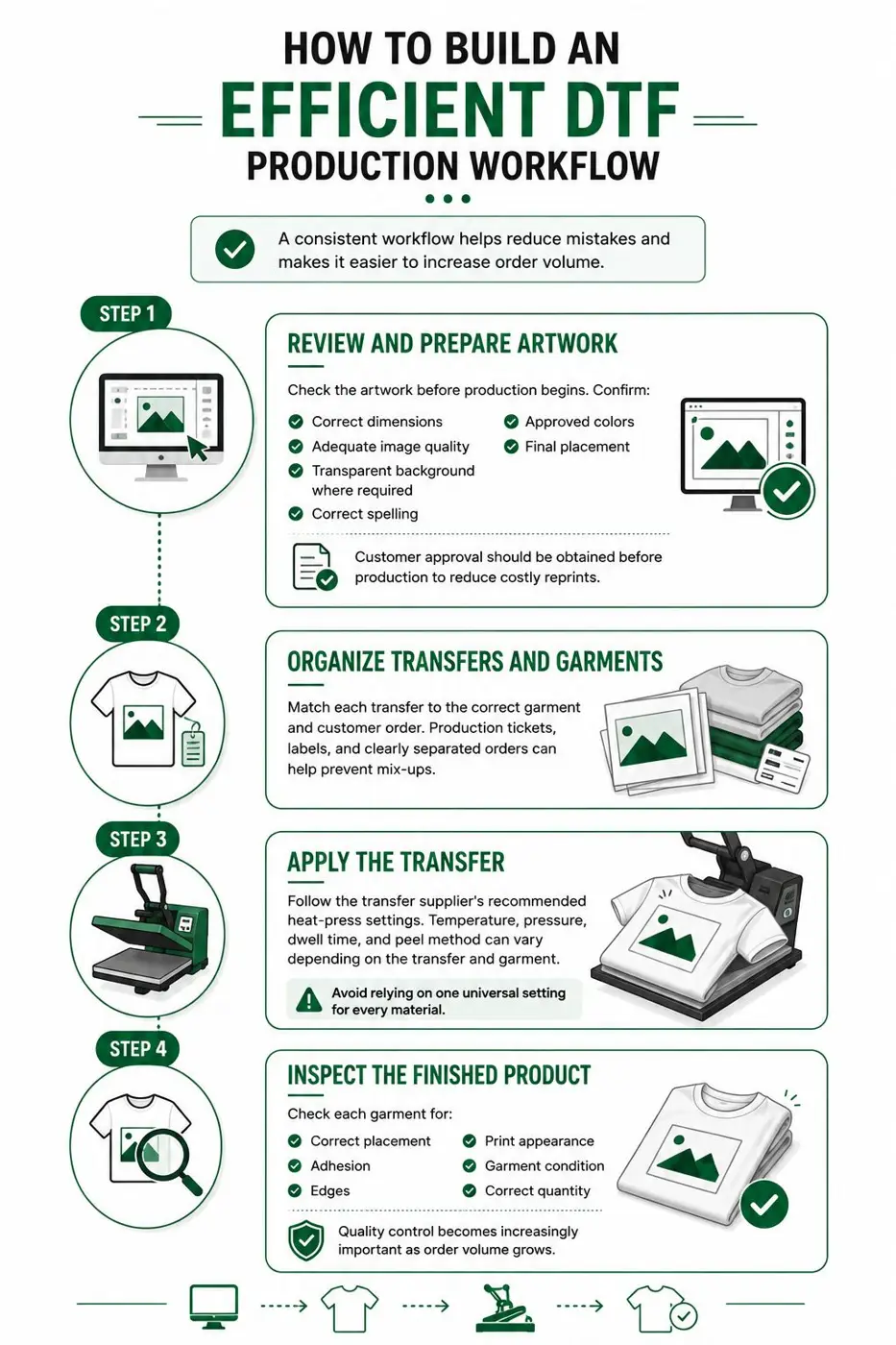
A consistent workflow helps reduce mistakes and makes it easier to increase order volume.
Step 1: Review and Prepare Artwork
Check the artwork before production begins. Confirm:
-
Correct dimensions
-
Adequate image quality
-
Transparent background where required
-
Correct spelling
-
Approved colors
-
Final placement
Customer approval should be obtained before production to reduce costly reprints.
Step 2: Organize Transfers and Garments
Match each transfer to the correct garment and customer order. Production tickets, labels, and clearly separated orders can help prevent mix-ups.
Step 3: Apply the Transfer
Follow the transfer supplier's recommended heat-press settings. Temperature, pressure, dwell time, and peel method can vary depending on the transfer and garment.
Avoid relying on one universal setting for every material.
Step 4: Inspect the Finished Product
Check each garment for:
-
Correct placement
-
Adhesion
-
Edges
-
Print appearance
-
Garment condition
-
Correct quantity
Quality control becomes increasingly important as order volume grows.
Common DTF Mistakes That Can Hurt Print Shop Profits
Even an efficient DTF process can become unprofitable if production mistakes are repeated.
Accepting Orders Without Calculating Margins
Before accepting a job, know what it will actually cost to produce. Small orders can require almost as much communication and handling as larger orders.
Poor Artwork Preparation
Low-resolution artwork, incorrect dimensions, unexpected backgrounds, and unapproved designs can lead to wasted transfers and garments.
Ignoring Heat-Press Instructions
Incorrect temperature, pressure, or pressing time can affect adhesion and print appearance. Always follow the manufacturer's application guidance and test unfamiliar garments.
Overlooking Material Waste
Poorly organized gang sheets can increase film usage. Review frequently used designs and optimize layouts whenever possible.
Scaling Too Quickly
Buying equipment before establishing consistent demand can create unnecessary financial pressure. Validate customer demand and understand your production economics first.
How Print Shops Can Get More DTF Customers
Adding DTF to your service menu is only the first step. The next challenge is generating consistent demand.
Target Local Businesses
Local businesses can become valuable recurring customers for branded apparel. Consider reaching out to:
-
Restaurants
-
Construction companies
-
Gyms
-
Retail stores
-
Schools
-
Sports teams
-
Nonprofits
-
Event organizers
Rather than selling individual shirts, create simple business apparel packages around uniforms, promotional campaigns, events, or seasonal needs.
Focus on Repeat B2B Customers
A customer who orders every few months can be more valuable than someone who makes one large purchase.
After completing an order, maintain the relationship and identify opportunities for repeat products, seasonal apparel, employee additions, or new promotional campaigns.
Showcase DTF Capabilities With Samples
Create a sample collection that demonstrates:
-
Detailed artwork
-
Full-color graphics
-
Small logos
-
Personalized designs
-
Different garment types
-
Various print sizes
Samples make it easier for potential customers to understand what your shop can produce.
How White-Label DTF Production Can Help Your Print Shop Scale
Print shops that want to increase capacity without immediately purchasing DTF equipment can consider a white-label production model.
What Is White-Label DTF Production?
With white-label production, a third-party provider manufactures the transfers while the print shop sells and fulfills the service under its own brand.
This allows the print shop to concentrate on customer acquisition, garment sourcing, pressing, fulfillment, and relationship management.
Benefits of a White-Label Model
A reliable production partner can potentially help a shop:
-
Reduce equipment investment
-
Handle larger order volumes
-
Expand its service range
-
Reduce production complexity
-
Accept orders without owning every piece of DTF equipment
white-label production services can therefore be particularly useful for businesses that have growing demand but are not ready to manage an entire DTF manufacturing operation.
A Practical 90-Day Plan for Growing a Print Shop With DTF
Days 1–30: Build the Foundation
Start by identifying your most promising customer segments. Establish pricing, create sample products, source reliable transfers, and document your production and quality-control procedures.
Days 31–60: Start Selling
Add DTF services to your website, contact local businesses, promote short-run and personalized apparel, and create packages designed around specific customer needs.
Use your Google Business Profile and local marketing channels to make potential customers aware of your expanded services.
Days 61–90: Optimize and Scale
Review which products and customers generate the strongest margins. Improve gang sheet layouts, introduce volume pricing, focus on recurring B2B customers, and monitor your outsourced transfer spending.
At this point, you can make a more informed decision about whether to continue outsourcing, adopt a hybrid approach, or invest in in-house DTF production.
Final Thoughts: Turn DTF Into a Growth Opportunity
DTF can give print shops another way to serve customers who need detailed graphics, short runs, personalization, and flexible apparel decoration. The goal is not to replace every existing printing method. Instead, DTF can complement screen printing, sublimation, DTG, and other techniques by filling production gaps.
For a new or growing shop, outsourcing custom dtf transfers can be a practical way to test demand without making a major equipment investment. As order volume increases, the business can evaluate bulk and wholesale dtf printing, improve gang sheet efficiency, or consider in-house production.
The most successful approach is to treat DTF as part of a broader business strategy: choose the right customers, price accurately, maintain quality, optimize production, and build recurring relationships. When those pieces work together, DTF can become more than another decoration method—it can become a scalable revenue opportunity for your print shop.
Key Takeaways
-
DTF is ideal for short runs, detailed graphics, and personalized apparel.
-
Print shops can use DTF alongside screen printing, DTG, sublimation, and HTV.
-
Gang sheets can improve material utilization and reduce waste.
-
Outsourcing lowers upfront investment, while in-house production may benefit higher-volume shops.
-
Accurate pricing should include labor, garments, transfers, overhead, and fulfillment.
-
Local businesses and recurring B2B customers can provide strong growth opportunities.
-
White-label DTF production can help shops scale without immediately purchasing equipment.
-
A 90-day strategy can help validate demand and identify the best production model.
FAQs About DTF Transfers for Print Shops
Are DTF transfers profitable for print shops?
They can be profitable when shops price orders correctly, control production costs, reduce material waste, and target applications where DTF provides a practical advantage.
What types of businesses can use DTF transfers?
Print shops can use DTF to serve apparel brands, local businesses, teams, creators, event organizers, schools, nonprofits, and customers looking for personalized garments.
Is it cheaper to outsource DTF transfers or print them in-house?
It depends on production volume and total operating costs. Outsourcing generally requires less upfront investment, while in-house production may offer better economics at consistent higher volumes.
Can DTF transfers be used for small orders?
Yes. DTF is particularly useful for short runs, personalized garments, and detailed designs where traditional production setups may be less efficient.
Are wholesale DTF transfers available for print shops?
Yes. Wholesale purchasing can be useful for shops with recurring demand because ordering larger quantities or using gang sheets may improve overall production economics.
Can I use gang sheets for multiple customer designs?
Yes, provided the designs are prepared and arranged appropriately. Gang sheets can combine multiple graphics and help make better use of available transfer material.