
August 21, 2026 · Connor McDonnell
Benefits of White Label DTF Fulfillment for Ecommerce Businesses
Running an ecommerce apparel business involves much more than creating great designs. Once a customer places an order, someone still needs to print the product, prepare it, package it, and ship it on time. For growing brands, handling all of those tasks in-house can quickly become expensive and difficult to manage.
White label DTF fulfillment gives ecommerce businesses another option. Instead of investing in printing equipment and managing every production step themselves, brands can work with a fulfillment partner that handles production and shipping while keeping the seller's brand at the center of the customer experience.
This approach can reduce operational complexity, limit inventory risk, make product testing easier, and give growing ecommerce businesses more time to focus on marketing and sales. However, it is important to understand how the model works and what to look for in a fulfillment partner before making a decision.
What Is White Label DTF Fulfillment?
White label DTF fulfillment is a production and fulfillment model in which a third-party provider produces custom DTF-printed products for an ecommerce business and ships them to customers without prominently displaying the provider's own branding.
DTF, or Direct-to-Film printing, involves printing a design onto a specialized film, applying adhesive powder, curing the transfer, and then applying it to a compatible garment or product with a heat press.
With a white-label fulfillment arrangement, the ecommerce seller does not necessarily need to own the printing equipment or manage the complete production process.
How White Label DTF Fulfillment Works
The process typically looks like this:
Customer places an order → Order is sent to fulfillment partner → Design is printed → Product is prepared → Order is packed → Product ships to customer
Depending on the provider and ecommerce setup, some or all of these steps can be automated.
For example, an apparel store might list 50 custom T-shirt designs online without keeping finished shirts in a warehouse. When a customer purchases one, the fulfillment partner produces the order and ships it directly to the customer.
This makes DTF fulfillment for ecommerce particularly useful for print-on-demand stores, creator merchandise, niche apparel brands, and businesses that want to test products without purchasing large quantities upfront.
White Label DTF Printing vs. In-House Production
With in-house DTF printing, a business is responsible for purchasing and maintaining equipment, sourcing supplies, managing production, applying transfers, handling quality control, packing orders, and coordinating shipping.
White-label production moves much of that operational responsibility to a fulfillment partner.
Neither approach is automatically better for every business. In-house printing can provide greater control for companies with established production operations and consistent order volumes. Outsourcing, however, can be attractive to businesses that prioritize flexibility, lower upfront investment, and operational simplicity.
White Label Fulfillment vs. Dropshipping
White-label fulfillment and dropshipping can overlap, but they are not exactly the same.
Dropshipping generally means a supplier fulfills products on behalf of the seller. White-label fulfillment places greater emphasis on keeping the seller's brand visible rather than the supplier's.
For an ecommerce apparel business, this can include branded packing slips, inserts, packaging options, or other customer-facing elements, depending on the fulfillment provider.
How White Label DTF Fulfillment Reduces Ecommerce Costs
One of the biggest reasons ecommerce businesses consider white label DTF fulfillment is the potential to reduce the costs and complexity associated with running an in-house printing operation.
Instead of building an entire production infrastructure, a business can pay for fulfillment as it needs it.
Avoid the Cost of DTF Printing Equipment
Starting a DTF printing operation requires more than purchasing a printer.
Depending on the setup, businesses may need:
-
DTF printers
-
Heat presses
-
Film
-
DTF inks
-
Adhesive powder
-
Powder application equipment
-
Curing equipment
-
RIP software
-
Maintenance supplies
-
Production space
There is also the learning curve associated with operating the equipment correctly.
Equipment requires regular maintenance, and printing problems can result in wasted film, ink, powder, garments, and production time.
With a fulfillment partner, ecommerce sellers can access professional production capabilities without building the entire setup themselves.
Reduce Inventory and Storage Requirements
Inventory is another major consideration for apparel businesses.
Buying finished products in advance can leave a business with unsold sizes, colors, and designs. Trends can change quickly, making excess inventory particularly risky for businesses that sell seasonal or niche products.
An on-demand fulfillment model can reduce this risk because products can be produced after customers place orders.
That does not necessarily mean a business will have zero inventory. Samples, blanks, or other materials may still be involved depending on the fulfillment arrangement. However, the seller may not need to maintain a large stock of finished, decorated products.
Lower Operational Overhead
Printing is only one part of fulfillment.
An ecommerce business also needs to think about:
-
Production labor
-
Quality control
-
Packing
-
Shipping
-
Storage
-
Order management
-
Equipment maintenance
-
Production scheduling
Outsourcing several of these activities can simplify the business's operating model.
The actual savings will depend on order volume, fulfillment pricing, shipping costs, labor requirements, and other expenses. Therefore, businesses should compare their total cost of fulfillment, rather than assuming outsourcing will always be cheaper.
Why White Label DTF Fulfillment Makes Ecommerce Brands Easier to Scale
As an ecommerce business grows, production can become a bottleneck. A store may be able to generate thousands of website visits through advertising or organic search, but its growth can suffer if its production team cannot keep up with orders.
White label DTF fulfillment can provide additional production capacity without requiring the seller to immediately expand its own facility.
Handle Order Spikes More Easily
Ecommerce demand rarely stays constant.
A product might suddenly become popular because of:
-
A social media post
-
An influencer promotion
-
A seasonal event
-
A holiday campaign
-
A product launch
-
A viral trend
An in-house operation may need additional equipment, employees, or production space to handle a sudden increase.
A fulfillment partner can provide another layer of production capacity. Businesses should still verify the provider's turnaround times and peak-season capabilities before relying on this model.
Launch New Products Faster
Traditional production can encourage businesses to manufacture inventory before knowing whether a product will sell.
White-label fulfillment makes it easier to experiment with new designs and collections.
A brand could launch:
-
A limited-edition T-shirt
-
A seasonal collection
-
A new niche design
-
A creator merchandise line
-
A personalized apparel concept
Instead of committing to a large production run, the business can test customer demand and increase marketing around designs that perform well.
Test Products With Less Inventory Risk
Product testing is particularly valuable for ecommerce brands.
A simple approach is:
Create → List → Sell → Fulfill → Analyze → Scale
After launching a product, the seller can monitor sales volume, conversion rate, customer feedback, returns, and repeat purchases.
Successful designs can receive more advertising and merchandising attention. Products that fail to gain traction can be removed or revised without leaving the business with a large amount of unsold decorated inventory.
Spend More Time Growing the Brand
Production can consume a significant amount of an ecommerce owner's time.
When a fulfillment partner handles much of the operational workload, the business can redirect attention toward:
-
SEO
-
Paid advertising
-
Social media
-
Email marketing
-
Product design
-
Customer acquisition
-
Website optimization
-
Brand development
The goal is not simply to outsource work. It is to use outsourcing to create more time for activities that directly contribute to business growth.
How White Label DTF Fulfillment Protects Your Brand Experience
Cost and scalability are important, but ecommerce customers ultimately interact with the brand—not the fulfillment workflow behind it.
That makes the customer experience an important part of choosing a white-label provider.
Keep Your Brand at the Center
A strong white-label arrangement is designed to minimize unnecessary exposure of the fulfillment provider's identity.
Depending on the service, businesses may be able to use:
-
Branded packing slips
-
Custom inserts
-
Branded packaging
-
Thank-you cards
-
Custom labels
-
Other brand-specific materials
Available options vary between providers, so merchants should confirm exactly what is supported before signing up.
Create a Consistent Unboxing Experience
Packaging can influence how customers perceive an ecommerce brand.
A consistent presentation can help create:
-
Stronger brand recognition
-
A more professional appearance
-
Greater customer confidence
-
Better opportunities for repeat purchases
-
More shareable unboxing experiences
Even a simple thank-you card or branded insert can make an order feel more connected to the store customers purchased from.
Maintain Consistent DTF Print Quality
Outsourcing production does not mean quality control becomes unimportant.
Businesses should evaluate a fulfillment provider's ability to deliver consistent results across different orders.
Look for factors such as:
-
Sharp design details
-
Consistent color reproduction
-
Proper white underbase application
-
Strong adhesion
-
Durable prints
-
Consistent garment quality
-
Quality-control procedures
Ordering samples before launching is one of the simplest ways to evaluate the actual customer experience.
Key Benefits of White Label DTF Fulfillment for Ecommerce
For ecommerce businesses, the main advantages can be summarized as follows:
|
In-House Production |
White Label DTF Fulfillment |
|
Requires printing equipment |
Production is outsourced |
|
Business manages maintenance |
Provider manages production equipment |
|
More production space may be needed |
Less internal production space |
|
Business handles production workflow |
Fulfillment partner handles agreed processes |
|
Inventory can become a challenge |
Easier to use on-demand production |
|
Scaling may require new equipment |
Can scale through fulfillment capacity |
|
Business manages packing and shipping |
Provider can handle fulfillment and shipping |
|
More operational responsibilities |
More time for marketing and growth |
The right model depends on the business's order volume, budget, staffing, desired control, and growth plans.
What Ecommerce Businesses Can Use White Label DTF Fulfillment For
White-label fulfillment is not limited to one type of ecommerce store. The model can support several business models where custom apparel is produced after an order is placed.
Print-on-Demand Apparel Stores
Print-on-demand businesses can use fulfillment partners to produce products only when customers purchase them.
This can be useful when the catalog contains many designs but individual designs have unpredictable demand.
Creator and Influencer Merchandise
Creators can launch branded merchandise without building their own printing operation.
Instead of spending time printing and packing orders, creators can focus on content, audience growth, and marketing their merchandise.
Niche Ecommerce Brands
Niche brands often rely on highly specific designs that may appeal to a smaller but highly targeted audience.
Examples include apparel for:
-
Hobby communities
-
Pet owners
-
Sports fans
-
Lifestyle groups
-
Local communities
-
Professional audiences
White-label fulfillment can make it easier to test these specialized products without committing to large production runs.
Seasonal and Limited-Edition Collections
Seasonal designs can be difficult to forecast.
A fulfillment model can help businesses introduce products for holidays, events, campaigns, and limited-time collections while reducing dependence on large upfront production runs.
Personalized and Custom Apparel
Custom DTF transfers can also support personalized products, although the exact customization options depend on the fulfillment provider's workflow and technology.
For businesses interested in producing individual designs or smaller quantities, Custom DTF Transfers can be part of a broader on-demand fulfillment strategy.
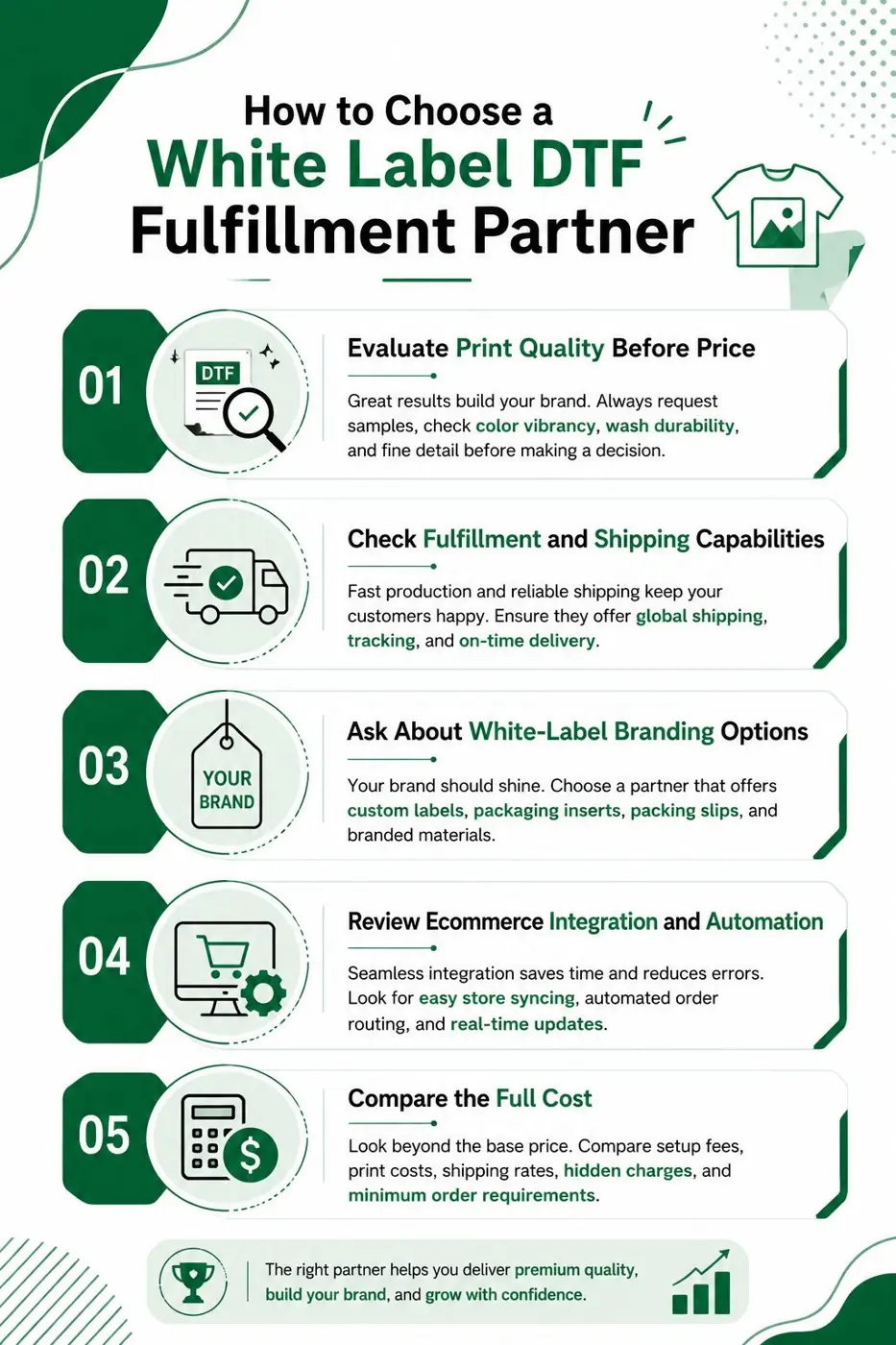
How to Choose a White Label DTF Fulfillment Partner
Choosing a provider based only on price can create problems later.
The cheapest fulfillment option may not provide the turnaround, quality, branding flexibility, or customer support your store needs.
Evaluate Print Quality Before Price
Request samples before committing to a long-term relationship.
Test:
-
Different garment colors
-
Fine design details
-
Large graphics
-
Different fabric types
-
Print durability
-
Overall product presentation
If possible, conduct wash testing to see how the print performs after repeated laundering.
Check Fulfillment and Shipping Capabilities
Ask potential providers about:
-
Production turnaround
-
Shipping methods
-
Tracking
-
Order processing
-
Quality control
-
US fulfillment capabilities
-
Peak-season capacity
-
Order issue resolution
A provider that produces excellent prints but cannot meet your required turnaround times may still be a poor fit.
Ask About White-Label Branding Options
Not every fulfillment provider offers the same branding capabilities.
Ask whether the service supports:
-
Custom packaging
-
Branded packing slips
-
Inserts
-
Labels
-
Thank-you cards
-
Removal of provider branding
Clarify which features are included and which may involve additional costs.
Review Ecommerce Integration and Automation
Manual order entry can become inefficient as order volume grows.
Depending on your ecommerce platform and fulfillment partner, automation may help with:
-
Sending orders
-
Updating order status
-
Generating tracking information
-
Managing fulfillment
-
Reducing manual data entry
The exact integration options will vary, so confirm compatibility before building your workflow around a specific provider.
Compare the Full Cost
Do not compare providers based solely on the cost of the DTF transfer.
Consider the complete equation:
Product or transfer cost + fulfillment + packaging + shipping + platform fees + expected returns = total fulfillment cost
This gives you a much clearer picture of your potential margins.
Businesses that already need larger quantities can also evaluate Bulk and Wholesale DTF Printing to determine whether higher-volume production fits their business model.
White Label DTF Fulfillment vs. In-House Printing: Which Is Better?
There is no universal answer.
The right choice depends on the stage of your ecommerce business and how much production control you need.
Choose In-House DTF Printing If You Need:
-
Maximum production control
-
Consistent and predictable high-volume production
-
A dedicated production space
-
An experienced production team
-
Control over every production step
-
Willingness to maintain equipment
In-house production can make sense when printing is already a core part of the company's operations.
Choose White Label DTF Fulfillment If You Need:
-
Lower upfront equipment investment
-
Less production management
-
Flexible product testing
-
Easier scaling
-
Direct-to-customer shipping
-
More time for marketing
-
Reduced operational complexity
For businesses still validating their products or growing their ecommerce operations, outsourcing can provide flexibility without requiring a major production investment.
For a deeper comparison of the two models, see White Label DTF vs. In-House Printing.
How to Get Started With White Label DTF Fulfillment
Moving to an outsourced fulfillment model does not need to happen all at once.
Step 1: Define Your Product Catalog
Determine which products you want to sell, including:
-
T-shirts
-
Hoodies
-
Crewnecks
-
Other compatible apparel
-
Sizes
-
Colors
-
Design variations
Start with products that fit your target audience rather than trying to offer everything immediately.
Step 2: Order and Test Samples
Before sending real customers through your fulfillment workflow, order samples.
Evaluate the print, garment, packaging, shipping speed, and overall presentation.
Step 3: Calculate Your Target Margins
Determine your complete cost per order and establish pricing that leaves room for marketing, platform fees, customer service, and unexpected costs.
Step 4: Build Your Ecommerce Workflow
Connect your store to your fulfillment process where supported.
The goal is to minimize manual work between receiving an order and sending it to production.
Step 5: Launch With a Focused Collection
Instead of launching hundreds of products immediately, consider starting with a smaller collection.
This gives you an opportunity to identify:
-
Best-selling designs
-
Popular garment styles
-
Customer preferences
-
Pricing issues
-
Fulfillment problems
Step 6: Scale the Products That Perform
Once you identify products that consistently attract customers, increase marketing and expand related designs.
This creates a more controlled growth process than producing large quantities of products before demand has been proven.
Why DTFS Can Be a Practical Option for White Label DTF Fulfillment
For ecommerce businesses evaluating outsourced DTF production, DTFS offers services that can fit different stages of the production process, from individual custom transfers to larger-volume and white-label requirements.
Businesses can explore White-Label Production Services when they want to outsource production while maintaining their own customer-facing brand.
For businesses that manage their own application process, Gang Sheet Printing can also help consolidate multiple designs into a more efficient transfer format.
The important point is to match the service to your actual workflow. A business that only needs transfers may not need complete fulfillment, while an ecommerce store looking to outsource production and shipping may benefit from a broader white-label solution.
Before choosing a provider, compare samples, pricing, turnaround times, shipping, branding options, integrations, and customer support.
For additional guidance, see How to Choose White Label DTF Printing Company.
Final Takeaway: Is White Label DTF Fulfillment Right for Your Ecommerce Business?
White label DTF fulfillment can give ecommerce businesses a way to sell custom apparel without taking on every responsibility associated with in-house production.
By outsourcing printing and fulfillment, brands can potentially reduce upfront equipment investment, limit finished-product inventory, simplify operations, launch new designs faster, and dedicate more time to marketing and customer growth.
The biggest advantage is flexibility. A business can test products, respond to demand, and expand its catalog without necessarily building a larger printing operation at the same pace.
However, outsourcing is not a shortcut around careful business planning. Fulfillment costs, shipping rates, product quality, turnaround times, branding options, and customer support all affect the final customer experience and profit margin.
The best approach is to compare the complete cost and workflow, order samples, and choose a fulfillment partner that fits your current needs while providing enough capacity for future growth.
Frequently Asked Questions About White Label DTF Fulfillment
What is white label DTF fulfillment?
White label DTF fulfillment is a service model where an ecommerce business outsources DTF printing and fulfillment to a third-party provider while keeping its own brand at the center of the customer experience. Depending on the provider, production, packaging, and shipping may all be handled on the seller's behalf.
Is white label DTF fulfillment good for ecommerce businesses?
It can be particularly useful for ecommerce brands that want to sell custom apparel without investing heavily in printing equipment, production space, or additional staff. It is also useful for businesses that want to test new designs and scale their product catalog more flexibly.
Does white label DTF fulfillment eliminate inventory?
It can significantly reduce the need for finished-product inventory because products can be produced after orders are received. However, businesses may still need samples, blank garments, or other materials depending on the fulfillment arrangement.
Can customers see the fulfillment company's branding?
That depends on the provider's white-label capabilities. Businesses should ask about branded packaging, packing slips, inserts, labels, and other customer-facing materials before choosing a fulfillment partner.
Is white label DTF printing cheaper than printing in-house?
It can reduce upfront equipment and operational expenses, but it is not automatically cheaper in every situation. High-volume businesses with established production infrastructure may find in-house printing more economical. The best comparison considers equipment, labor, materials, maintenance, fulfillment, shipping, storage, and overhead.
Can white label DTF fulfillment scale with an ecommerce business?
Yes, outsourcing production can make scaling easier because the seller does not necessarily need to expand its own printing infrastructure as order volume increases. However, businesses should confirm that the fulfillment partner has enough production capacity to support expected growth.
How do I choose a white label DTF printing company?
Look at print quality, samples, turnaround time, shipping options, ecommerce integrations, white-label branding capabilities, pricing transparency, customer support, and production capacity. A provider should fit your actual order volume and customer expectations rather than simply offering the lowest price.