


For many U.S. print shops and apparel brands, the real challenge isn’t just printing—it’s staying profitable while handling custom orders, fast turnarounds, and diverse fabric demands. Traditional methods like DTG and screen printing can slow things down with setup time, material limitations, and inconsistent results on certain garments. That pressure has pushed businesses to look for a more efficient alternative.
DTF printing is stepping in as that solution, offering greater flexibility and a smoother production workflow. In this blog, we’ll break down the key advantages of DTF printing, where it fits best, and why it’s becoming a preferred choice for businesses focused on quality, speed, and scalability.
A Quick Overview of DTF Printing
DTF (Direct-to-Film) printing is a method where designs are printed onto a special film and then transferred onto fabric using heat and adhesive powder. It’s widely used for creating custom DTF transfers that can be applied to various garments with consistent quality.
The process is straightforward: your design is printed onto film, coated with adhesive powder, cured, and then heat-pressed onto the fabric. This creates a durable, flexible print that works on multiple materials.
Compared to methods like DTG or screen printing, DTF offers more versatility and fewer setup limitations, making it a practical choice for both small businesses and large-scale production.
Why Businesses Are Choosing DTF Printing
Businesses across the apparel industry are rapidly adopting DTF printing because it aligns perfectly with how the market is evolving. Today, customers expect personalization, fast turnaround, and the ability to order in small quantities. Traditional methods often struggle with short runs, but DTF makes small-batch and even one-off orders both practical and profitable.
Another major driver is flexibility and cost efficiency. DTF printing eliminates the need for complex setups like screens or pretreatment, reducing labor and production time. This allows businesses to handle multiple designs, fabrics, and order sizes without increasing overhead costs.
At the same time, the rise of on-demand apparel businesses has made speed and adaptability essential. Whether it’s eCommerce brands, Etsy sellers, or local print shops, DTF enables quick production without sacrificing quality—making it an ideal solution for modern, fast-moving businesses.
Related: How Custom DTF Transfers Help Small Businesses Grow Faster?
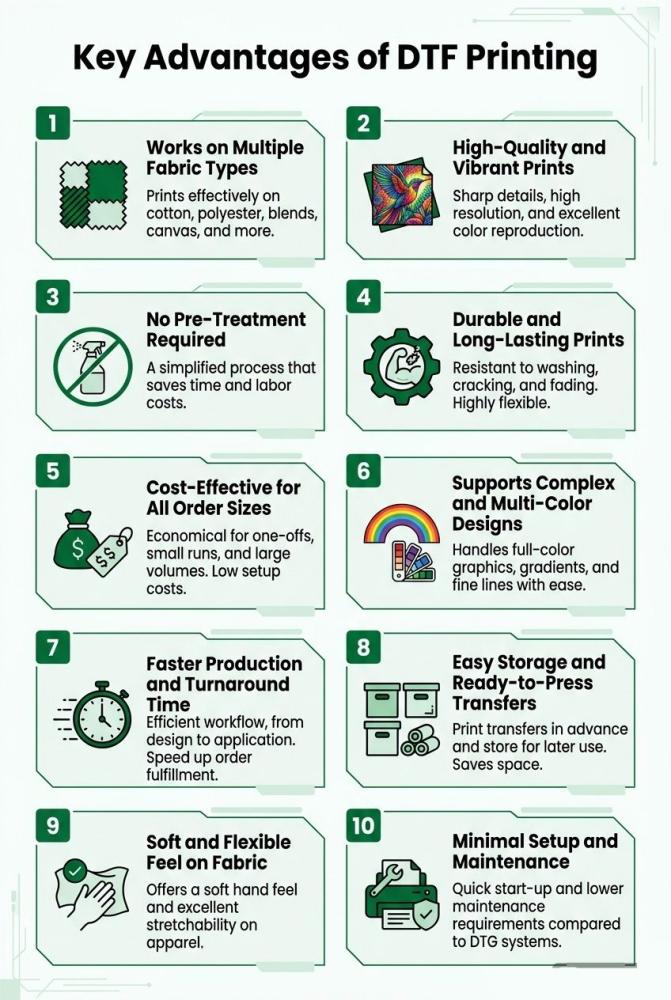
Key Advantages of DTF Printing
DTF (Direct-to-Film) printing has quickly become a preferred choice for apparel businesses due to its versatility, efficiency, and consistent output quality. Here are the key advantages that make it stand out:
Works on Multiple Fabric Types
One of the biggest strengths of DTF printing is its ability to work across a wide range of materials. From cotton and polyester to blends and performance fabrics, DTF delivers reliable results without requiring different processes for each fabric. Unlike other methods, there are minimal material limitations.
High-Quality and Vibrant Prints
DTF produces sharp, detailed prints with excellent color accuracy. It performs especially well on dark garments, where colors remain bold and vibrant without fading or dullness.
No Pre-Treatment Required
Compared to DTG printing, DTF eliminates the need for fabric pre-treatment. This simplifies the workflow, reduces production time, and minimizes errors, making the process faster and more efficient.
Durable and Long-Lasting Prints
DTF transfers are known for their durability. They offer strong wash resistance, maintain flexibility, and are less likely to crack or peel over time—ensuring long-lasting results.
Cost-Effective for All Order Sizes
With low setup costs and minimal preparation, DTF is ideal for both small and bulk orders. Whether you're printing one piece or hundreds, the cost remains manageable and scalable.
Supports Complex and Multi-Color Designs
DTF has no color limitations, making it perfect for intricate designs, gradients, and detailed logos. You can print complex artwork without increasing production complexity.
Faster Production and Turnaround Time
The streamlined process—from printing on film to heat pressing—allows for quicker production. This makes DTF ideal for businesses handling urgent or high-volume orders.
Easy Storage and Ready-to-Press Transfers
DTF transfers can be printed in advance and stored for later use. This “print now, press later” flexibility helps businesses manage inventory and fulfill orders more efficiently.
Reduced Waste and Higher Efficiency
Using optimized layouts like gang sheets allows you to maximize material usage. With gang sheet printing, you can reduce waste and improves overall production efficiency.
Scalable for Growing Businesses
DTF printing is highly scalable. Whether you're a startup or an established print shop, it’s easy to expand operations without significantly increasing complexity or cost.
DTF vs Other Printing Methods
When choosing a printing method, it’s important to understand how DTF compares to traditional options like DTG and screen printing.
DTF vs DTG (Direct-to-Garment)
DTG printing works well on cotton but often requires pre-treatment, especially for dark garments. This adds time, cost, and complexity. In contrast, DTF works on multiple fabric types without pre-treatment, making it more flexible and efficient. DTF also produces more vibrant results on a wider range of materials.
DTF vs Screen Printing
Screen printing is cost-effective for large bulk orders but involves setup time, screens, and limited color flexibility. It’s not ideal for small runs or detailed designs. DTF, on the other hand, has minimal setup and supports full-color, complex artwork without additional cost per color—making it perfect for both small and large orders.
Quick Comparison
DTF stands out for its versatility, faster turnaround, and ability to handle detailed, multi-color designs. While DTG and screen printing still have their place, DTF offers a more modern, scalable solution for today’s on-demand and custom apparel businesses.
Who Should Use DTF Printing?
DTF printing is a versatile solution that fits a wide range of business models, especially in today’s fast-moving apparel market.
Small businesses and startups
For new businesses, DTF offers a low barrier to entry. With minimal setup costs and no need for complex equipment like screens, startups can begin producing high-quality prints without heavy investment. It’s ideal for testing designs and building a brand gradually.
Custom apparel brands
Brands focused on personalization benefit greatly from DTF. Whether it’s custom logos, graphics, or limited-edition drops, DTF makes it easy to produce detailed, multi-color designs with consistent quality across different fabrics.
Print-on-demand sellers
DTF is perfect for print-on-demand models where flexibility and speed matter. You can fulfill orders as they come in, avoid holding large inventory, and still deliver professional-quality products to customers.
Bulk production businesses
Even for larger operations, DTF scales efficiently. With options like gang sheets and batch production, businesses can handle high-volume orders while maintaining cost efficiency and quick turnaround times.
Limitations to Consider
While DTF printing offers many advantages, it’s important to understand a few limitations before fully committing to the process.
Initial learning curve
DTF may seem simple, but achieving consistent results takes practice. Understanding artwork preparation, powder application, and heat press settings requires time and testing—especially for beginners.
Equipment and maintenance
DTF printers, curing equipment, and heat presses require regular maintenance to perform at their best. Printheads can clog, and improper handling of inks or films can affect output quality. This means ongoing attention and operational discipline are necessary.
Importance of proper curing and setup
Curing is a critical step in DTF printing. Incorrect temperature or timing can lead to poor adhesion, cracking, or weak durability. A well-calibrated setup—including the right pressure, temperature, and workflow—is essential for reliable results.
By understanding these limitations and addressing them early, businesses can avoid costly mistakes and fully maximize the benefits of DTF printing.
Related: Will DTF Replace Screen Printing?
Tips to Maximize DTF Printing Benefits
Getting the most out of DTF printing isn’t just about having the right equipment—it’s about refining your process for consistent, high-quality results. Small improvements in materials, design, and workflow can make a big difference in both print quality and profitability.
Use high-quality materials
Your output is only as good as your inputs. Investing in premium films, inks, and adhesive powder ensures better color vibrancy, stronger adhesion, and improved durability. Low-quality materials may save money upfront but often lead to failed prints, rework, and unhappy customers.
Optimize artwork and settings
Clean, high-resolution artwork (300 DPI) is essential for sharp and professional prints. Make sure your designs have transparent backgrounds, correct color settings, and properly configured RIP software. Fine-tuning settings like white ink density, curing time, and heat press temperature helps maintain consistency across every order.
Test before bulk production
Never skip test prints—especially when working with new designs, fabrics, or settings. Running small samples allows you to identify issues early, adjust parameters, and avoid costly mistakes. This is particularly important for bulk orders, where even minor errors can multiply quickly.
By focusing on quality materials, optimized workflows, and consistent testing, you can reduce waste, improve efficiency, and deliver reliable DTF prints that meet customer expectations every time.
Final Thought
DTF printing stands out as a versatile and reliable solution for modern apparel businesses. From its ability to print on multiple fabrics to delivering vibrant, durable designs without complex setup, the advantages are clear. It supports both small custom orders and large-scale production, making it ideal for businesses at any stage.
As demand for fast, high-quality, and customizable apparel continues to grow, DTF offers the flexibility and efficiency needed to stay competitive. The key takeaway is simple: with the right setup, materials, and process, DTF printing can become a powerful long-term solution for scaling your business while maintaining consistent print quality.
FAQs
What makes DTF printing better than other methods?
DTF printing stands out for its versatility and ease of use. Unlike traditional methods, it works on a wide range of fabrics without pre-treatment and supports complex, full-color designs. It also allows for both small and bulk orders with minimal setup, making it more flexible than screen printing or DTG.
Is DTF printing durable?
Yes, DTF prints are highly durable when applied correctly. They offer strong adhesion, good stretchability, and excellent wash resistance. Proper curing and heat pressing ensure the design stays intact without cracking or peeling over time.
Can DTF be used on all fabrics?
DTF works on most common fabrics, including cotton, polyester, and blends. However, certain materials like nylon or heavily coated fabrics may require special handling or may not perform as well.
Is DTF cost-effective for small businesses?
Absolutely. DTF is ideal for small businesses because it has low setup costs and supports on-demand printing. You can produce small batches without wasting materials, making it a budget-friendly option.
How long do DTF prints last?
With proper application and care, DTF prints can last 50+ washes while maintaining color and quality. Longevity depends on factors like fabric type, curing accuracy, and washing conditions.