


If you are stepping your foot into the custom t-shirt printing business, choosing the right technology is crucial. DTF vs plastisol transfers is one of the biggest decisions you’ll face early on. Both these methods promise durability, quality, and scalability, but they work very differently.
DTF transfers offer flexibility across fabrics and smaller runs, while the plastisol transfer method has long been trusted for bulk production and consistent results. The real question is—what works better for your business model?
Whether you're printing on demand or scaling operations, understanding plastisol vs DTF printing can help you avoid costly mistakes and make smarter investments from day one. Let’s find out which one is more suitable for you, DTF or plastisol.
TL;DR
Both plastisol and DTF have their own pros and cons. In DTF vs plastisol transfers, the real difference comes down to scale and complexity.
DTF is fast. Setup takes 20–40 minutes. Even one piece is profitable. It handles complex, multi-color, photorealistic designs at high detail. Works on all fabrics. Soft feel. Consistent.
Plastisol is slower to start. Setup takes 2–4 hours. Not worth it under 50 pieces. But at 500+ units? It becomes highly cost-effective—especially for simple designs.
Durability? Both deliver 50–100+ washes.
DTF wins for flexibility, small orders, and speed.
Plastisol wins for bulk, simplicity, and special effects.
Today, most businesses lean toward DTF. Why? Faster turnaround. More customization. Better flexibility. Plastisol still fits large, stable production setups. But the shift is clear—DTF aligns with how the market works now.
An Overview of DTF Transfer Printing
A proper understanding of what DTF printing is and how it works is essential to make a prudent decision. DTF or Direct to Film printing is a method where designs are printed onto a special film, coated with adhesive powder, cured, and then heat-pressed onto fabric. Simple workflow. Powerful output.
Unlike traditional methods, DTF doesn’t rely on fabric type. Cotton, polyester, blends—it handles all. That’s a major advantage when comparing DTF transfer vs plastisol transfer. You’re not restricted. You’re flexible.
It also supports detailed, multi-color artwork without complex setup. No screens. No long prep time. Just design, print, and press.
A typical DTF printing process goes like this:
-
Create or finalize your design (high-quality, transparent background)
-
Print the design onto DTF film using specialized DTF inks
-
Apply adhesive powder evenly on the printed film
-
Cure the powder using heat (oven or heat press)
-
Place the film on the garment (ink side down)
-
Heat press with correct temperature, time, and pressure
-
Allow the print to cool (cold peel in most cases)
-
Peel off the film carefully
-
Do a final press for a better finish and durability
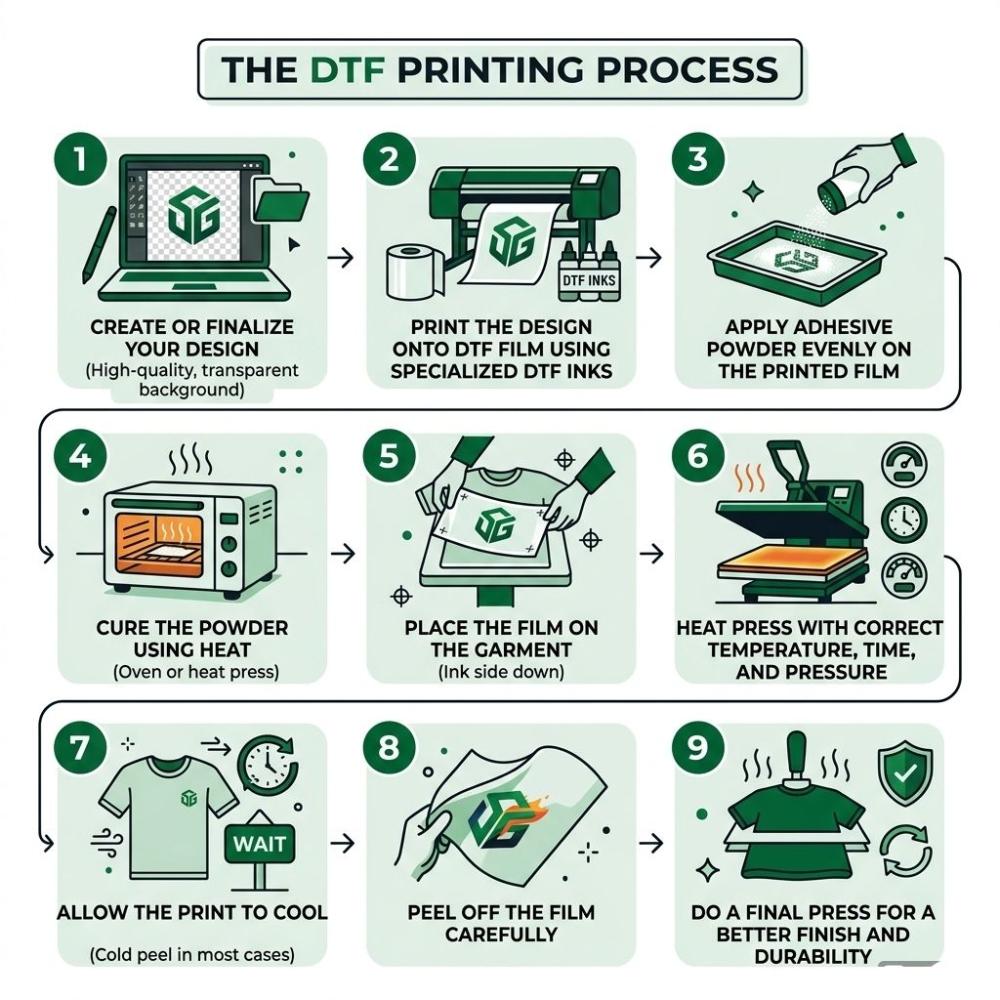
Advantages and drawbacks of DTF printing:
|
Advantages |
Drawbacks |
|
Works on multiple fabrics (cotton, polyester, blends, more) |
Initial equipment cost can be high |
|
No screen setup required (faster start) |
Requires regular maintenance (especially white ink) |
|
Ideal for small orders and custom prints |
White ink can clog if not managed properly |
|
Handles complex, multi-color designs easily |
Learning curve for beginners in file prep |
|
Soft, flexible finish with good stretch |
Film, powder, and curing add extra steps |
|
Faster turnaround for short runs |
Consumable costs (film, powder, ink) can add up |
|
Supports on-demand and bulk printing |
Environmental conditions can affect results |
An Overview of Plastisol Transfer Printing
For a fair comparison, you need to know what plastisol transfer printing actually is. And, how it works in reality, too. So, plastisol printing is a kind of screen printing in which PVC-based plastisol inks are used to print designs on transfer papers. These transfers are then heat-pressed onto garments to create the final print.
It’s a structured process. More setup. More control.
In plastisol ink screen printing, each color requires a separate screen, which makes it ideal for simple, repeat designs rather than complex artwork. That’s why in a plastisol vs direct to film example, plastisol works best for bulk orders with consistent graphics.
When comparing plastisol vs DTF printing, plastisol stands out for durability and special effects like puff or metallic finishes. But it trades flexibility for efficiency—making it better suited for high-volume production environments.
A typical plastisol screen printing process goes like this:
-
Create and separate your design into individual colors
-
Prepare screens for each color in the design
-
Apply plastisol ink onto transfer paper using screen printing
-
Cure (gel) the ink partially using a heat source
-
Align the transfer on the garment (ink side down)
-
Heat press with proper temperature, time, and pressure
-
Allow slight cooling (hot or warm peel depending on transfer type)
-
Peel off the transfer paper carefully
-
Perform a final press for better bonding and finish
Advantages and drawbacks of plastisol printing:
|
Advantages |
Drawbacks |
|
Extremely durable prints |
High setup time (2–4 hours before printing) |
|
Cost-effective for bulk orders (500+ units) |
Not profitable for small or custom orders |
|
Consistent results for repeat designs |
Requires screens for each color |
|
Supports special effects (puff, metallic, glitter) |
Limited flexibility for complex, multi-color artwork |
|
Strong color opacity, especially on dark fabrics |
Works best mainly on cotton and blends |
|
Established method with proven reliability |
Slower turnaround for short runs |
|
Lower cost per print at high volume |
More material waste during setup and production |
Plastisol vs DTF Transfer Printing: A Business-Perspective Comparison
DTF and plastisol are two different methods of printing with their own pros and cons. Plastisol screen printing is a long-standing method that has been around for a significant time. On the other hand, direct to film printing is relatively new. There are lots of differences between plastisol and DTF as follows.
DTF Transfer vs Plastisol Transfer Cost
When it comes to upfront costs, plastisol printing is cheaper than DTF. If you already own screen printing equipment, the cost is even lower. Screens cost around $8–$35 each. Basic setups start at $2,000–$5,000. Sounds affordable.
But here’s the catch. Setup time is 2–4 hours. That cost spreads across your order. Small runs suffer. A 10-shirt job can cost $10–$35 per shirt in labor alone.
DTF is different. Higher entry cost—$3,000 to $20,000+. Ongoing consumables too. But setup? Just 20–40 minutes.
So, the per-print cost stays low. Even for small orders. A 10-shirt job may cost just $2–$3 in labor. Break-even sits around 50–100 pieces. Below that, DTF wins. Above 500? Plastisol becomes cheaper for simple designs.
Print Quality and Detail
Another important factor to consider during your plastisol vs DTF printing dilemma is overall quality and detailing of the print.
Inventory Risk
Plastisol transfers usually require minimum orders (e.g., 50 sheets). Imagine a client orders 35 shirts, the shop owner pays for 50, and 15 transfers are left over. He "hopes" the client comes back for the other 15. So, there is an inventory risk with plastisol. This is a hidden cost with plastisol that you can’t ignore.
On the other hand, there is no minimum order required in DTF printing. It allows for even one-offs. While there is no minimum in DTF, large suppliers can set a minimum to keep their machines running efficiently. However, if you are starting a business with an in-house printing setup, you can avoid the inventory problem with zero minimums.
Some suppliers may also require a specific size of sheet in DTF printing. Often in DTF, gang sheets are used to reduce costs, waste, and production time. They are large sheets (usually in “22xAA” sizes). Gang sheet printing offers a cost-effective way to print.
On-demand printing allows you to order transfers online or source from a local supplier in the USA, like DTFS.co without managing and maintaining printers, papers, and other equipment. However, minimum orders can leave with leftover transfers. You can avail on-demand printing for both plastisol and DTF printing.
Fabric Compatibility
Many high-performance polyester and tri-blend shirts (like Lululemon or Nike styles) have a low melting point. Plastisol often requires 325°F+, which can leave a permanent shiny "scorch square" on expensive garments. Using Plastisol on a $40 moisture-wicking polo is a gamble.
So, due to high heat pressing requirements, plastisol is more suitable for heavy cotton garments. DTF, on the other hand, is safe on premium garments as it works on temp between 280°F – 290°F. So, it’s a strong consideration for your plastisol vs DTF printing comparison.
|
Feature |
Plastisol Transfers |
DTF Transfers |
|
Typical Temp |
325°F – 350°F |
280°F – 290°F |
|
Risk Factor |
High (Scorching/Melting) |
Low (Fabric Safety) |
|
Best For |
Heavy Cotton / Hoodies |
Performance / Tri-Blends / Luxury |
|
Result |
Thick, heavy feel |
Thin, flexible, "no-mark" finish |
Rush Orders
Imagine a local event planner calls on Wednesday for a bulk printing order to be delivered by Friday. A shop using outsourced plastisol transfers says “no” to such an order because of shipping times. But a shop using DTF transfers easily accepts the order and charges 30% rush fees.
In short, when it comes to last-minute orders, shops using DTF transfers can handle it efficiently, but not the ones using plastisols. By using gang sheets, shops using DTF can ship orders more quickly for bulk printing.
While you are limited by setup and outsourcing timeline in plastisol printing, with DTF, you can deliver fast with as little as a 24-hour turnaround time.
Shelf Life or Storage Life
The shelf life or storage impacts waste and your profits. So, understanding the shelf life of plastisol and DTF transfers is essential to make a prudent decision. What if you have leftover stocks of DTF or plastisol? It is essential to understand how long do DTF transfers last and how to ensure proper storage to extend life. Similarly, how long do plastisols last, and how to store them.
In theory, plastisol transfers have better shelf life when properly stored in a dry, cool, and dark environment. They can last for several years. On the other hand, DTF transfers are also very durable, but they have a comparatively shorter shelf life. The typical storage life ranges between 6 and 12 months, and recommended to use between this time.
Plastisol transfers are built with screen-printed ink on a release liner that is only partially cured. So, they are relatively chemically stable for years. For example, you can get a plastisol transfer from a drawer after three years, and it most likely prints the same as day one.
However, DTF transfers can also last longer if you store them properly. Over time, chemicals can leak out of plastisol transfers, making it oily or causing ghost prints. DTF is more prone to degradation from heat and moisture.
Color Accuracy
If you care about color accuracy, then plastisol is a more suitable option for you because it offers chemical precision. While Plastisol offers chemical precision for brand standards, DTF offers photographic versatility.
Think of this like buying a specific bucket of "Home Depot" paint. If a brand demands Pantone 186C (Coke Red), you buy or mix ink to that exact chemical formula. It is an opaque, physical layer of specific pigment.
DTF uses CMYK (Cyan, Magenta, Yellow, and Black). It creates colors by layering tiny dots. While it can get very close to most colors, it is physically impossible for CMYK to recreate certain high-saturation "out-of-gamut" colors—specifically those that require fluorescent or metallic pigments.
So, when it comes to color accuracy, plastisol can hit 100% of the Pantone Solid Coated library, and DTF hits 85-90% of colors.
For most modern designs—think gym logos, event tees, or multi-color illustrations—the tiny variance in color accuracy is invisible to the naked eye. The customer values the soft feel and lack of scorch marks on their expensive gear far more than a 2% shift in blue saturation.
Which is Better: DTF or Plastisol Transfer Printing?
So, which is better—DTF or plastisol? The honest answer… it depends on how you run your business.
If your focus is speed, customization, and handling varied orders, DTF stands out. It’s built for modern printing demands. No heavy setup. No minimum pressure. You can print one piece today and 200 tomorrow—without changing your workflow. That flexibility is hard to beat.
Plastisol, on the other hand, is built for structure. Bulk orders. Repeat designs. Long production runs. When volume is high and designs are simple, it becomes extremely cost-efficient.
So it’s not about better or worse. It’s about fit.
When to Choose DTF?
-
You handle small to medium orders regularly
-
You need fast turnaround or rush jobs
-
Your designs are complex (gradients, multi-color, detailed artwork)
-
You print on multiple fabric types (polyester, blends, performance wear)
-
You want low setup time and minimal upfront cost per job
-
You run a print-on-demand or custom apparel business
When to Choose Plastisol?
-
You print in large volumes (100–500+ pieces)
-
Your designs are simple (logos, 1–3 colors)
-
You need exact color matching (Pantone accuracy)
-
You want specialty effects (puff, metallic, glitter)
-
You already have screen printing equipment
-
Your workflow is built around bulk production efficiency
Conclusion
DTF and plastisol transfers both deliver strong results—but they serve different purposes. One is built for flexibility. The other for scale.
If your business relies on fast turnaround, custom orders, and varied designs, DTF gives you the freedom to operate without limits. No heavy setup. No minimum pressure. Just consistent output.
Plastisol, on the other hand, shines in structured environments. Large runs. Simple designs. Lower cost per piece at scale. The key is clarity. Know your order size. Know your customers.
Because in the end, the right choice isn’t about the method. It’s about building a workflow that keeps your business profitable, efficient, and ready to grow.
FAQs
Which is better for beginners—DTF or plastisol?
DTF is easier to start with. It requires less setup and works well for small, custom orders.
Is DTF more expensive than plastisol?
DTF has higher upfront costs but lower cost per small order. Plastisol is cheaper for bulk printing.
Which method lasts longer on garments?
Both are highly durable and can last 50–100+ washes when applied correctly.
Can plastisol handle complex designs like DTF?
Not easily. Plastisol works best with simple designs, while DTF handles detailed, multi-color artwork better.
Which printing method is faster?
DTF is faster for small and urgent orders. Plastisol is faster only in large-scale production.