


When sourcing custom transfers, one of the first questions buyers ask is whether there’s a minimum order quantity for DTF transfers. Unlike traditional printing methods that often require large production runs, DTF printing offers far more flexibility, making it accessible for small businesses, apparel brands, creators, and even one-off projects.
However, not every supplier follows the same ordering policy. Some allow single-sheet purchases, while others set a DTF transfer minimum order based on sheet size, gang sheets, or wholesale volume requirements.
Understanding a supplier’s DTF transfer MOQ is important because it directly affects pricing, production efficiency, and order planning. Whether you're testing a new design, fulfilling customer orders, or scaling a merchandise business, knowing what to expect before placing an order can help you avoid unnecessary costs and choose the right supplier.
For businesses looking for flexible ordering options, high-quality custom DTF transfers can provide a cost-effective solution without the restrictions often associated with traditional apparel printing methods.
What is Minimum Order Quantity (MOQ)?
Minimum Order Quantity (MOQ) refers to the smallest number of products a supplier requires a customer to purchase in a single order. In the DTF printing industry, a DTF transfer minimum order can vary significantly depending on the supplier’s business model, production setup, and pricing structure.
Some companies allow single-sheet orders, while others establish a DTF transfer MOQ to maintain production efficiency and reduce operating costs.
For buyers, understanding the custom DTF transfers minimum order quantity is important because it affects pricing, inventory planning, and overall profitability. Suppliers that specialize in bulk DTF transfers often offer lower per-unit costs but may require larger order volumes.
Businesses looking to grow efficiently can benefit from understanding how outsourced production supports scalability. Learn more in this guide on scaling an apparel business with outsourced DTF printing.
Typical Minimum Order Quantity for DTF Transfers Across the USA
One of the biggest advantages of DTF printing compared to traditional screen printing is its flexibility in order volume. Unlike screen printing, which often requires larger production runs to offset setup costs, many DTF suppliers offer very low or even no minimum order requirements.
However, the exact DTF transfer MOQ varies from supplier to supplier. Some companies cater to hobbyists and small businesses by accepting single-sheet orders, while others focus on large-scale production and establish higher minimums for wholesale buyers.
Understanding common DTF transfer order sizes can help you choose the right supplier based on your business needs, budget, and production volume.
Typical DTF Transfer Minimum Order Requirements in the USA
Why MOQ Varies Between Suppliers
Several factors influence DTF printing minimum order requirements:
-
Production capacity and equipment setup
-
Material and labor costs
-
Shipping efficiency
-
Target customer base
-
Wholesale versus retail business models
Suppliers focused on DTF transfer minimum order flexibility often attract startups and small brands, while wholesale-focused companies prioritize larger production runs to maximize efficiency.
What Order Size Is Right for You?
Your ideal DTF transfer order size depends on your business goals:
-
Testing new designs? Choose suppliers with low or no MOQ.
-
Running limited-edition products? Small gang sheet orders are often sufficient.
-
Producing apparel regularly? Mid-volume orders offer better pricing.
-
Scaling an established brand? Wholesale DTF transfers usually provide the lowest per-transfer cost.
The good news is that modern DTF production allows buyers to start small and scale gradually. Whether you're ordering a single gang sheet or hundreds of transfers, understanding a supplier's DTF transfer MOQ helps you control costs, reduce waste, and make more profitable purchasing decisions.
Typical Minimum Order Quantity According to Apparel Type
While most DTF suppliers base their MOQ on transfer sheets rather than garments, order sizes often vary depending on the type of apparel being decorated. Certain products are commonly ordered in larger quantities for business, promotional, or retail purposes, while others are frequently customized in smaller batches.
Typical DTF Order Quantities by Apparel Type
Why Apparel Type Affects Order Size
Different garments serve different markets.
For example:
-
Corporate uniforms are usually ordered in larger quantities.
-
Fashion brands often test new designs with smaller runs.
-
Promotional apparel is commonly purchased in bulk.
-
Personalized gifts and boutique products typically require lower quantities.
Understanding typical order patterns helps buyers estimate transfer requirements, manage inventory efficiently, and choose suppliers whose MOQ structure aligns with their production goals.
Why Does Minimum Order Quantity Matter for DTF Transfer Buyers?
When ordering DTF transfers, many buyers focus primarily on design quality, turnaround time, and pricing. However, one factor that can significantly impact your purchasing decisions is the supplier's minimum order quantity (MOQ). Understanding the DTF transfer minimum order requirements helps businesses manage costs, inventory, production planning, and overall profitability.
1. MOQ Directly Impacts Your Cost Per Transfer
One of the biggest reasons suppliers establish a DTF transfer MOQ is production efficiency. Running a print job involves machine setup, labor, film preparation, and quality control, regardless of whether you order one transfer or hundreds.
As order quantities increase:
-
Cost per transfer decreases
-
Production becomes more efficient
-
Material waste is reduced
-
Buyers receive better pricing
This is why many suppliers offer discounted rates on bulk DTF transfers, making larger orders far more economical than multiple small purchases.
2. Small Businesses Need Flexible MOQ Options
For startups, Etsy sellers, apparel brands, and print-on-demand businesses, large order requirements can create unnecessary financial risk. Ordering more transfers than you can immediately use ties up capital and increases storage needs.
Suppliers that offer low or no custom DTF transfers minimum order quantity requirements allow businesses to:
-
Test new designs before scaling
-
Launch limited-edition products
-
Reduce inventory risk
-
Validate customer demand
This flexibility is especially valuable for businesses still refining their product offerings.
3. Gang Sheets Help Reduce Minimum Order Concerns
Even when suppliers have order minimums, gang sheets can help buyers maximize value from every purchase.
Instead of ordering multiple individual transfers, you can combine several designs on one sheet through gang sheet printing.
Benefits include:
-
Better material utilization
-
Lower cost per design
-
Reduced waste
-
More efficient small-batch production
For many businesses, gang sheets effectively eliminate concerns about meeting minimum order requirements.
4. Wholesale Buyers Benefit from Higher MOQs
Businesses producing apparel at scale often view MOQ requirements differently. Higher-volume orders typically unlock better pricing structures and production efficiencies.
Purchasing wholesale DTF transfers can provide:
-
Lower per-transfer costs
-
Consistent production quality
-
Faster reordering processes
-
Improved profit margins
As order volume grows, suppliers can optimize production runs and pass savings on to customers.
5. MOQ Influences White-Label and Production Partnerships
For resellers and fulfillment businesses, supplier requirements become even more important. Many growing apparel brands use white-label production services to expand without investing in their own printing equipment.
Understanding MOQ expectations helps businesses:
-
Forecast inventory accurately
-
Manage cash flow
-
Plan marketing campaigns
-
Scale operations efficiently
The right supplier partnership can significantly simplify growth.
6. MOQ Plays a Role in Business Scalability
As your business grows, order volume naturally increases. What begins as small transfer orders can quickly evolve into larger recurring purchases.
Companies focused on long-term growth often leverage outsourced production to scale efficiently. This guide on scaling an apparel business with outsourced DTF printing explains how production partnerships can support expansion without major upfront investments.
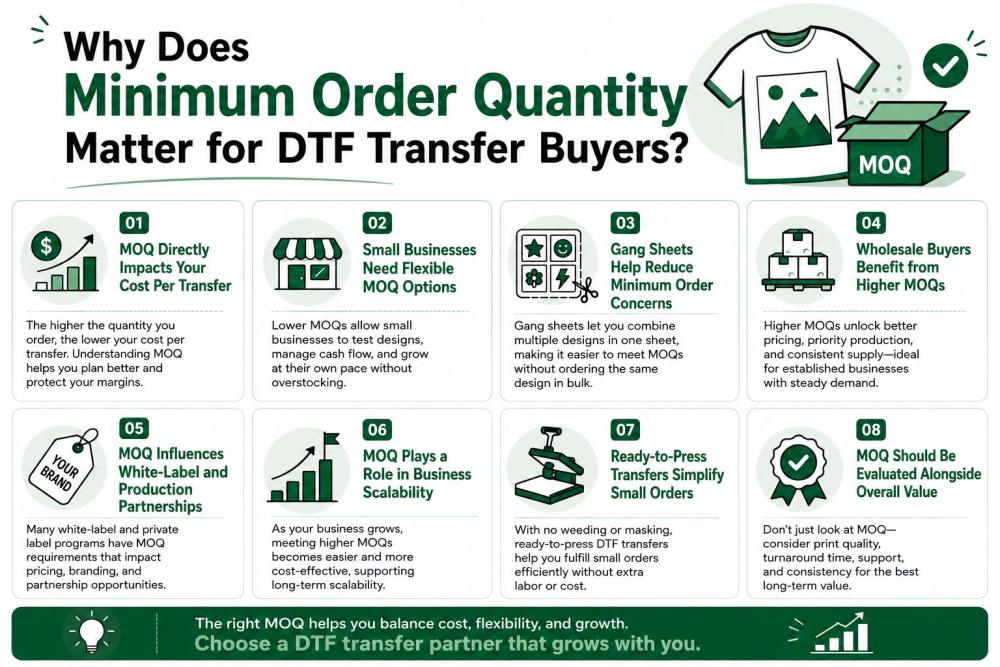
7. Ready-to-Press Transfers Simplify Small Orders
Some suppliers specialize in ready-made transfer solutions that reduce setup requirements and simplify ordering.
For businesses seeking smaller quantities, ready-to-press DTF transfers can offer a convenient alternative to custom production runs while still maintaining professional print quality.
8. MOQ Should Be Evaluated Alongside Overall Value
The lowest MOQ isn't always the best option.
Buyers should evaluate:
-
Transfer quality
-
Turnaround times
-
Pricing structure
-
Supplier reliability
-
Customer support
-
Production consistency
Understanding the broader advantages of DTF printing helps buyers make informed decisions that balance flexibility, cost, and long-term business goals.
Ultimately, MOQ matters because it affects every stage of the buying process—from budgeting and inventory management to profitability and growth. Whether you're ordering a few transfers for testing or purchasing bulk DTF transfers for large-scale production, understanding supplier minimums helps you choose the most efficient and cost-effective path forward.
Common Mistakes First-Time Buyers Make When Ordering Custom DTF Transfers
Ordering DTF transfers may seem straightforward, but many first-time buyers make costly mistakes that affect print quality, profitability, and production efficiency. Whether you're a small business owner, apparel brand, or print shop, understanding these common errors can help you get better results and avoid wasted time and money.
1. Focusing Only on Price Instead of Overall Value
Many buyers choose the cheapest supplier without considering transfer quality, consistency, turnaround times, or customer support.
Low-cost transfers can lead to:
-
Poor adhesion
-
Color inaccuracies
-
Cracking or peeling after washing
-
Reprints and dissatisfied customers
The lowest price isn't always the lowest long-term cost. Reliable suppliers often provide better value through consistent quality and fewer production issues.
2. Ignoring Minimum Order Requirements
One of the most common mistakes is failing to understand the minimum order quantity for DTF transfers before placing an order.
Some suppliers offer no DTF transfer minimum order, while others require buyers to meet specific purchasing thresholds.
Before ordering, always verify:
-
Order minimums
-
Gang sheet requirements
-
Pricing tiers
-
Bulk discounts
Understanding the supplier's DTF transfer MOQ helps prevent unexpected costs and allows better production planning.
3. Ordering Too Many Transfers Too Soon
New businesses often overestimate demand and purchase large quantities before validating their designs.
While larger orders reduce costs, excessive inventory can create cash flow challenges.
Instead:
-
Test designs first
-
Start with smaller production runs
-
Analyze customer demand
-
Scale gradually
Many successful brands use flexible production strategies. This guide on how custom DTF transfers help small businesses grow faster explains how smart ordering decisions can accelerate business growth without creating unnecessary inventory risks.
4. Uploading Poor Artwork Files
High-quality transfers begin with high-quality artwork.
Common artwork mistakes include:
-
Low-resolution images
-
Incorrect dimensions
-
Missing transparent backgrounds
-
RGB instead of CMYK color expectations
-
Poorly prepared logos
Even the best printer cannot fully compensate for poor source files. Always review artwork requirements before ordering.
5. Overlooking Production and Shipping Timelines
Many first-time buyers assume transfers will arrive immediately after ordering.
However, production schedules vary depending on:
-
Order volume
-
Supplier capacity
-
Shipping method
-
Seasonal demand
If you're running promotions, events, or apparel launches, always build extra time into your schedule to avoid costly delays.
6. Not Understanding Outsourced Production Benefits
Some buyers hesitate to outsource because they believe in-house production provides more control. In reality, many successful apparel brands rely on professional transfer suppliers to reduce equipment costs and improve scalability.
As demand increases, outsourced production becomes increasingly attractive. Learn why US apparel brands are switching to outsourced DTF printing and how it helps businesses grow without significant capital investment.
7. Misunderstanding Bulk Pricing Structures
Many buyers focus solely on the custom DTF transfers minimum order quantity and overlook how pricing changes at different volume levels.
Important considerations include:
-
Quantity discounts
-
Gang sheet efficiencies
-
Shipping costs
-
Production fees
-
Wholesale pricing tiers
In many cases, slightly increasing order quantities significantly lowers the per-transfer cost.
8. Not Taking Advantage of Gang Sheets
One of the biggest missed opportunities for first-time buyers is failing to maximize gang sheets.
Gang sheets allow multiple designs to be printed on a single sheet, improving efficiency and reducing costs.
Benefits include:
-
Better material utilization
-
Lower cost per design
-
Easier inventory management
-
Reduced waste
Businesses ordering larger quantities often save significantly through strategic gang sheet usage. This guide on saving more with bulk gang sheet orders explains how to maximize profitability while scaling production.
9. Assuming All Suppliers Operate the Same Way
Not every supplier follows identical pricing, production, or MOQ policies.
Before ordering, compare:
-
Transfer quality
-
Turnaround times
-
Customer reviews
-
Order minimums
-
Bulk pricing options
-
Support availability
Understanding these differences helps buyers select the supplier that best fits their business needs.
Avoiding these common mistakes allows first-time buyers to make more informed purchasing decisions, reduce costs, improve print quality, and build a stronger foundation for long-term success with DTF transfers.
Here's a polished conclusion section:
Final Thought
Understanding the minimum order quantity for DTF transfers is essential for making smarter purchasing decisions, controlling costs, and scaling your apparel business efficiently. While some suppliers still enforce a DTF transfer MOQ for wholesale production, the industry is rapidly evolving toward more flexible ordering options.
Today, many providers offer low-volume and even no-minimum solutions to support small businesses, creators, print shops, and growing apparel brands. Whether you need a single design test or large-scale production, choosing the right supplier matters.
With DTFS.co, you can order high-quality custom DTF transfers with no minimum order quantity, giving you the freedom to print exactly what you need, when you need it.