


Growing an apparel business sounds exciting until production starts slowing everything down. Many clothing brands reach a point where printing, inventory management, shipping delays, and equipment maintenance begin taking more time than actual business growth. Instead of focusing on marketing, customer acquisition, and launching new collections, owners often get stuck managing production problems.
That is one reason why outsourced DTF printing has become one of the fastest-growing solutions for scaling apparel brands. Instead of investing heavily in expensive machinery and labor, businesses can outsource production while maintaining flexibility, quality, and faster turnaround times.
For small clothing brands, ecommerce stores, streetwear startups, and print-on-demand sellers, this approach creates a more scalable business model without adding unnecessary operational pressure.
What Is Outsourced DTF Printing?
Direct-to-Film (DTF) printing is a garment decoration method where designs are printed onto a special PET film, coated with adhesive powder, cured, and then heat pressed onto fabric.
Unlike traditional printing methods, DTF works on multiple fabric types, including:
-
Cotton
-
Polyester
-
Blends
-
Performance fabrics
-
Heavyweight garments
The process allows brands to print full-color artwork with sharp detail, gradients, and vibrant colors without the limitations often associated with screen printing.
With DTF Printing outsourcing, businesses send artwork files to a professional supplier instead of handling production internally. The supplier prints ready-to-press transfers or fully finished garments depending on the service model.
This allows brands to scale production without purchasing:
-
Commercial printers
-
Powder shakers
-
Ventilation systems
-
RIP software
-
Additional warehouse space
For many growing brands, outsourcing removes one of the biggest growth barriers: operational overload.
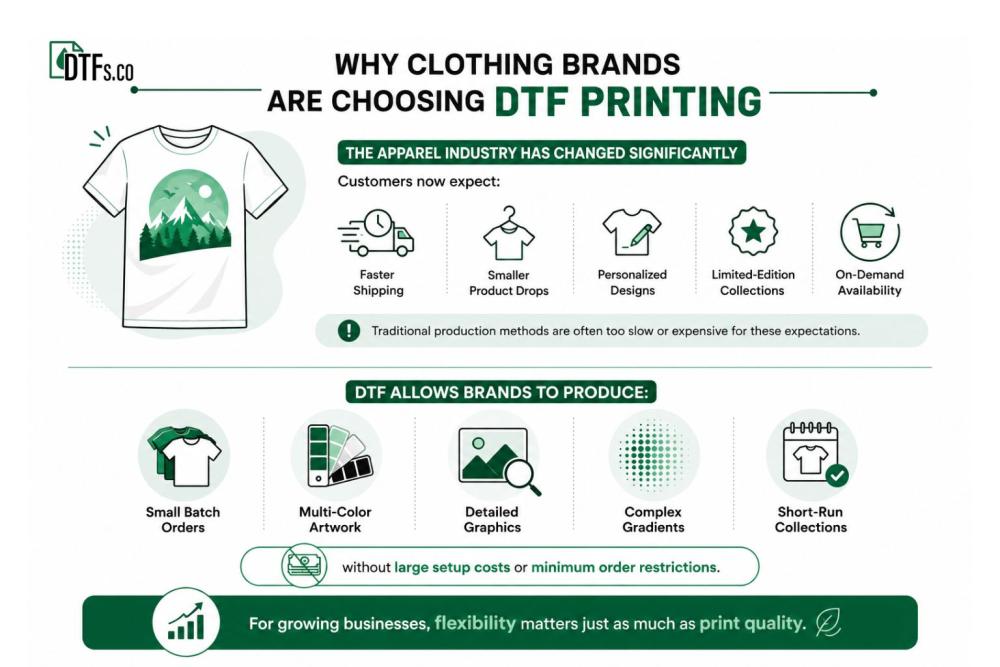
Why Clothing Brands Are Choosing DTF Printing
The apparel industry has changed significantly over the last few years.
Customers now expect:
-
Faster shipping
-
Smaller product drops
-
Personalized designs
-
Limited-edition collections
-
On-demand availability
Traditional production methods are often too slow or expensive for these expectations.
Screen printing works well for large bulk runs, but setup costs can become expensive for smaller orders. DTG printing offers flexibility but may struggle with production speed and fabric compatibility at scale.
This is where DTF printing for clothing brands stands out.
DTF allows brands to produce:
-
Small batch orders
-
Multi-color artwork
-
Detailed graphics
-
Complex gradients
-
Short-run collections
without large setup costs or minimum order restrictions.
For growing businesses, flexibility matters just as much as print quality.
How Outsourced DTF Printing Helps Apparel Brands Scale Faster
One of the biggest advantages of outsourced DTF printing is that it allows businesses to increase production capacity almost immediately.
Instead of spending months learning equipment maintenance and workflow management, brands can focus on growth-oriented activities while experienced suppliers handle production.
Eliminate Equipment Costs
Commercial DTF setups can become extremely expensive once all required equipment is included.
Typical startup costs may involve:
-
DTF printers
-
Heat presses
-
Curing ovens
-
Adhesive powder systems
-
Cleaning supplies
-
Software licenses
-
Maintenance parts
For many small businesses, these investments create financial pressure before consistent sales volume even exists.
By outsourcing production, apparel brands can preserve cash flow and redirect resources toward:
-
Advertising campaigns
-
Influencer marketing
-
Website optimization
-
Product photography
-
Inventory expansion
-
Customer retention
This approach reduces risk while creating more room for business growth.
Increase Production Capacity During Demand Spikes
Most apparel brands eventually experience sudden demand increases.
These often happen during:
-
Holiday seasons
-
Viral social media moments
-
Influencer collaborations
-
Product launches
-
Event merchandise sales
In-house production setups can struggle during these periods. Delays, printing errors, and fulfillment bottlenecks quickly affect customer experience.
An experienced outsourced supplier can help brands handle higher order volume without requiring additional staff or equipment purchases.
This flexibility allows businesses to accept larger orders confidently instead of turning away potential revenue.
Reduce Inventory Risk With On-Demand Fulfillment
Inventory risk is one of the biggest challenges in apparel ecommerce.
Traditional bulk production often forces businesses to guess how many units customers will buy. If a design performs poorly, unsold inventory ties up cash flow and warehouse space.
With outsourced DTF production, brands can operate using smaller production runs and just-in-time fulfillment strategies.
Instead of ordering hundreds of garments upfront, businesses can:
-
Launch new designs online
-
Measure customer demand
-
Produce only winning products
-
Scale successful collections gradually
This lowers financial risk while improving product testing flexibility.
For smaller apparel businesses, this model creates a major competitive advantage.
Why DTF Is a Modern Apparel Decoration Technology
Modern apparel brands prioritize speed, flexibility, and customization. DTF printing aligns perfectly with these goals.
Compared to older decoration methods, DTF offers several operational advantages.
Unlimited Color Printing
Traditional screen printing often increases in cost with every additional color.
DTF allows brands to print:
-
Full-color graphics
-
Photographic artwork
-
Complex illustrations
-
Fine details
-
Gradients
without dramatically increasing setup expenses.
This makes it ideal for:
-
Streetwear brands
-
Artist collaborations
-
Fashion collections
-
Custom merchandise
Better Small-Batch Production
Small-batch manufacturing has become increasingly important for ecommerce businesses.
Consumers now respond well to:
-
Limited releases
-
Exclusive drops
-
Seasonal collections
-
Personalized products
DTF allows brands to produce smaller runs profitably without large setup requirements.
Multi-Fabric Compatibility
Unlike some printing methods that work best on specific garment types, DTF transfers perform well across multiple materials.
This makes it easier for brands to expand product offerings into:
-
Hoodies
-
Sweatpants
-
Tote bags
-
Performance wear
-
Jackets
-
Workwear
without changing production methods entirely.
Smart Scaling Strategies Using Wholesale DTF Transfers
Many apparel brands scale efficiently by combining outsourcing with smart purchasing strategies.
One of the most effective approaches involves using wholesale DTF transfers.
These are typically ordered in bulk gang sheets, where multiple designs are arranged together on larger transfer sheets to reduce waste and improve efficiency.
Brands often use gang sheets to include:
-
Front graphics
-
Sleeve prints
-
Neck labels
-
Branding tags
-
Small logo placements
on a single sheet.
This improves profit margins while reducing per-design production costs.
For brands managing multiple SKUs, gang sheets also simplify workflow organization and reduce turnaround times.
Focus More on Marketing Instead of Production
One of the most overlooked advantages of outsourcing is operational freedom.
Many apparel business owners spend too much time:
-
Cleaning print heads
-
Managing supplies
-
Troubleshooting equipment
-
Fixing production errors
-
Reprinting damaged products
These tasks may be necessary internally, but they do not directly grow the business.
Outsourcing allows owners to shift focus toward activities that actually increase revenue:
-
Content creation
-
Paid advertising
-
Influencer outreach
-
Customer engagement
-
Brand partnerships
-
Ecommerce optimization
In many cases, scaling happens faster when brands spend less time operating equipment and more time building audience demand.
Choosing the Right Outsourced DTF Strategy for Long-Term Apparel Growth
As apparel brands grow, production decisions start affecting everything from customer satisfaction to profit margins. Fast shipping, consistent print quality, and reliable fulfillment become critical once order volume increases.
That is why choosing the right outsourced DTF printing strategy matters just as much as choosing the right designs or marketing channels.
The right supplier can help a brand scale smoothly. The wrong one can create delays, poor-quality prints, customer complaints, and unnecessary operational stress.
Understanding what to look for in a production partner helps apparel businesses grow more efficiently while protecting their brand reputation.
What to Look for in a Custom DTF Transfer Supplier
Not all suppliers provide the same quality, turnaround speed, or consistency.
Before committing to a long-term provider, businesses should evaluate several important areas carefully.
Print Quality and Durability
High-quality transfers should feel soft, flexible, and durable after pressing.
When evaluating a custom direct to film transfer supplier, test:
-
Color vibrancy
-
Edge sharpness
-
Stretch resistance
-
Wash durability
-
Adhesion consistency
Poor-quality transfers often develop problems such as:
-
Cracking
-
Peeling
-
Fading
-
Thick plastic texture
-
Weak bonding after washing
These issues eventually affect customer trust and repeat sales.
Ordering sample packs before scaling production is always recommended.
Turnaround Time and Fulfillment Speed
Production speed matters heavily in ecommerce apparel.
Customers expect quick fulfillment, especially during:
-
Product launches
-
Seasonal promotions
-
Holiday shopping periods
-
Influencer collaborations
Reliable suppliers should provide:
-
Clear production timelines
-
Rush order options
-
Order tracking systems
-
Consistent communication
-
Capacity for larger order volumes
Fast turnaround times allow brands to maintain positive customer experiences while scaling operations more confidently.
File Preparation Standards
Professional suppliers usually require:
-
Transparent PNG files
-
300 DPI artwork
-
Proper sizing
-
Clean backgrounds
-
CMYK-ready colors
Following correct artwork guidelines reduces production errors and improves print consistency.
Many suppliers also offer gang sheet builders that simplify artwork organization before ordering.
For brands regularly producing multiple designs, organized file preparation becomes essential for efficient scaling.
In-House vs Outsourced DTF Printing
At some point, many apparel brands compare In-House vs Outsourced DTF Printing to determine which production model best supports their growth goals. Both approaches offer unique advantages depending on business size, sales volume, operational capacity, and long-term scalability needs.
Benefits of Keeping Production In-House
Some brands prefer internal production because it provides:
-
Direct quality control
-
Same-day production flexibility
-
Immediate order fulfillment
-
Complete workflow oversight
This setup may work well for businesses with:
-
Stable high-volume demand
-
Dedicated production teams
-
Large operational space
-
Consistent daily order flow
However, internal production also requires ongoing maintenance, staffing, and equipment management.
Benefits of Outsourced Apparel Printing
For many growing brands, outsourced apparel printing offers more flexibility during expansion stages.
Outsourcing reduces:
-
Operational complexity
-
Equipment maintenance
-
Labor requirements
-
Upfront financial risk
It also makes it easier to:
-
Test products quickly
-
Launch new collections
-
Handle large order spikes
-
Expand product categories
Many successful apparel businesses eventually adopt hybrid models where:
-
Core production stays internal
-
Overflow orders get outsourced
-
Limited collections use outside suppliers
-
Rush orders get split across partners
This approach balances scalability with operational control.
How Gang Sheet Printing Improves Profit Margins
One of the smartest strategies in DTF outsourcing involves efficient Gang Sheet Printing.
A gang sheet combines multiple graphics onto a single transfer sheet to maximize usable space.
Instead of printing designs individually, brands can place:
-
Front graphics
-
Back prints
-
Sleeve logos
-
Neck tags
-
Small branding elements
onto one large sheet.
This reduces waste while lowering production costs per design.
Why Gang Sheets Matter for Scaling
As apparel brands grow, small savings across production add up quickly.
Gang sheets help businesses:
-
Improve transfer efficiency
-
Reduce unused print space
-
Lower overall production costs
-
Organize multi-design orders more effectively
For smaller brands, this strategy improves profitability without requiring large order minimums.
Many businesses also use gang sheets for:
-
Sample production
-
Influencer merchandise
-
Event apparel
-
Seasonal collections
because they support smaller, flexible runs efficiently.
Why White-Label Production Services Matter for Ecommerce Brands
Brand consistency matters heavily in online apparel sales.
Customers typically judge a business based on:
-
Packaging quality
-
Delivery speed
-
Product consistency
-
Presentation
This is why many suppliers now offer White-Label Production Services.
These services may include:
-
Blind shipping
-
Custom packing slips
-
Brand-free packaging
-
Direct-to-customer fulfillment
For ecommerce stores, white-label fulfillment creates a more professional customer experience while reducing operational workload.
Instead of receiving bulk shipments and repackaging products manually, brands can streamline fulfillment directly through their supplier.
This becomes especially useful for:
-
Shopify stores
-
Etsy sellers
-
Print-on-demand brands
-
Influencer merchandise businesses
trying to scale quickly without warehouse expansion.
Common Mistakes Businesses Make With Outsourced Printing
Outsourcing simplifies production, but poor supplier decisions can still create major problems.
Avoiding common mistakes helps businesses scale more smoothly.
Choosing Suppliers Based Only on Price
Cheap production often creates expensive long-term problems.
Low-cost suppliers may produce:
-
Inconsistent colors
-
Poor adhesion
-
Delayed shipments
-
Weak durability
-
Low-quality film texture
Saving a few dollars per order means little if customers stop buying because print quality fails.
Reliable consistency usually matters more than the absolute lowest price.
Ignoring Shipping and Logistics Costs
International suppliers may initially appear cheaper.
However, businesses often overlook:
-
Shipping fees
-
Customs delays
-
Reprint timelines
-
Communication delays
-
Longer fulfillment windows
When scaling an apparel business, fulfillment reliability becomes part of customer service.
Failing to Test Products Before Scaling
Never launch high-volume marketing campaigns without testing transfers first.
Always evaluate:
-
Wash performance
-
Heat press compatibility
-
Fabric feel
-
Stretch flexibility
-
Long-term durability
Testing reduces refund risk and protects brand reputation.
The Future of Fashion Production Is Flexible
The apparel industry continues moving toward smaller, faster, and more flexible production models.
Consumers increasingly prefer:
-
Limited collections
-
Personalized products
-
Faster launches
-
Unique drops
-
Frequent new releases
Traditional manufacturing methods often struggle to support this level of agility.
That is why DTF printing outsourcing continues growing across:
-
Streetwear brands
-
Ecommerce stores
-
Corporate merch companies
-
Sportswear startups
-
Creator-led merchandise brands
Flexible production allows businesses to respond to trends faster without taking on excessive inventory risk.
Final Thoughts
Scaling an apparel business successfully requires more than just increasing sales. It also requires building a production system capable of handling growth efficiently.
For many brands, outsourced printing for small business offers the fastest path toward scalable fulfillment without major operational complexity.
Instead of spending heavily on equipment and maintenance, businesses can focus on:
-
Marketing
-
Product development
-
Customer experience
-
Brand expansion
-
Ecommerce growth
The most effective scaling strategy often starts with flexibility.
By using Wholesale DTF Printing, gang sheets, and reliable outsourcing partners, apparel brands can grow production capacity while keeping operations lean, efficient, and adaptable.
For many modern clothing businesses, outsourced DTF production is no longer just a cost-saving option. It has become a long-term growth strategy that supports faster launches, lower risk, and smarter scaling.