


DTF’s success lies in its ability to produce vibrant, durable, and photorealistic designs across a wide variety of fabrics. However, not all transfers deliver the same results. Many decorators discover too late that the transfer they purchased looked acceptable on the carrier film but failed during pressing, cracked after washing, or showed weak adhesion from the start.
Learning how to identify poor-quality DTF transfers before they ever touch a heat press can save time, money, and customer complaints. In this guide, you'll learn the key indicators of DTF transfer quality, the most common warning signs of substandard production, and exactly how to check DTF transfer quality before application to avoid costly reprints and disappointing results.
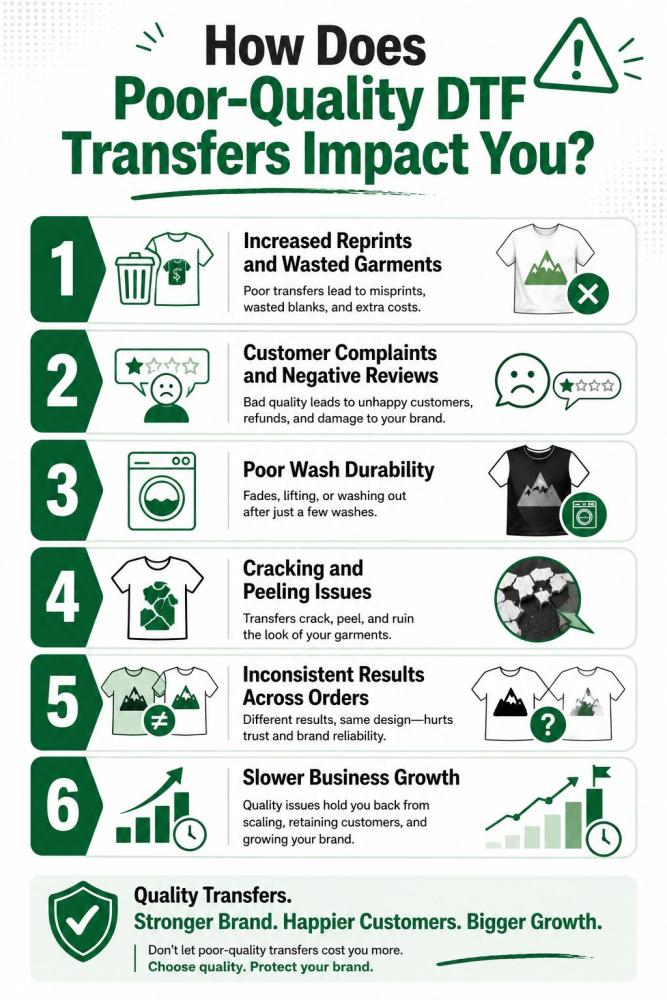
How Does Poor-Quality DTF Transfers Impact You?
At first glance, a transfer may appear acceptable, but hidden quality issues often become visible after pressing, washing, or regular wear. Poor-quality DTF transfers can lead to product failures, customer complaints, wasted garments, and higher production costs.
For businesses that depend on consistent DTF printing quality, even a small defect can affect customer satisfaction and profitability. Print shops and custom apparel businesses need to look for a reliable DTF transfer supplier to ensure consistent quality.
1. Increased Reprints and Wasted Garments
One of the biggest consequences of using poor-quality DTF transfers is the need for reprints. Due to various problems with bad quality transfers, the print fades or cracks, which forces you to reprint. Also, increased customer returns make the problem worse.
Common issues include:
-
Transfers peeling after pressing
-
Edges lifting during washing
-
Cracking after a few wears
-
Poor adhesion on certain fabrics
-
Uneven color reproduction
Every failed transfer means:
-
Additional labor
-
Replacement garments
-
Production delays
-
Reduced profit margins
Businesses using professionally produced custom DTF transfers typically experience fewer failures and more consistent results.
2. Customer Complaints and Negative Reviews
Customers expect custom apparel to remain vibrant and durable.
When DTF transfer problems appear shortly after purchase, it often results in:
-
Refund requests
-
Product returns
-
Negative online reviews
-
Lost repeat business
Common complaints include:
-
Peeling graphics
-
Faded colors
-
Cracked designs
-
Rough or plasticky feel
A single bad order can cost far more than the money saved by purchasing low-cost transfers.
3. Poor Wash Durability
Many DTF transfer defects don't become obvious until after laundering. Transfer defects after washing indicate causes like poor adhesion, improper curing, use of inferior inks and powder, and more.
Low-quality transfers often suffer from:
-
Weak adhesive bonding
-
Inconsistent powder application
-
Inferior inks
-
Poor film quality
The result is premature deterioration after only a few wash cycles.
If durability is a concern, this guide on how long DTF transfers last explains what to expect from high-quality transfers.
4. Cracking and Peeling Issues
Cracking is one of the most common indicators of poor transfer quality. Similarly, if transfers crack or spoil after peeling, there is something wrong with the quality of the transfer.
Symptoms include:
-
Fine stress lines
-
Broken ink layers
-
Surface splitting
-
Complete design failure
These issues are often caused by:
-
Low-grade adhesive powder
-
Improper curing
-
Excessive ink thickness
-
Poor film construction
For a deeper look at these causes, see why DTF prints crack after washing.
5. Inconsistent Results Across Orders
Consistency becomes especially important when producing apparel at scale.
Low-quality suppliers often produce transfers with:
-
Different color tones between batches
-
Varying adhesive coverage
-
Uneven film quality
-
Inconsistent print sharpness
This creates problems for:
-
Clothing brands
-
Print shops
-
Corporate merchandise programs
-
Promotional product businesses
Many businesses use professionally produced gang sheet printing services to improve consistency and reduce production variability.
6. Slower Business Growth
Ultimately, recurring quality issues can slow business growth.
When customers receive products with visible DTF transfer defects, they are less likely to:
-
Reorder
-
Recommend your brand
-
Leave positive reviews
-
Trust future purchases
This is especially important for growing apparel brands. As explained in how custom DTF transfers help small businesses grow faster, reliable transfer quality plays a major role in customer retention and long-term profitability.
Bottom Line
The true cost of poor-quality DTF transfers extends far beyond the purchase price. Reprints, returns, customer dissatisfaction, and inconsistent production can quickly outweigh any upfront savings. Investing in strong DTF transfer quality helps protect your brand reputation, improve durability, and deliver the consistent results customers expect.
What are the Key Indicators of DTF Transfer Quality?
Identifying transfer quality before pressing can save you from costly reprints, wasted garments, and unhappy customers. Whether you're ordering a few designs or placing large orders through bulk wholesale printing, knowing how to check DTF transfer quality is essential.
Use this DTF transfer quality checklist to perform a quick DTF transfer inspection before applying any transfer.
1. Check Print Sharpness and Detail
One of the first signs of a bad DTF transfer is poor image clarity.
Look for:
-
Crisp text and fine lines
-
Smooth edges around graphics
-
Clear gradients without banding
-
No blurry or pixelated areas
High-quality transfers should reproduce artwork exactly as designed. If details are already unclear before pressing, the final print quality will only get worse.
2. Inspect Color Vibrancy
Strong DTF printing quality starts with accurate color reproduction.
Check for:
-
Bright, saturated colors
-
Consistent tones across the design
-
No faded or washed-out areas
-
Accurate matching to your original artwork
Low-quality transfers often appear dull because of inferior inks or inconsistent printing processes.
3. Examine the White Underbase
The white layer is critical for opacity and durability.
A quality transfer should have:
-
Even white coverage
-
No transparent patches
-
Smooth underbase application
-
Consistent density throughout the design
Poor white ink application is one of the most common causes of fading, cracking, and weak color performance.
4. Inspect Adhesive Powder Coverage
The adhesive layer should be uniform across the design.
Watch for:
-
Excess powder buildup
-
Uneven coating
-
Missing powder areas
-
Powder clumps along edges
Inconsistent powder application often leads to peeling and adhesion failures after washing.
5. Check Film Quality
The carrier film itself reveals a lot about the overall transfer quality.
Look for:
-
Smooth surface finish
-
No wrinkles or creases
-
No scratches or contamination
-
Stable, consistent coating
You can learn more about the production process in this guide on how DTF transfers are made.
6. Look for Edge Consistency
The design edges should appear clean and controlled.
Quality transfers have:
-
Sharp outlines
-
Consistent ink coverage
-
No overspray
-
No jagged borders
Uneven edges are often early indicators of production problems.
7. Perform a Flexibility Test
Before pressing, gently bend the transfer film.
A good transfer should:
-
Remain flexible
-
Show no cracking
-
Maintain design integrity
-
Resist flaking
Brittle transfers often indicate poor ink formulation or improper curing during production.
Quick DTF Transfer Inspection Checklist
Before pressing any transfer, verify:
-
Sharp image details
-
Vibrant color reproduction
-
Consistent white underbase
-
Even adhesive powder coverage
-
Smooth film surface
-
Clean design edges
-
Flexible transfer construction
For a deeper evaluation framework, review this complete guide on what makes a good DTF transfer.
By following this DTF transfer inspection process, you can quickly identify DTF transfer defects, avoid common DTF transfer problems, and confidently determine whether a transfer meets professional production standards before it ever touches a heat press.
What are the Common Signs of a Substandard DTF Transfer?
Even before you press a transfer, there are several warning signs that can help you identify poor-quality DTF transfers. Learning to spot these issues early can save time, prevent wasted garments, and reduce costly customer complaints.
1. Visible Banding or Print Lines
One of the most obvious DTF transfer defects is visible horizontal or vertical banding across the design.
Look for:
-
Uneven color transitions
-
Noticeable print lines in gradients
-
Streaks running across large color areas
These issues often indicate poor printer calibration or low-quality production processes.
2. Dull or Inconsistent Colors
High-quality transfers should display vibrant, accurate colors immediately upon inspection.
Warning signs include:
-
Washed-out colors
-
Uneven saturation
-
Color shifts between similar design elements
-
Weak whites and faded highlights
Poor color reproduction is a major indicator of weak DTF printing quality.
3. Grainy or Pixelated Artwork
A professional transfer should maintain sharp details and clean edges.
Red flags:
-
Jagged text
-
Blurry graphics
-
Pixelated images
-
Rough edge definition
These problems often result from low-resolution artwork processing or poor print settings.
4. Uneven Adhesive Powder Coverage
The adhesive layer is critical for proper bonding.
Inspect the transfer for:
-
Excess powder buildup
-
Bare spots in adhesive coverage
-
Clumps or inconsistent distribution
-
Visible powder outside the design area
Improper powder application is one of the most common causes of future DTF transfer problems such as peeling and lifting.
5. Excessive Gloss or Sticky Film Surface
Premium transfers typically have a clean, balanced finish.
Potential warning signs include:
-
Overly glossy appearance
-
Sticky film texture
-
Residue on the carrier sheet
-
Uneven coating across the design
These issues may indicate lower-grade film materials.
6. Poor White Ink Coverage
White ink acts as the foundation of the transfer.
Signs of poor coverage:
-
Semi-transparent white areas
-
Inconsistent opacity
-
Dark garment colors showing through
-
Patchy white underbase
Weak white ink often leads to faded prints after pressing.
7. Cracked or Damaged Film
Always inspect the carrier film before application.
Avoid transfers showing:
-
Creases
-
Wrinkles
-
Cracks in printed areas
-
Torn edges
-
Peeling design sections
Physical damage can compromise adhesion and shorten transfer lifespan.
8. Strong Chemical Odors
While some odor is normal, excessive chemical smells can signal poor manufacturing practices.
This may indicate:
-
Low-grade inks
-
Improper curing
-
Inferior adhesive materials
-
Inconsistent production standards
How DTF Transfer Test Prints Help Spot Poor Quality Transfers?
A DTF transfer test print is one of the most effective ways to evaluate DTF transfer quality before committing to a large production run. While a transfer may look good when it arrives, many DTF transfer problems only become visible after pressing, stretching, washing, or wearing the garment.
For apparel brands, print shops, and decorators, test printing helps identify poor-quality DTF transfers early—before they result in customer complaints, reprints, or wasted inventory.
Why Test Prints Matter
A test print allows you to verify:
-
Print clarity and detail
-
Color accuracy
-
Adhesion performance
-
Stretch resistance
-
Wash durability
-
Overall DTF printing quality
Even small quality issues can become major production problems when multiplied across hundreds of garments.
What to Check During a DTF Test Print
1. Print Sharpness and Detail
Inspect:
-
Fine lines
-
Small text
-
Gradients
-
Color transitions
Poor transfers often show:
-
Blurry edges
-
Jagged details
-
Inconsistent ink coverage
High-quality transfers should produce crisp, clean artwork with strong detail retention.
2. Adhesion Performance
After pressing:
-
Check corners
-
Inspect edges
-
Look for lifting or curling
Weak bonding is one of the earliest indicators of poor-quality DTF transfers and can lead to peeling after washing.
3. Stretch Test
Gently stretch the printed area.
A quality transfer should:
-
Flex with the fabric
-
Maintain image integrity
-
Return to shape without damage
Low-quality transfers often develop:
-
Surface cracks
-
Stress lines
-
Adhesive separation
These issues frequently indicate future DTF transfer durability problems.
4. Wash Test
One of the most important evaluations is a durability test.
Wash the garment:
-
Inside-out
-
In cold water
-
Using a normal wash cycle
Then inspect for:
-
Cracking
-
Peeling
-
Fading
-
Edge lifting
A transfer that begins deteriorating after only a few washes often signals poor manufacturing standards.
Why Brands Use Test Prints Before Large Orders
Many growing brands and fulfillment providers use controlled testing before scaling production.
For example, companies utilizing white-label production services frequently perform sample testing to ensure every supplier consistently meets quality standards before customer orders are fulfilled.
This process helps:
-
Reduce reprints
-
Improve customer satisfaction
-
Protect brand reputation
-
Maintain production consistency
If you're serious about identifying signs of a bad DTF transfer, a test print is your best quality-control tool. It reveals potential adhesion failures, durability issues, and print defects before they impact customers, making it an essential step for anyone evaluating the quality of DTF transfer or selecting a long-term supplier.
To Wrap Up
Spotting a poor-quality DTF transfer before pressing can save you from costly reprints, customer complaints, and wasted garments. By performing a careful DTF transfer inspection, checking film quality, print clarity, adhesive consistency, color vibrancy, and conducting a simple test print, you can identify problems before they impact production.
High DTF printing quality isn't just about appearance—it directly affects durability, wash performance, and customer satisfaction. Whether you're a small business, apparel brand, or print shop, following a reliable DTF transfer quality checklist helps ensure every transfer delivers the professional results your customers expect.