


When it comes to custom apparel, the design is only half the story. The real difference lies in the transfer. A print may look sharp on the sheet, but if it cracks, peels, or feels heavy on the fabric, the entire garment loses value. That’s why understanding what makes a good DTF transfer is critical for any apparel brand, print shop, or growing clothing business.
High-quality DTF transfers directly impact comfort, durability, color vibrancy, and customer satisfaction. A well-made transfer should bond smoothly, stretch with the fabric, and survive repeated washes without fading. Poor DTF transfer quality, on the other hand, can lead to returns, complaints, and damaged brand reputation.
If you want prints that feel soft, look vibrant, and last longer, focusing on DTF transfer quality is not optional. It’s the foundation of premium custom apparel — and the difference between average results and professional standards.
This blog breaks down what makes a good DTF transfer and why DTF transfer quality directly impacts comfort, durability, and print vibrancy.
The Rise of DTF Transfers in Apparel Industry and the Role of Quality
The apparel industry has seen a sharp rise in demand for custom DTF transfers, especially with the growth of t-shirt printing businesses, print-on-demand brands, and small clothing startups. DTF technology allows businesses to produce vibrant, full-color designs quickly and on various fabrics, making it highly attractive in today’s fast-moving market.
However, growth alone is not enough. Quality defines success. High-grade film, reliable printers, premium inks, and proper DTF supplies directly impact print clarity, adhesion strength, stretchability, and wash durability. Good DTF designs printed with quality materials ensure comfort, long-lasting wear, and customer satisfaction—turning one-time buyers into repeat customers.
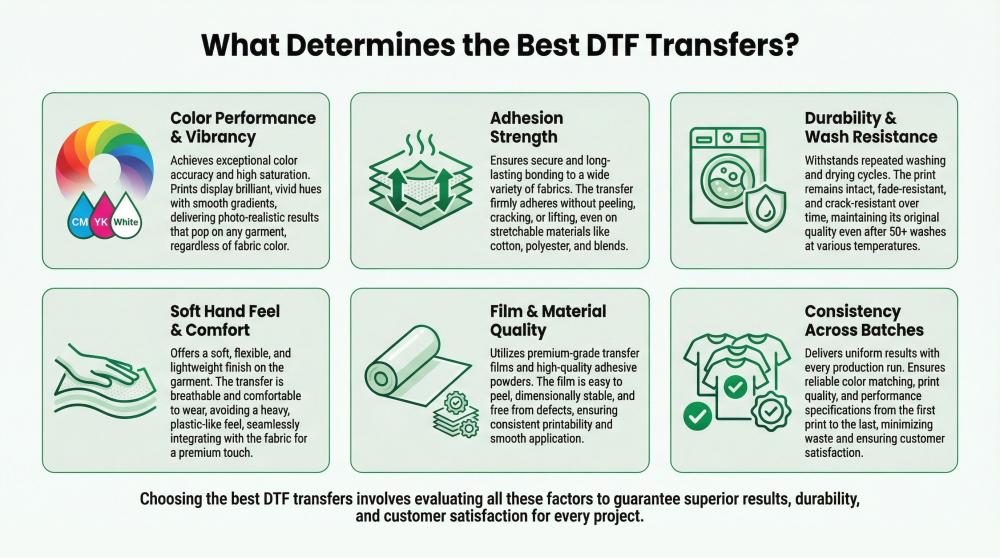
What Determines the Best DTF Transfers?
A great design means nothing if the transfer fails. The foundation of premium custom apparel lies in strong DTF transfer quality. When transfers crack, peel, or feel heavy, your brand reputation suffers. But when you use high quality DTF transfers, you deliver vibrant prints, lasting durability, and garments customers love to wear. Understanding the key DTF printing quality factors helps protect your business and increase repeat orders.
Below are the core attributes that determine the best direct to film (DTF) transfers:
Color Performance & Vibrancy
Strong color output is essential. High quality DTF transfers should produce rich, accurate, and consistent colors on both light and dark garments. Proper ink layering and white underbase application ensure opacity without dullness. Poor pigment balance leads to faded or washed-out prints.
Adhesion Strength
A good transfer must bond securely to the fabric. The adhesive powder and curing process determine how well the design fuses under heat. Weak adhesion results in edge lifting and peeling after washing — a clear sign of poor DTF transfer quality.
Durability & Wash Resistance
The best transfers withstand multiple wash cycles without cracking. Quality film, proper curing, and balanced ink flexibility allow the design to stretch naturally with the garment instead of breaking under tension.
Soft Hand Feel & Comfort
Comfort matters. A thick, plasticky print reduces garment appeal. Premium transfers feel smooth, lightweight, and flexible. This is especially important in fashion and streetwear brands where feel influences customer perception.
Film & Material Quality
The PET film must release cleanly and remain stable during pressing. Low-grade film can warp or leave residue. Even in gang sheet printing, consistent film quality ensures every design performs equally well.
Consistency Across Batches
Another factor for quality DTF printing includes stable printer calibration, uniform powder coating, and controlled curing. Consistency ensures every order — small or bulk — maintains the same professional finish.
When these factors align, you get high quality DTF transfers that elevate both print results and business growth.
How the Material Quality Matters in the Best DTF Transfers?
When evaluating what makes a good DTF transfer, material quality sits at the core. Even with advanced printers and skilled operators, poor materials will compromise results. True DTF transfer quality begins with the right combination of film, ink, adhesive powder, and curing standards.
PET Film Quality
The film acts as the carrier for the design. High-grade PET film ensures smooth ink absorption, stable heat resistance, and clean peel performance. Low-quality film may warp under heat, curl during storage, or leave residue after pressing. Premium film directly supports high quality DTF transfers by maintaining consistent release and sharp image detail.
Ink Formulation & Pigment Strength
DTF inks must provide strong pigmentation, flexibility, and bonding capability. Inferior inks lead to dull colors, cracking, or poor stretch performance. Quality inks maintain vibrancy even after multiple wash cycles. Color stability is one of the most visible indicators of strong DTF transfer quality.
Adhesive Powder Performance
The adhesive powder determines how well the design bonds to fabric. Fine, evenly distributed powder melts consistently and activates properly under heat. Low-grade powder may clump, under-cure, or create weak adhesion, resulting in peeling or edge lifting.
Curing & Heat Stability
Material chemistry must tolerate proper curing temperatures without degrading. Stable materials ensure flexibility, durability, and long-term wear.
In short, high quality DTF transfers are built on premium materials. Without strong foundational components, even the best artwork cannot deliver professional results.
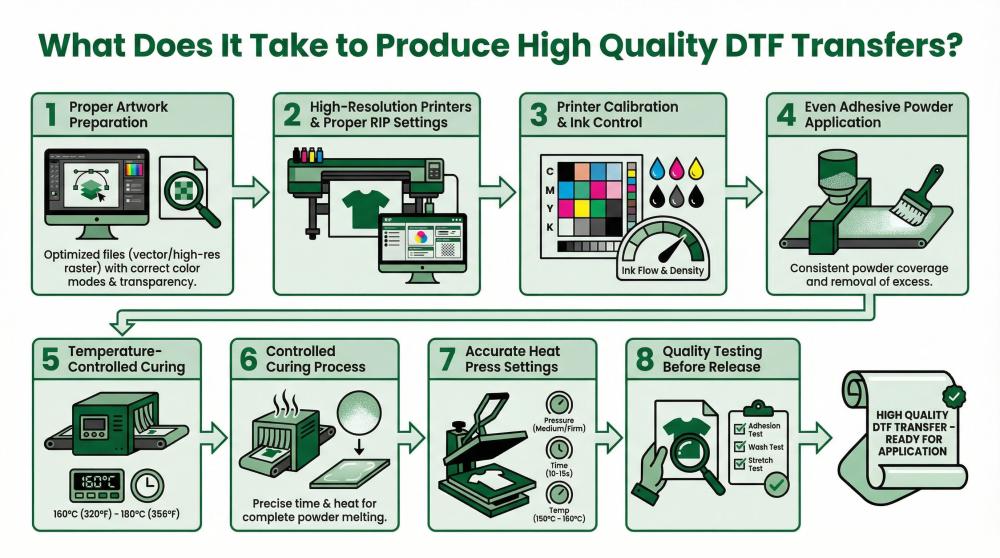
What Does It Take to Produce High Quality DTF Transfers?
Producing high quality DTF transfers is far more technical than simply printing a design onto film. True DTF transfer quality is achieved through a controlled, step-by-step DTF transfer printing process that prioritizes precision, material integrity, and performance testing. Professional producers understand that one weak step can compromise durability, comfort, and color vibrancy. That is exactly why professional printers choose high-quality DTF transfers — consistency protects their reputation and profit margins.
Below are the key elements required to produce professional-grade results:
Proper Artwork Preparation
High-resolution (300 DPI) files, correct color profiles, and well-built white underbase layers are essential. Clean artwork ensures sharp edges, strong opacity on dark garments, and accurate color output.
High-Resolution Printers & Proper RIP Settings
Professional setups use high-resolution printers paired with optimized RIP software settings. Correct ink density, pass count, and color profiling prevent banding, dull output, and misregistration — all key DTF printing quality factors.
Printer Calibration & Ink Control
Ink density, white ink layering, and color alignment must be precisely calibrated. Poor calibration leads to banding, faded tones, or weak opacity — directly reducing DTF transfer quality.
Even Adhesive Powder Application
Adhesive must be evenly distributed and excess removed. Uneven powder causes weak bonding or overly thick prints that feel heavy on fabric.
Temperature-Controlled Curing
Curing must activate adhesive without overheating the film. Controlled temperature ensures flexibility and long-term wash resistance while preventing brittleness.
Controlled Curing Process
Temperature and curing time must activate the adhesive without over-melting. Over-curing reduces flexibility. Under-curing leads to peeling.
Accurate Heat Press Settings
Proper pressure, temperature, and dwell time ensure full bonding. Professional producers test settings before bulk runs.
Quality Testing Before Release
Stretch tests, peel tests, and wash tests verify durability. This final checklist guarantees high quality DTF transfers perform reliably in real-world use.
Professional-grade production is meticulous — and that precision is what separates average prints from premium results.
Bad DTF Transfer vs Good DTF Transfers: The Key Signs to Look For
Not all transfers are created equal. The difference between poor and premium prints becomes obvious after pressing — and even more noticeable after washing. Understanding the visible and performance-based signs of DTF transfer quality can save your business from returns, complaints, and damaged reputation. High quality DTF transfers consistently perform better in comfort, durability, and appearance.
Below are the key differences to watch for:
Color Vibrancy
-
Good DTF Transfers: Bright, rich, and accurate colors with strong white opacity underneath.
-
Bad DTF Transfers: Dull tones, faded appearance, or weak opacity on dark garments.
Adhesion Strength
-
Good: Bonds firmly to fabric with no lifting at edges.
-
Bad: Edges begin peeling after pressing or first wash.
Stretch Performance
-
Good: Flexes with the garment without cracking.
-
Bad: Cracks immediately when stretched lightly.
Hand Feel & Comfort
-
Good: Smooth, lightweight, and flexible feel.
-
Bad: Thick, rubbery, or overly plasticky texture.
Film Peel Behavior
-
Good: Clean peel without ink lifting or tearing.
-
Bad: Ink pulls up with film or leaves residue.
Wash Durability
-
Good: Withstands multiple wash cycles without fading.
-
Bad: Shows cracking, peeling, or color loss quickly.
|
Feature |
High Quality DTF Transfers |
Bad DTF Transfers |
|
Color Output |
Vibrant & accurate |
Faded or uneven |
|
Adhesion |
Strong, sealed edges |
Peeling & lifting |
|
Stretchability |
Flexible & crack-resistant |
Cracks easily |
|
Comfort |
Smooth & lightweight |
Thick & stiff |
|
Peel Test |
Clean release |
Ink separation |
|
Wash Resistance |
Long-lasting |
Early wear & fading |
A Complete DTF Print Quality Checklist for Better Results
Consistent results don’t happen by chance. Achieving strong DTF transfer quality requires a structured checklist that covers every stage of production — from artwork to final press. Whether you produce in-house or source high quality DTF transfers, these factors directly impact durability, comfort, and customer satisfaction.
Artwork Resolution & Setup
Ensure files are 300 DPI with clean edges and proper transparency. Poor artwork leads to blurry prints and weak white underbase coverage.
Color Accuracy & White Ink Opacity
Check color vibrancy and confirm the white base is dense enough for dark garments. Weak opacity reduces brightness and overall print impact.
Film Condition
Inspect PET film for warping, scratches, or residue. A smooth, stable film ensures sharp detail and clean peeling.
Adhesive Powder Application
Powder must be evenly coated with no clumps. Uneven adhesive causes weak bonding and edge lifting.
Curing Temperature & Time
Verify curing is complete but not overdone. Under-curing leads to peeling. Over-curing reduces flexibility.
Heat Press Settings
Confirm correct temperature, pressure, and dwell time. Proper pressing ensures strong adhesion and a smooth finish.
Stretch & Wash Test
Perform a quick stretch and wash test before bulk runs. High quality DTF transfers should flex without cracking and survive repeated washes.
Following this checklist protects print performance and guarantees reliable, professional results.
Conclusion
In custom apparel, print quality defines brand value. A design may look impressive on screen, but without strong DTF transfer quality, the final garment can fail in comfort, durability, and wash performance. From color vibrancy and adhesion strength to stretch resistance and soft hand feel, every factor plays a role in delivering professional results. Choosing high quality DTF transfers ensures your prints remain bold, flexible, and long-lasting — protecting both your margins and your reputation.
If you want consistent performance and reliable output, material quality and production standards matter. DTFS provides premium custom DTF transfers engineered for vibrant color, strong adhesion, and superior durability. With a strict quality checklist and professional-grade production process, DTFS helps businesses achieve better print results and confidently scale their custom apparel operations.
FAQs: What Makes a Good DTF Transfer
1. What makes a good DTF transfer?
A good DTF transfer offers strong adhesion, vibrant color, smooth hand feel, and long-lasting wash durability.
2. How can I check DTF transfer quality before bulk orders?
Run a stretch test, peel test, and wash test to confirm bonding strength and flexibility.
3. Comparing DTF options: What makes some transfers better?
Higher-grade film, premium inks, proper curing, and even adhesive coating determine superior DTF transfer quality.
4. The best DTF transfers for different use cases?
Soft, flexible transfers are best for fashion apparel, while stronger, high-adhesion transfers suit workwear and heavy-use garments.
5. Do high quality DTF transfers crack after washing?
When properly produced and pressed, high quality DTF transfers resist cracking for many wash cycles.
6. Why does DTF transfer quality matter for my business?
Better DTF transfer quality reduces returns, improves customer satisfaction, and strengthens your brand reputation.