


You press your design. It looks perfect. Clean. Vibrant. Exactly how you imagined.
Then… that smell hits.
If you’ve ever dealt with DTF transfer smell after pressing, you’re not alone. It’s one of the most common concerns in the printing world. Many beginners—and even experienced shops—often wonder why do DTF prints smell right after application. Is it normal? Is something wrong?
The truth is, the DTF transfer odor problem usually comes down to materials, curing, and process control. Small details. Big impact.
In this guide, we’ll break down exactly why it happens, what it means, and how you can fix it—so your prints not only look great, but feel right too.
Understanding the General Cause Behind Smell After Pressing
Here’s the short, direct answer: the smell comes from heat-activated adhesive and ink curing. That’s it.
When you press a DTF transfer, the adhesive powder melts and bonds to the fabric. At the same time, the ink layer is fully cured under heat. This combination creates a temporary odor—often described as slightly chemical or plasticky.
This is the most common cause of DTF print smell after pressing. It’s not random. It’s part of the process.
In many cases, the smell is mild and fades quickly. But if it’s strong or lingers, it usually points to DTF curing issues smell—like overheating, under-curing, or inconsistent temperature control. The type and quality of materials also play a role, especially DTF adhesive powder smell, which can vary significantly between low-grade and premium powders.
So yes, some odor is normal. But strong, persistent smell? That’s a signal to check your process.
Related: How to Cure DTF Powder with Heat Press?
The Real Reason (Simplified Science)
1. Adhesive Powder Chemistry
This is the biggest contributor. DTF printing relies on a hot-melt adhesive powder to bond the design to the fabric. Once your design is printed—whether it’s a single piece or part of a gang sheet printing setup—the powder is applied over the wet ink layer. This powder is not just a coating. It’s the foundation of durability.
Here’s what happens during the process:
-
The powder contains polymer-based compounds
-
Heat activates these compounds
-
The powder melts and forms a bonding layer
-
During melting, it releases a light odor
That odor is your first and most common source of smell.
In most cases, the DTF adhesive powder smell is mild. Slightly chemical. Sometimes even faintly sweet. It’s temporary and fades as the material cools and stabilizes after pressing.
But the situation changes when process control slips.
-
Low-quality powder introduces unstable compounds
-
Over-application creates excess melt and stronger fumes
-
Improper curing traps odor within the adhesive layer
That’s when the smell becomes noticeable. Lingering. Hard to ignore.
So if you’re dealing with a consistent DTF transfer odor problem, start here. Check your powder quality. Check your application. Because not all powders behave the same—and this one factor alone can make or break your final output.
2. Ink Curing Reaction
Next comes the ink layer. DTF inks are built to react under heat. They don’t just dry—they cure. So when you press the transfer, the ink isn’t sitting passively on the film. It’s actively changing. Setting. Locking into place with the adhesive layer.
Here’s what happens during this phase:
-
Solvents inside the ink begin to evaporate
-
Pigments stabilize and fix into position
-
The ink bonds with the melted adhesive underneath
This reaction releases a temporary smell. It’s completely normal. Part of the process.
But this is also where most DTF printing problems and solutions start to show up. Because curing needs precision. Even a small imbalance can change the result.
-
Under-cured ink → stronger smell, weak bonding, prints may peel
-
Over-cured ink → burnt or harsh odor, stiff and brittle finish
-
Uneven curing → inconsistent smell across different areas of the print
This is what’s commonly called DTF curing issues smell.
And here’s the important part—it’s not just about odor. It’s a signal. A warning sign that your temperature, time, or pressure isn’t dialed in correctly. Good curing? Clean finish. Minimal smell. Bad curing? You’ll notice it instantly.
3. Heat Activation (The Trigger Point)
Now let’s talk about the trigger. Heat is what activates everything.
Without heat, nothing really happens:
-
The powder stays dry
-
The ink remains uncured
-
There’s no bonding
-
And no smell
But the moment heat is introduced, everything changes.
-
The adhesive powder melts
-
The ink begins and completes curing
-
A strong bond forms between design and fabric
-
And at the same time, vapors are released
This is exactly why you notice the smell right after pressing.
During heat pressing—whether it’s a single piece or bulk DTF printing—temperatures usually reach around 150–160°C. At this stage, the adhesive liquefies, the ink locks into place, and the entire system activates at once. That activation releases a temporary odor. This is the moment when DTF transfer smell after pressing becomes most noticeable.
Here’s the key insight:
-
The smell is strongest immediately after pressing
-
It gradually fades as the print cools and stabilizes
That fading is a good sign. It means the process worked as expected. But if the smell stays strong… If it lingers longer than it should… That’s your red flag. It usually points to issues in temperature control, curing balance, or material quality.
Where the Smell Actually Comes From
Often, you feel the smell after pressing in DTF, you may ask where is this smell coming from? “It’s the ink.” Or “it’s the powder.” That’s a real question.
The reality? The smell builds across the entire workflow. If you want to fix the DTF transfer smell after pressing, you need to understand exactly where it starts—and how it evolves at each stage.
During Printing
This is the first layer. Subtle, but important. When the design is printed onto the film, the ink is still wet and beginning its initial drying phase. At this point, you’re not dealing with strong odors—but the foundation is already being set. Light solvents inside the ink start to evaporate slowly. This can create a faint DTF ink smell after curing, even before the actual curing process begins.
Film quality also plays a quiet but critical role here. Poor coating or low-grade film materials contribute to early-stage odor—often referred to as DTF film smell reasons. High-quality films and inks? They stay controlled and clean. Cheap ones? They introduce problems early.
-
Light solvent evaporation begins
-
Mild odor may already be noticeable
-
Film and ink quality influence base smell
Note: This stage doesn’t create the main smell—but it defines what comes next.
During Powdering
This is where things start to build. Once adhesive powder is applied over the wet ink, the process shifts from visual to structural. The powder sticks to the ink layer, forming the base for bonding. Excess powder is shaken off, but fine particles always remain.
At this point, a faint DTF adhesive powder smell can start to appear—especially if the powder quality is low or the application is uneven. While it may not seem like a big issue now, this step heavily influences how strong the smell becomes later.
-
Powder adheres to wet ink surface
-
Excess is removed, but fine particles remain
-
Smell begins to build depending on material quality
Common problems here include over-application, which leads to excess melting later, and inconsistent coating, which results in uneven odor distribution.
Note: Not the strongest stage for smell—but a critical setup point.
During Curing
Now things get active. During curing, the powdered film is exposed to heat to partially melt the adhesive and stabilize the ink. This is where most DTF print smell actually begins. The adhesive starts reacting, and the ink begins locking into place. Vapors are released for the first time in a noticeable way.
If everything is balanced, the smell stays mild and controlled. But if curing is off—even slightly—you’ll see problems immediately. This is where DTF curing issues smell becomes obvious.
-
Adhesive starts melting and setting
-
Ink stabilizes and bonds internally
-
Initial vapors are released
Under-curing traps chemicals. Over-curing creates burnt odors. Uneven curing leads to a patchy smell across the design.
Note: If something goes wrong here, it will show up after pressing.
During Heat Press
This is the peak moment. The final stage. When the transfer is pressed onto the fabric, everything activates at once. The adhesive fully melts, the ink completes curing, and the bond forms permanently with the garment.
At this exact point, the DTF transfer smell after pressing becomes strongest. Heat amplifies everything that has built up in previous stages. Any imbalance—powder, ink, or curing—gets exposed instantly.
-
Adhesive fully liquefies and bonds
-
Ink completes final curing
-
Vapors release rapidly under high heat
You’ll notice a sudden burst of odor. That’s normal—to a point. But if the smell is too strong or doesn’t fade, it means earlier steps weren’t controlled properly.
Note: This is not where the problem starts. This is where everything becomes visible.
When Should You Worry?
Not every smell is a problem. That’s the first thing to understand. A light odor after pressing is completely normal in DTF printing. But there’s a clear line between what’s acceptable and what needs attention.
Here’s a simple way to judge it:
|
Situation |
Normal |
Problem |
|
Light smell fades |
✅ |
❌ |
|
Strong chemical smell |
❌ |
✅ |
A mild smell right after pressing? That’s expected. It usually comes from adhesive activation and ink curing. If it fades within a few hours—or after one wash—you’re in the clear.
But if the smell is strong, harsh, or lingers for days, that’s when you should start paying attention. A heavy chemical odor often points to issues like poor-quality materials, over-curing, or trapped fumes in the adhesive layer.
Watch for these warning signs:
-
Smell doesn’t fade over time
-
Odor gets stronger after pressing
-
Customers notice it immediately
Other Causes for DTF Transfers Smell After Pressing
If you’re dealing with a strong or persistent odor, it’s rarely just “normal DTF behavior.” It usually comes down to a few core issues. And each one has a real, practical reason behind it.
Low-Quality Adhesive Powder
Not all powders are created equal. Cheap powders often contain unstable compounds that release stronger fumes when heated. They may also melt unevenly, trapping odor inside the print instead of letting it dissipate properly.
Over-Curing / Under-Curing
Curing is a balancing act.
-
Under-curing leaves moisture and chemicals trapped, causing a lingering smell
-
Over-curing burns the adhesive, creating a sharp, unpleasant odor
Even small timing or temperature errors can cause this.
Incorrect Press Temperature
Too much heat intensifies fumes. Too little heat prevents proper bonding. Both lead to odor issues. Many operators rely on guesswork instead of calibrated settings—and that’s where problems begin.
Cheap Films
Low-grade films often have poor coatings. When heated, they can release their own smell, adding to the overall odor problem.
Ink Quality Issues
Inferior inks contain more volatile components. During curing, these release stronger smells and may not stabilize properly.
How to Fix DTF Transfer Odor Problem
Experiencing a harsh chemical scent after a long day of production is a common DTF transfer odor problem that many shop owners overlook until it affects their workspace or customer feedback. That lingering, vinegar-like or "burnt plastic" scent is usually the result of uncured chemicals or overheated film. To maintain a professional environment and ensure your garments are retail-ready, you need a systematic approach to eliminate these fumes.
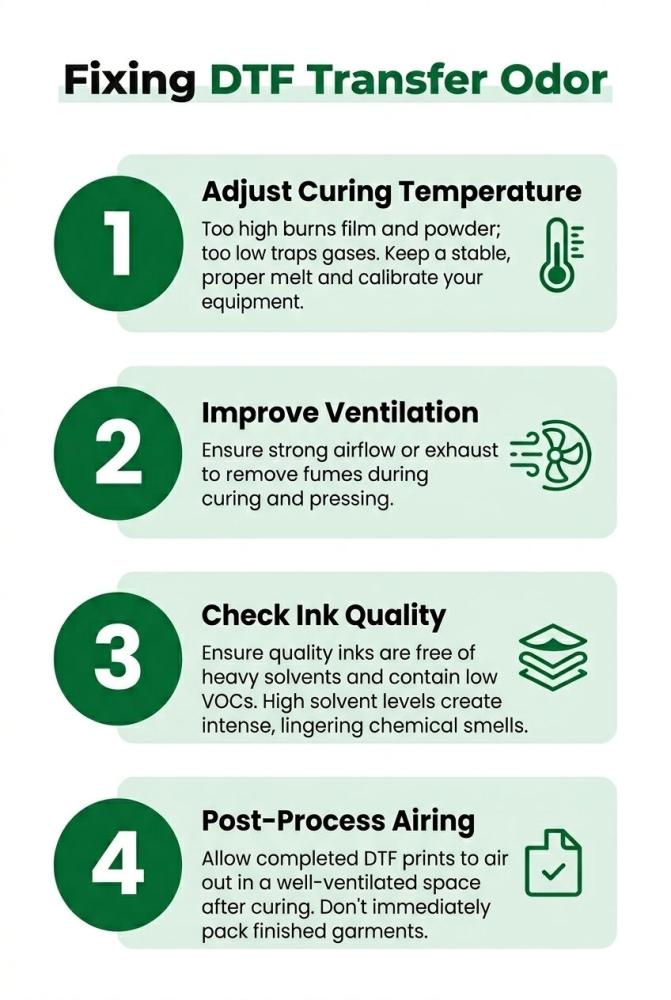
Refine Your Curing Temperature
The most frequent cause of DTF transfer smell after pressing is improper curing. If your oven or heat press is set too high, you are essentially scorching the PET film and the TPU powder, releasing acrid smoke. Conversely, if the temperature is too low, the pollutants are trapped inside the "skin" of the melted powder and only escape when the shirt is pressed, hitting you with a concentrated burst of odor.
-
Calibration: Use an infrared thermometer to verify your oven’s actual temperature. Aim for a stable melt that creates a "sugar-like" texture without smoking.
-
Consistency: Ensure your heat press is calibrated. Small fluctuations in heat can lead to DTF transfer heat press issues that trap gases within the ink layers.
Optimize Your Ventilation System
If you are wondering how to remove DTF smell from your shop, the answer is almost always airflow. DTF printing involves off-gassing during the curing stage. Without a dedicated exhaust system or a high-quality air purifier with a HEPA and carbon filter, those gases settle into the fabric of the shirts and the walls of your room.
-
Direct Exhaust: If possible, vent your curing oven directly to the outdoors.
-
Air Circulation: Keep a steady flow of fresh air in the pressing area to disperse any vapors that escape during the final application.
Switch to Premium Materials
Not all inks and powders are created equal. Lower-quality consumables often use cheaper binders and solvents that have a much stronger chemical profile. If you have a persistent DTF transfer odor problem, it may be time to audit your supply chain. High-quality, filtered inks and REACH-compliant powders are formulated to minimize off-gassing, resulting in a cleaner-smelling finished product.
Utilize Post-Press Finishing
If a scent persists immediately after the shirt comes off the press, a quick post-press routine can help. Allow the garment to "gas out" in a well-ventilated area for a few minutes before folding or bagging. For high-end orders, a quick "scent-removal" press—placing a fresh sheet of parchment paper over the design and pressing for 3–5 seconds—can help pull any remaining moisture and odors out of the fibers.
Related: How Long Do You Press a DTF Transfer?
In a Nutshell
A lingering DTF transfer odor problem doesn’t have to be a permanent part of your production line. While a slight scent is a natural byproduct of heat-activated chemistry, a harsh or persistent smell is a clear signal that your process needs a tune-up.
By calibrating your curing temperatures, investing in premium powders, and ensuring your shop has proper ventilation, you can effectively remove DTF smell and protect your professional reputation.
At DTFS.co, we believe your prints should impress, not overwhelm. Master these small adjustments to ensure every garment you deliver is as fresh as it is vibrant.
FAQs
Is it normal for DTF transfers to smell after heat pressing?
Yes, a mild odor is completely normal. This occurs because the heat activates the TPU (adhesive) powder and triggers the final curing stage of the DTF inks. In most cases, this "plasticky" or slightly sweet scent is temporary and should dissipate quickly as the garment cools.
Why does my DTF print have a strong, vinegar-like or burnt smell?
A harsh or "burnt" odor usually points to over-curing or a heat press temperature that is set too high, which scorches the film and adhesive. Conversely, a sharp chemical smell can indicate under-curing, where moisture and solvents remain trapped in the ink and are only released when you press the shirt.
Can the quality of my adhesive powder affect the smell?
Absolutely. Low-quality or "budget" adhesive powders often contain unstable chemical compounds and fillers that release stronger, more unpleasant fumes during the melting process. Switching to premium, REACH-compliant powders can significantly reduce off-gassing.
How long does the DTF transfer smell usually last?
Under normal conditions, the scent should fade within a few hours of pressing. If the garment is left in a well-ventilated area, it often disappears almost instantly. If the smell persists for days, it is a sign of improper curing or poor-quality consumables.
Will washing the garment remove the DTF odor?
Yes. If a faint scent remains after production, a single wash cycle will typically remove any lingering surface odors. For professional shops, however, it is best to resolve the odor through process calibration before the customer receives the item.