
August 11, 2026 · Connor McDonnell
UV DTF vs UV Printing: What's the Difference?
UV DTF vs UV printing is an important comparison for businesses decorating hard products such as tumblers, glassware, acrylic signs, phone cases, packaging, and promotional merchandise. Although both technologies use UV-curable inks, they create the finished decoration in very different ways.
Direct UV printing applies ink straight onto the product, while UV DTF creates a transfer on film that is applied afterward. That difference affects equipment requirements, substrate flexibility, production workflow, setup time, application, and finish.
For small businesses, ecommerce sellers, promotional companies, and product decorators, choosing the wrong process can increase costs and limit what can be produced. For businesses that need flexible hard-surface decoration without investing in equipment, custom DTF transfers can provide a practical alternative.
This guide explains the difference and helps you determine which method fits your products and production goals.
Key Takeaways
-
UV DTF prints onto film before the design is transferred to the final product.
-
Direct UV printing applies UV-curable ink directly onto the object.
-
UV DTF is especially useful for curved, irregular, oversized, or difficult-to-print products.
-
Direct UV printing can provide a more integrated finish and greater control over texture and layered effects.
-
UV DTF can simplify batch production because products do not need to remain inside a printer during decoration.
-
The best option depends on product shape, quantity, durability requirements, finish, and production workflow.
UV DTF vs UV Printing: Understanding the Two Technologies
The fundamental difference between UV DTF vs traditional UV printing is where the image is created. UV DTF prints the artwork onto a specialized film system before the design is transferred to the finished product. Direct UV printing places the ink directly onto the product and cures it with ultraviolet light.
UV DTF therefore separates the printing stage from the application stage. A transfer can be produced ahead of time, cut, stored, and applied later. Direct UV printing keeps printing and decoration connected: the object must be positioned correctly in the printer or on a compatible rotary attachment.
For businesses comparing these technologies, the distinction is more important than the word "UV." Both use UV-curable inks, but the production workflow is fundamentally different.
For businesses that need ready-made decorated transfers for different products, custom transfer production can also be more practical than purchasing and operating specialized equipment.
UV DTF Printing Process: How It Works
The UV DTF printing process starts with artwork prepared for a hard-surface transfer. The design is printed onto a specialized A-film using UV-curable inks. Depending on the system, white ink and varnish can be incorporated to create opacity, highlights, gloss, or dimensional effects.
The printed design is then laminated with a B-film. This creates the transferable decal structure. The finished transfer can be cut into individual graphics, positioned on the target surface, burnished firmly, and peeled to leave the printed design adhered to the product.
A simplified workflow looks like this:
-
Prepare and size the artwork.
-
Print the design onto UV DTF film.
-
Cure the UV ink during printing.
-
Laminate the printed film.
-
Cut or separate the finished transfer.
-
Clean and prepare the product.
-
Position and apply the transfer.
-
Burnish the design and remove the carrier.
Unlike conventional garment DTF, UV DTF does not rely on hot-melt powder and a heat press for final application.
Businesses that prefer to outsource production can order custom UV DTF transfers online and focus their internal workflow on product decoration, fulfillment, and quality control.
UV Printing Process: How Direct UV Printing Works
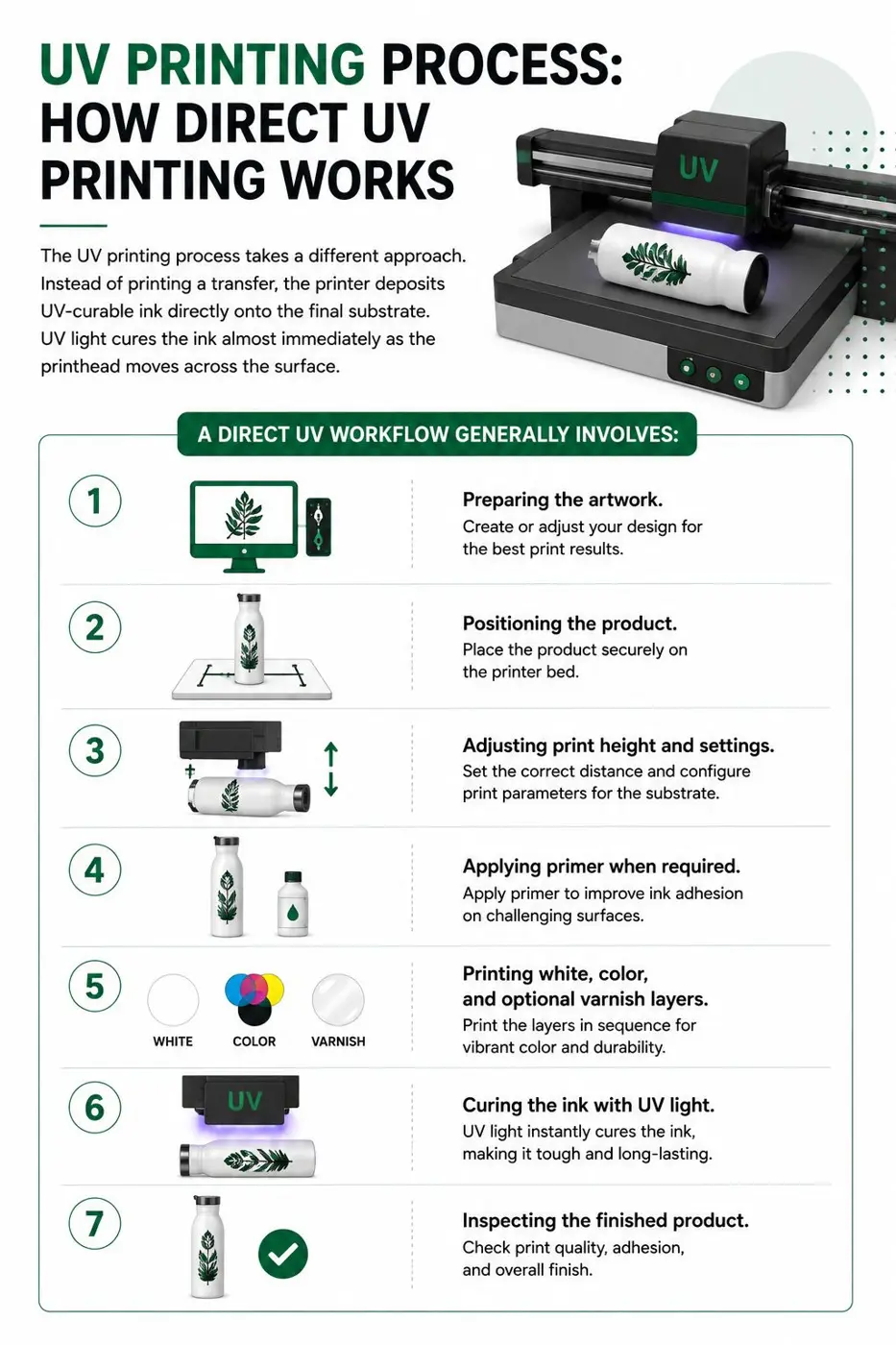
The UV printing process takes a different approach. Instead of printing a transfer, the printer deposits UV-curable ink directly onto the final substrate. UV light cures the ink almost immediately as the printhead moves across the surface.
A direct UV workflow generally involves:
-
Preparing the artwork.
-
Positioning the product.
-
Adjusting print height and settings.
-
Applying primer when required.
-
Printing white, color, and optional varnish layers.
-
Curing the ink with UV light.
-
Inspecting the finished product.
The biggest operational requirement is that the object must be compatible with the printer's physical dimensions and print configuration.
Flat and rigid products are often particularly well suited to direct UV printing. Cylindrical products may require a rotary attachment or specialized UV cylinder printer.
UV DTF vs Direct UV Printing: Substrate Compatibility
Both technologies can decorate hard and semi-rigid products, but their physical limitations differ.
Direct UV printing works especially well when the product can be positioned securely under the printhead. Flat acrylic panels, plaques, signs, phone cases, boards, and other rigid products can be efficient applications.
UV DTF becomes more attractive when the object is difficult to position inside a printer. Curved surfaces, tapered drinkware, bottles, irregular promotional items, and products that exceed printer dimensions can often be decorated using transfers.
However, UV DTF is not automatically suitable for every surface. Adhesion depends on the substrate, coating, cleanliness, texture, and transfer adhesive. Smooth, clean surfaces generally provide more predictable results.
UV DTF vs UV Printing: Finish and Appearance
Appearance is one of the most noticeable differences between the two methods.
Direct UV printing places the cured ink directly against the product. This can produce a highly integrated appearance, especially on premium rigid products. Some UV printers can also use varnish and layered printing to create gloss, texture, or raised visual effects.
UV DTF produces a transfer that sits on the surface. High-quality transfers can still produce sharp, vibrant, glossy graphics, but the edge and texture of the transfer may be more noticeable when viewed closely.
For promotional products, personalized drinkware, packaging, and retail merchandise, UV DTF can provide an attractive decorative finish without requiring direct printing equipment.
UV DTF vs UV Printing: Durability Comparison
Durability is more complicated than simply declaring one process better.
Direct UV prints are cured directly onto the substrate, so adhesion can be strong when the ink, primer, and surface are correctly matched. This can make direct UV printing attractive for products exposed to regular handling or demanding environments.
UV DTF durability depends heavily on the transfer adhesive and the surface preparation. A contaminated, oily, rough, or poorly compatible surface can cause lifting or premature failure even when the transfer itself was printed correctly.
Factors affecting durability include:
-
Surface preparation
-
Substrate coating
-
Ink or transfer formulation
-
Exposure to abrasion
-
Water and chemicals
-
Outdoor exposure
-
Product handling
-
Application technique
Testing the exact product before commercial production is therefore more reliable than assuming durability from the printing method alone.
Application technique is particularly important because problems such as contamination, incorrect pressure, bubbles, and improper carrier-film removal can affect the finished result. Businesses can review common UV DTF transfer mistakes before beginning production.
UV DTF Printing vs UV Printing: Production Speed
Production speed depends heavily on the type and quantity of products.
Direct UV printing can be highly efficient for repeatable flat products because artwork can be printed directly onto prepared items. Once the printer is configured, batches can move through a consistent workflow.
UV DTF can be faster for businesses decorating many different product shapes because transfers can be produced separately and applied later. The same printed transfer can also be used across a batch of compatible products.
This creates an important distinction:
Direct UV printing can be efficient at the printing stage, while UV DTF can be efficient across the overall decoration workflow.
-
For businesses handling multiple graphics, gang sheet printing can improve film utilization by combining multiple designs into a more efficient production layout.
-
For businesses producing hundreds of identical flat products, direct UV may be highly practical.
-
For businesses handling mixed products and irregular shapes, UV DTF can simplify production.
UV DTF vs UV Printing: Cost Considerations
Equipment investment is another major difference.
A direct UV setup may require a UV printer, RIP software, ventilation considerations, maintenance supplies, primers, fixtures, and potentially rotary equipment. The investment can make sense for businesses with consistent production volume.
UV DTF production requires a UV DTF printer and film workflow, but businesses can also outsource transfer production. Outsourcing changes the economics because the business avoids purchasing and maintaining printing equipment.
For higher-volume requirements, bulk DTF printing can also help businesses lower per-transfer costs through larger production runs.
The real calculation should include:
-
Equipment investment
-
Ink and consumables
-
Film
-
Maintenance
-
Labor
-
Product handling
-
Failed prints
-
Transfer waste
-
Storage
-
Shipping
-
Production volume
A lower equipment price does not necessarily mean a lower long-term production cost.
UV DTF vs Direct UV Printing for Curved Products
Curved products are one of the strongest use cases for UV DTF.
Consider a tumbler. Direct UV printing may require a rotary attachment and appropriate calibration to maintain registration around the cylinder. A tapered or irregular object can add further complexity.
Material-specific preparation is still important, particularly with specialty substrates. For leather applications, see the guide to DTF transfers for leather or faux leather before committing to a production run.
With UV DTF, the graphic is printed separately and manually positioned on the product. This can make drinkware, bottles, jars, and similar items easier to decorate.
For large graphics, however, application skill becomes increasingly important. A large transfer can develop wrinkles or bubbles if applied too quickly or without adequate pressure.
When Direct UV Printing Is the Better Choice
Direct UV printing is often preferable when:
-
Products are flat and rigid.
-
The printer can accommodate the product dimensions.
-
A premium integrated appearance is important.
-
Raised or layered effects are required.
-
Production involves large quantities of similar products.
-
The business needs direct control over every print.
-
The substrate and ink system have been tested together.
It can be particularly valuable for signage, plaques, acrylic displays, rigid packaging, promotional products, and specialty industrial applications.
When UV DTF Is the Better Choice
UV DTF is often the better option when:
-
Products have curved surfaces.
-
Items are too large or awkward for a flatbed printer.
-
Multiple product shapes need decoration.
-
Designs need to be prepared before application.
-
Small-batch personalization is important.
-
A business does not want to invest in direct UV equipment.
-
Transfers need to be applied at a different location from where they are printed.
A transfer-based workflow can also help businesses separate production from fulfillment.
For businesses that need repeated quantities, gang-sheet production can improve film utilization by placing multiple designs efficiently on one sheet.
UV DTF vs UV Printing: Which Is Better for Small Businesses?
There is no universal winner.
A small ecommerce seller producing personalized tumblers may benefit from UV DTF because transfers can be ordered according to demand and applied without operating a direct UV printer.
A promotional-products company producing standardized acrylic signs may prefer direct UV printing because the products are flat, repeatable, and suitable for automated production.
A print shop serving both markets may eventually use both technologies. The two methods solve different production problems rather than competing for exactly the same applications.
UV DTF vs UV Printing for Promotional Products
Promotional merchandise often includes bottles, tumblers, acrylic products, phone accessories, awards, packaging, and other rigid goods.
Common applications include drinkware, bottles, promotional containers, branded accessories, and other hard-surface merchandise. For additional examples, see UV DTF promotional product applications.
UV DTF is useful when product shapes vary significantly. Transfers can be prepared in batches and applied to different compatible items.
Direct UV printing is attractive when the promotional item has a consistent shape and the business wants the decoration printed directly into the production workflow.
For larger promotional programs, businesses should evaluate the complete workflow rather than comparing only the print price per item.
Quality Control and Production Consistency
Whichever method is selected, consistent production requires standardized artwork, surface preparation, color management, and inspection.
For UV DTF, application becomes part of quality control. The operator needs to align the transfer, control pressure, remove the carrier correctly, and inspect the edges.
For direct UV printing, product positioning, print height, ink settings, primer selection, and curing performance become more important.
A professional workflow should include:
-
Approved artwork
-
Tested substrates
-
Standardized print settings
-
Sample approval
-
Production inspection
-
Repeatable cleaning procedures
-
Final quality checks
This is why the difference between UV DTF and UV printing is not only a technology decision. It is also a workflow decision.
Why Businesses Use Professional UV DTF Production
For businesses that do not need to operate their own UV printer, outsourcing can reduce equipment investment and maintenance responsibilities.
A professional supplier can handle the printing and transfer-production stages while the business focuses on sales, product assembly, fulfillment, or decoration. This can be especially useful for ecommerce brands, promotional companies, product decorators, and businesses testing a new product line.
For larger programs, wholesale production can also make it easier to maintain consistent transfer quality across repeat orders.
Final Decision: UV DTF vs UV Printing
The best choice depends on the product, production volume, desired finish, and business model.
Choose direct UV printing when you need direct-to-object decoration, premium integrated finishes, repeatable rigid products, or specialized layered effects. Choose UV DTF when you need flexibility with curved, irregular, oversized, or mixed products and want a transfer-based workflow.
Ultimately, UV DTF vs UV printing is less about which technology is universally superior and more about which production process removes the biggest bottleneck in your business. Test the actual substrate, calculate the complete production cost, and evaluate application time before committing to a workflow.
Common Questions About UV DTF vs UV Printing
Is UV DTF the same as UV printing?
No. UV DTF prints onto transfer film first, while direct UV printing applies UV-curable ink directly to the finished product.
Which is better for tumblers?
UV DTF is often more convenient for curved or tapered tumblers because the transfer can be applied manually. Direct UV printing can also work when a suitable rotary setup is available.
Which gives a more premium finish?
Direct UV printing can provide a more integrated appearance because the ink is printed directly onto the substrate. UV DTF can still produce highly detailed, glossy results.
Which method is easier for small batches?
UV DTF can be practical for small batches because businesses can outsource transfers and apply them as needed. Direct UV printing can make sense when the business already owns the equipment and has a repeatable workflow.
Can UV DTF replace direct UV printing?
Not completely. UV DTF expands the range of objects that can be decorated through transfer application, while direct UV printing offers advantages for direct-to-object production and specialized finishes.
Is UV DTF durable?
It can be durable when applied to a compatible, properly prepared surface. Adhesion varies by substrate, coating, handling, and environmental exposure, so product-specific testing is recommended.