


It’s been more than two decades since Direct to Film (DTF) printing was introduced. Gradually, this technology got traction among the custom apparel businesses, but the actual boost in popularity came in 2020 when small and mid-sized apparel businesses started adopting it on a large scale.
Where is DTF printing heading now, and what can be said about its future? With a projected market size of USD 3.92 billion by 2030, growing at a CAGR of 6%, the future of DTF printing seems promising and lucrative. Let’s delve deep into the prospects of DTF printing in this blog by understanding the key driving factors for growth and the business landscape.
Key Driving Factors Behind the Growth of DTF Printing
The future of DTF printing is expanding rapidly as apparel businesses, fashion brands, print shops, and e-commerce sellers continue shifting toward faster, more flexible, and highly customizable production methods.
Over the last few years, DTF printing market trends have shown strong growth due to rising consumer demand for personalized apparel, advancements in printing technology, and the growing need for low-cost short-run production.
Unlike traditional screen printing methods that require lengthy setup processes and large order quantities, DTF printing allows businesses to produce vibrant, durable, and on-demand designs with minimal preparation time. This flexibility is one of the biggest reasons why analysts expect strong DTF market growth and outlook through 2030 and beyond.
Below are the major factors driving the evolution and expansion of the DTF printing industry.
Rising Demand for Custom and On-Demand Apparel
One of the biggest DTF printing future trends is the explosive demand for personalized clothing and small-batch production. Consumers increasingly want custom t-shirts, branded apparel, limited-edition drops, team uniforms, and personalized fashion items.
Traditional printing methods struggle with:
-
High setup costs
-
Long turnaround times
-
Minimum order quantity requirements
-
Limited fabric compatibility
DTF printing solves these issues by enabling:
-
Fast short-run production
-
Affordable single-piece printing
-
Full-color customization
-
Efficient on-demand manufacturing
By utilizing third-party custom DTF transfers, small brands and e-commerce storefronts can instantly offload the overhead of physical ink management while capitalizing on these rapid fulfillment advantages. This is especially important for Etsy sellers, print-on-demand businesses, and small apparel brands.
As personalization continues dominating the apparel industry, DTF printing remains one of the most scalable solutions for modern garment decoration.
Advancements in Direct to Film Printing Innovations
Rapid improvements in printer hardware, RIP software, adhesive powders, and ink formulations are transforming the industry.
Modern Direct to film printing innovations now deliver:
-
Faster print speeds
-
Sharper image quality
-
Better color vibrancy
-
Improved wash durability
-
Lower ink consumption
For example, in January 2025, Roland DGA launched the Roland DG TY-300 DTF printer in North America, designed for higher productivity and lower operating costs. The printer reportedly delivers transfer graphics up to four times faster than some competing systems while improving print consistency and image quality.
Automation is also emerging as one of the major DTF printing trends 2026, with:
-
Automated powder shakers
-
Inline curing systems
-
AI-assisted color calibration
-
Auto-nesting gang sheet software
-
Smart production workflow management
These technologies reduce labor costs and improve production scalability for both small shops and large manufacturers.
Expansion of E-Commerce and Print-on-Demand Businesses
The growth of online shopping continues fueling the future of DTF printing. Global e-commerce sales reached approximately USD 6.4 trillion in 2025 and continue growing rapidly. As online apparel brands increasingly adopt print-on-demand models, DTF printing offers the flexibility needed for low-inventory fulfillment.
DTF printing supports:
-
Fast fulfillment cycles
-
Multi-design production
-
Low-risk inventory management
-
One-off custom orders
This makes it ideal for:
-
Shopify apparel stores
-
Amazon merch sellers
-
POD businesses
-
Social-commerce apparel brands
As fashion becomes more trend-driven and demand shifts faster, businesses need agile production methods that can adapt instantly without large inventory commitments.
Government Support and Textile Manufacturing Expansion in the USA
Government-backed manufacturing initiatives and reshoring efforts in the United States are contributing to the growth of the DTF printing industry. As apparel brands and textile manufacturers increasingly move production closer to domestic markets, businesses are investing in advanced digital printing technologies to improve speed, flexibility, and customization capabilities. This shift is positively influencing the DTF market growth and outlook across the U.S. apparel sector.
Programs supporting American manufacturing, small business development, and textile innovation are encouraging companies to modernize production workflows with automated and digital solutions like DTF printing. At the same time, rising demand for locally produced apparel, faster fulfillment, and print-on-demand manufacturing continue to accelerate adoption. Many US apparel brands are also switching to outsourced DTF printing.
Major apparel hubs in states like:
-
California
-
Texas
-
North Carolina
-
Georgia
-
Florida
Now getting increased investment in custom apparel production, fulfillment facilities, and digital textile printing operations.
This investment helps improve:
-
Faster domestic apparel production
-
Supply chain flexibility
-
On-demand manufacturing capabilities
-
Sustainable production workflows
-
Adoption of automated DTF printing systems
As brands focus on reducing overseas dependency and responding faster to fashion trends, DTF printing is becoming a key technology in the future of U.S. apparel manufacturing.
Sustainability and Reduced Production Waste
Sustainability is becoming one of the most important DTF printing future trends. Compared to traditional methods,
DTF printing can significantly reduce:
-
Excess inventory
-
Water consumption
-
Chemical waste
-
Overproduction
On-demand production minimizes unsold stock, while leveraging DTF gang sheet printing improves film utilization, packs multiple designs tightly onto a single roll, and drastically reduces raw material waste. Many apparel brands now prefer digital printing methods because they align better with sustainable manufacturing goals and modern consumer expectations.
Challenges Still Affecting the Market
Despite strong growth, some challenges continue affecting the industry.
Variability in ink quality, adhesive powders, and PET films can impact:
-
Wash durability
-
Color accuracy
-
Adhesion quality
-
Long-term print performance
Low-quality consumables may cause:
-
Cracking after washing
-
Peeling transfers
-
Fading colors
-
Weak bonding on fabrics
As the industry matures, improving material consistency and production standards will become essential for maintaining long-term growth and customer trust.
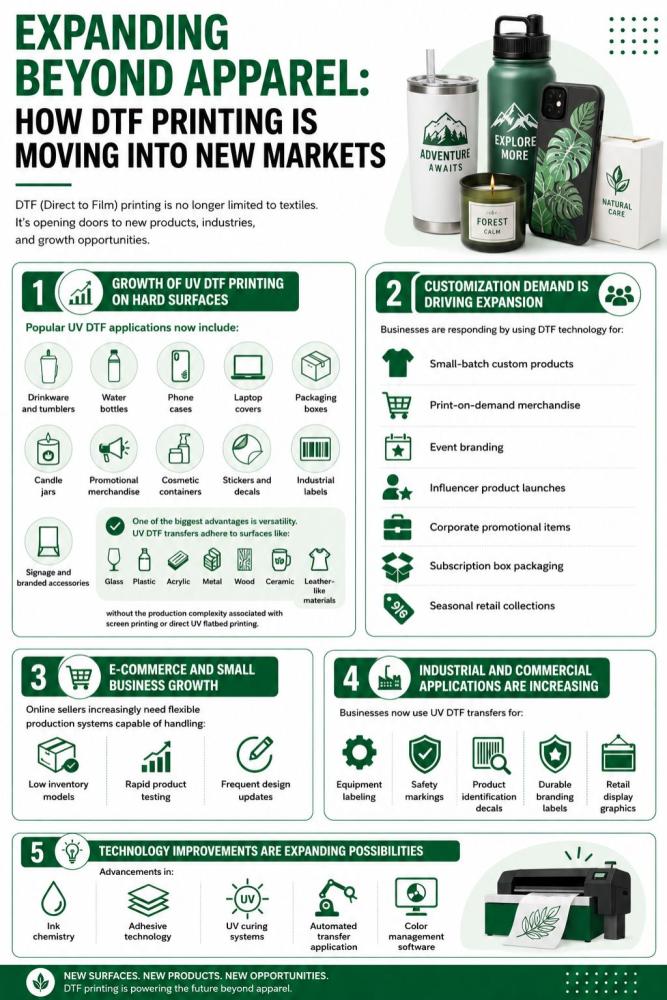
Expanding Beyond Apparel: How DTF Printing Is Moving Into New Markets
For years, T-shirts and hoodies dominated the direct-to-film industry. But the future of DTF printing is expanding far beyond apparel. With the rise of UV DTF technology and improvements in digital transfer systems, businesses can now apply vibrant, full-color graphics onto hard, curved, textured, and irregular surfaces with far fewer limitations than traditional printing methods.
This shift is becoming one of the biggest DTF printing trends 2026 is expected to accelerate. As customization demand grows across multiple industries, DTF printing is evolving from an apparel decoration method into a broader product personalization and branding solution.
Growth of UV DTF Printing on Hard Surfaces
Unlike traditional garment-focused DTF printing, UV DTF transfers allow designs to be applied directly onto hard goods without requiring heat presses or material-specific pretreatment. This opens entirely new commercial opportunities for businesses looking to diversify beyond apparel.
Popular UV DTF applications now include:
-
Drinkware and tumblers
-
Water bottles
-
Phone cases
-
Laptop covers
-
Packaging boxes
-
Candle jars
-
Promotional merchandise
-
Cosmetic containers
-
Stickers and decals
-
Industrial labels
-
Signage and branded accessories
One of the biggest advantages is versatility.
UV DTF transfers adhere to surfaces like:
-
Glass
-
Plastic
-
Acrylic
-
Metal
-
Wood
-
Ceramic
-
Leather-like materials
without the production complexity associated with screen printing or direct UV flatbed printing.
Customization Demand Is Driving Expansion
The personalization economy continues fueling major DTF printing market trends. Consumers increasingly expect customized products, limited-edition packaging, personalized gifts, and branded merchandise with fast turnaround times.
Businesses are responding by using DTF technology for:
-
Small-batch custom products
-
Print-on-demand merchandise
-
Event branding
-
Influencer product launches
-
Corporate promotional items
-
Subscription box packaging
-
Seasonal retail collections
Unlike traditional production methods that require expensive setup costs, DTF allows businesses to produce short runs profitably.
This flexibility makes it attractive for:
-
Etsy sellers
-
Shopify brands
-
Print-on-demand businesses
-
Local promotional companies
-
Corporate branding suppliers
E-Commerce and Small Business Growth
The expansion of e-commerce is another major driver behind DTF printing future trends.
Online sellers increasingly need flexible production systems capable of handling:
-
Low inventory models
-
Rapid product testing
-
Frequent design updates
-
Fast customization requests
DTF printing supports all of these requirements with relatively low setup costs and scalable workflows.
For small businesses, this creates opportunities to expand into:
-
Personalized drinkware
-
Wedding products
-
Home décor
-
Branded packaging
-
Custom office accessories
-
Personalized gifts
without investing in large-scale manufacturing infrastructure.
Industrial and Commercial Applications Are Increasing
Beyond consumer customization, DTF technology is also entering commercial and industrial sectors.
Businesses now use UV DTF transfers for:
-
Equipment labeling
-
Safety markings
-
Product identification decals
-
Durable branding labels
-
Retail display graphics
Because UV DTF transfers offer strong adhesion and durability on difficult surfaces, they are becoming an efficient alternative to traditional adhesive labeling systems in some industries.
Technology Improvements Are Expanding Possibilities
Advancements in:
-
Ink chemistry
-
Adhesive technology
-
UV curing systems
-
Automated transfer application
-
Color management software
are improving durability, print sharpness, and production speed. These innovations are helping DTF printing move into higher-value commercial markets where consistency and scalability matter.
As digital printing technology continues evolving, the future of DTF printing will likely include:
-
Greater automation
-
Faster production systems
-
Expanded material compatibility
-
More sustainable ink solutions
-
Higher-resolution transfer capabilities
The industry is no longer limited to apparel decoration alone. DTF printing is steadily transforming into a versatile manufacturing and customization technology serving multiple fast-growing industries.
Profitability & Business Landscape in the DTF Industry
One of the biggest reasons behind current DTF printing market trends is the relatively low barrier to entry compared to traditional apparel decoration methods. A complete starter setup for direct-to-film printing — including a printer, heat press, curing system, RIP software, and supplies — can often be launched with an investment near the $8,000–$15,000 range depending on production scale. This accessibility has attracted thousands of small businesses, apparel startups, Etsy sellers, and local print shops into the market.
However, as the industry becomes more competitive, profitability is no longer driven simply by owning a DTF printer. The real differentiator in 2026 is operational strategy. Successful businesses are focusing less on high-volume commodity printing and more on high-margin customization, workflow efficiency, and niche specialization.
Why Operational Efficiency Matters More Than Equipment
Many new businesses assume profitability comes from faster printers alone.
In reality, profitable shops optimize:
-
Gang sheet layouts
-
Ink consumption
-
Production batching
-
Material waste reduction
-
Color consistency
-
Turnaround speed
-
Automated workflows
Shops with strong process control often outperform competitors using more expensive equipment but weaker production systems. This operational shift is becoming one of the biggest Direct to film printing innovations shaping the industry.
Personalized, On-Demand Printing Is Driving Higher Margins
The most profitable segment of the market is increasingly:
-
Short-run customization
-
Print-on-demand apparel
-
Corporate merchandise
-
Event-based printing
-
Localized brand drops
-
Personalized products
Consumers now expect:
-
Fast fulfillment
-
Low minimum order quantities
-
Unique designs
-
Seasonal customization
-
Small-batch production
DTF printing fits this demand perfectly because it eliminates many setup limitations associated with screen printing. Businesses can profitably print one item or one hundred items without creating screens or large setup costs.
For commercial print shops managing these mid-to-large tier commercial runs, outsourcing the raw volume to dedicated bulk wholesale DTF printing hubs allows them to scale up operations seamlessly while keeping production margins exceptionally high.
Automation Is Becoming a Competitive Advantage
As the market matures, automation is becoming critical for long-term profitability.
Advanced print shops are investing in:
-
Auto powder shakers
-
Inline curing systems
-
Auto nesting software
-
Workflow automation tools
-
RIP color management systems
-
Barcode production tracking
These systems reduce labor costs, improve production consistency, and lower spoilage rates — all major contributors to improved margins.
Market Competition Is Increasing
The low entry barrier has also intensified competition. Many shops now compete heavily on price alone, creating margin pressure across the industry.
Businesses that survive long term are increasingly differentiating themselves through:
-
Better turnaround times
-
Premium print quality
-
Specialty fabrics
-
White-label fulfillment
-
Niche markets
-
Reliable customer service
DTF Market Growth and Outlook
Industry analysts continue projecting strong DTF market growth and outlook due to:
-
Expanding e-commerce demand
-
Growth in personalized apparel
-
Lower startup costs
-
Improvements in printer speed and automation
-
Rising demand for short-run production
But the next phase of industry growth will likely favor businesses that combine technology with efficient operations and strong brand positioning rather than competing solely on production volume. They can also increase their profit margins and reduce costs through outsourced DTF printing by avoiding the purchase and maintenance of dedicated equipment.
Conclusion
The future of DTF printing is being shaped by customization, automation, faster production systems, and expanding applications beyond apparel. As businesses continue shifting toward on-demand manufacturing and personalized products, DTF technology is becoming one of the most scalable and profitable digital printing solutions in the market.
From apparel decoration and UV DTF hard-surface applications to e-commerce fulfillment and short-run production, current DTF printing market trends show strong long-term growth potential. Businesses that invest in efficient workflows, high-quality production, and niche specialization will be better positioned to succeed as Direct to film printing innovations continue transforming the industry.
FAQs
What is the future of DTF printing?
The future of DTF printing is focused on automation, faster production, sustainable inks, UV DTF expansion, and personalized on-demand printing across multiple industries beyond apparel.
Why is the DTF printing market growing so quickly?
Growing demand for custom apparel, e-commerce fulfillment, low setup costs, and short-run production flexibility are major drivers behind current DTF printing market trends.
What industries use DTF printing besides apparel?
DTF and UV DTF printing are now widely used for drinkware, packaging, promotional products, labels, signage, phone cases, and custom hard-surface branding applications.
Are Direct to film printing innovations improving profitability?
Yes. Modern DTF systems improve workflow automation, reduce material waste, speed up production, and allow businesses to profit from low-volume personalized orders more efficiently.