


Direct to Film or DTF printing is everywhere in the USA right now. Print shops across the nation are talking about it. Apparel startups are experimenting with it. Even traditional screen printers are starting to pay attention. The reason is simple.
DTF removes many of the headaches that come with screen printing. No complex screen setups. No color limitations. No large minimum orders. You print the design, apply adhesive powder, press it on fabric, and it’s done. Fast. Flexible. Profitable for small runs.
Naturally, this raises a big question across the industry: will DTF eventually replace screen printing, or are both technologies built for different kinds of work? Let’s break it down.
A Quick Market Overview for DTF Printing
The Direct-to-Film (DTF) printing market is growing steadily as apparel businesses adopt faster, more flexible printing technologies.
-
In 2025, the global DTF printing market was valued at $2.92 billion and is projected to reach $3.92 billion by 2030, expanding at a 6% CAGR as per GrandViewResearch stats.
-
This growth is largely driven by rising demand for customized and on-demand apparel, especially t-shirts, which remain the dominant end product.
-
Dedicated DTF printers hold about 45% market share, showing strong industry adoption.
-
The market size of DTF printing in the USA stands at USD 300 million.
-
Increasing awareness of DTF’s cost efficiency, versatility, and ability to print on multiple fabrics continues to accelerate its global adoption.
What Is DTF Printing and How Does It Work?
Direct-to-Film (DTF) printing is a modern garment decoration method that allows designs to be printed on a special film and then transferred onto fabric using heat and pressure. Unlike traditional printing techniques, DTF works on cotton, polyester, blends, and even dark garments without a complicated setup. This flexibility is one of the reasons the DTF vs screen print transfer debate has become so popular among print shops and apparel brands.
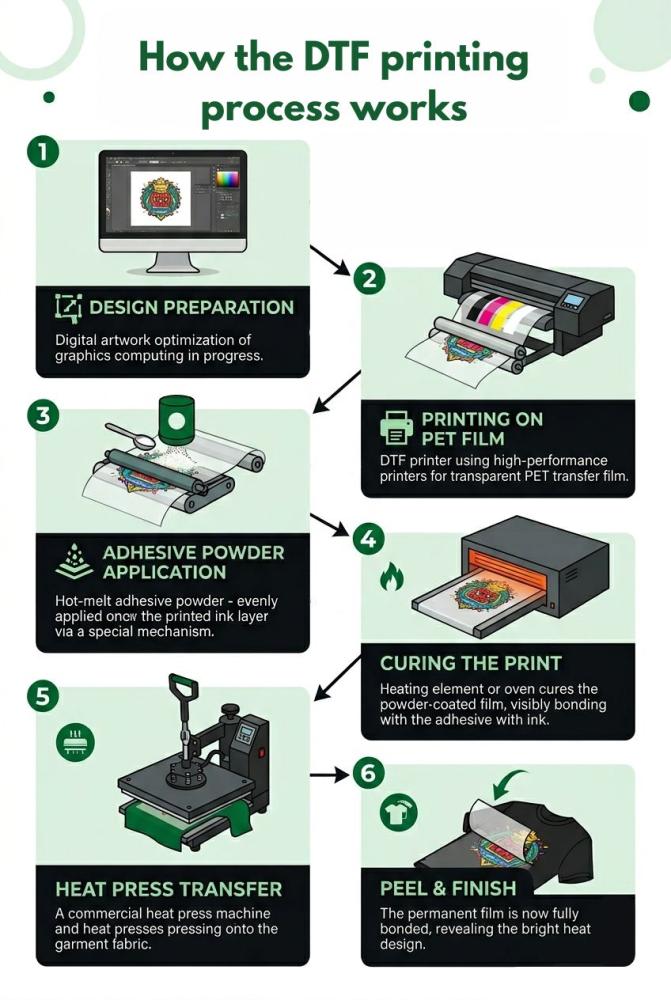
Here’s how the DTF printing process works:
-
Design Preparation: The artwork is prepared digitally using graphic software and optimized for printing.
-
Printing on PET Film: The design is printed onto a PET transfer film using a DTF printer with CMYK and white inks.
-
Adhesive Powder Application: A special hot-melt adhesive powder is applied to the printed ink layer.
-
Curing the Print: The powder-coated film is heated to cure the adhesive and bond it with the ink.
-
Heat Press Transfer: The film is pressed onto the garment using a heat press.
-
Peel & Finish: After cooling, the film is peeled off, leaving the design permanently bonded to the fabric.
Can DTF Replace Screen Printing?
The growing discussion around DTF vs screen printing reflects how rapidly the apparel decoration industry is evolving. While screen printing has dominated for decades, Direct-to-Film (DTF) printing offers a more flexible approach that aligns with the needs of modern print businesses.
One major advantage of direct to film printing is its simplified production process. Screen printing requires screen preparation, color separation, and longer setup times. DTF eliminates most of that complexity. Designs are printed onto transfer film and applied with a heat press, making production faster and easier—especially for custom or small-batch orders using custom DTF transfers.
Another reason the DTF vs screen printing comparison favors the direct to film method is its ability to handle detailed, multi-color artwork without additional setup costs. Screen printing becomes expensive as the number of colors increases, while DTF prints complex designs in a single pass.
Compared to other methods such as screen printing vs direct to garment, DTF also offers broader fabric compatibility and easier workflow.
Key advantages of DTF printing include:
-
Works on cotton, polyester, blends, and dark fabrics
-
Handles complex, multi-color designs without extra setup
-
Lower setup cost compared to screen printing
-
Faster turnaround for short runs and custom orders
-
Suitable for print-on-demand apparel businesses
Because of these benefits, many print shops are adopting DTF as a practical alternative to traditional garment printing methods.
Has Screen Printing Become Obsolete?
Short answer: No. It’s still relevant and many businesses are using it.
Screen printing is still a major force in the apparel industry. However, the landscape is changing. It may be replaced by new technologies like direct to film printing (DTF) in the future. They are shifting how many businesses approach garment printing.
First, let’s be clear about where screen printing still shines.
Screen printing remains powerful because:
-
It is extremely cost-effective for bulk orders
-
It produces very durable prints
-
It delivers a soft, embedded ink feel on fabric
-
It works well for simple designs with limited colors
Because of this, large production shops still rely on it heavily. However, there are limitations. And this is where newer methods enter the conversation.
Screen printing struggles when:
-
Orders are small or highly customized
-
Designs include many colors or gradients
-
Businesses need fast turnaround times
-
Customers want on-demand printing
As a result, many modern print shops are not abandoning screen printing. Instead, they are adapting.
The new reality? Hybrid workflows.
-
Screen printing for large runs
-
DTF for short runs and custom orders
So no. Screen printing isn’t obsolete. But the industry is definitely evolving.
A Quick Comparison of DTF vs Screen Printing
|
Feature |
DTF Printing |
Screen Printing |
|
Setup Time |
Very low |
High |
|
Best For |
Small runs & custom orders |
Bulk production |
|
Color Capability |
Unlimited colors |
Limited by number of screens |
|
Fabric Compatibility |
Works on most fabrics |
Works well but may require ink adjustments |
|
Setup Cost |
Low |
High |
|
Durability |
Good |
Excellent |
|
Print Feel |
Slightly thicker |
Softer feel |
The discussion around DTF vs screen print continues to grow as more apparel businesses explore modern printing technologies. Both methods have strong advantages. However, they are designed for different production needs, order sizes, and design complexities.
Understanding these differences helps businesses choose the right process for their printing workflow.
1. Setup Process
Setup plays a major role when comparing DTF vs screen printing because it directly affects production speed, labor requirements, and upfront costs. Businesses that frequently change designs or handle small orders often prefer faster setup processes that require minimal manual preparation.
DTF Printing Setup
-
Minimal preparation required
-
No screen creation or stencil preparation
-
Designs are printed directly onto PET film
-
Faster production start time
-
Ideal for businesses that handle frequent design changes
DTF printing eliminates much of the manual setup work that traditional printing methods require.
Screen Printing Setup
-
Requires creating a separate screen for each color
-
Involves design separation and stencil preparation
-
Setup time increases as design complexity grows
-
Cleaning and reclaiming screens is necessary after production
Because of this setup process, screen printing is typically less efficient for short runs or frequent design changes.
2. Printing Process
The actual printing workflow differs significantly between these two technologies. While screen printing relies on mechanical ink transfer through mesh screens, DTF printing uses a digital process involving transfer films, adhesive powder, and heat pressing to apply designs.
DTF Printing Process
-
Design is printed onto PET transfer film
-
Adhesive powder is applied to the ink
-
Film is cured using heat
-
Design is transferred onto the garment using a heat press
This workflow makes DTF highly adaptable for custom printing.
Screen Printing Process
-
Ink is pushed through a mesh screen onto the garment
-
Each color is applied using a separate screen
-
Garments must be cured after printing
While more complex, this process creates highly durable prints for large production runs.
3. Order Size Efficiency
Order volume strongly influences whether DTF vs screen print transfer is the better option. Some printing technologies are optimized for small, customized batches, while others become more cost-effective when producing large quantities of identical garments.
DTF Printing
DTF works best for:
-
Small batch orders
-
Custom apparel
-
Print-on-demand production
-
Personalized clothing
Because there are no screens to set up, printing one shirt or fifty shirts requires almost the same preparation.
Screen Printing
Screen printing performs best when producing:
-
Bulk apparel orders
-
Corporate uniforms
-
Sports team merchandise
-
Promotional merchandise
Once the screens are set up, printing hundreds or thousands of garments becomes extremely efficient.
Also read: Is Direct to Film Transfer Right for Small Apparel Businesses?
4. Color and Design Complexity
Design flexibility is another major factor when comparing these printing techniques. Some methods handle intricate graphics, gradients, and full-color artwork easily, while others perform better with simpler designs and limited color combinations.
DTF Printing
DTF allows printers to produce:
-
Complex graphics
-
Gradients
-
Photo-quality prints
-
Unlimited colors in a single design
Because the design is digitally printed, color complexity does not significantly affect production time.
Screen Printing
Screen printing works best for:
-
Simple graphics
-
Logos
-
Limited color designs
However, the process becomes more complicated as colors increase since each color requires its own screen.
5. Fabric Compatibility
Different printing methods interact with fabrics in different ways. Some technologies work well across cotton, polyester, blends, and specialty materials, while others may require specific inks, pretreatments, or adjustments depending on the garment type.
DTF Printing
DTF works well on many types of materials, including:
-
Cotton
-
Polyester
-
Cotton-poly blends
-
Fleece
-
Dark and light fabrics
This versatility makes it attractive for businesses that print on various garment types.
Screen Printing
Screen printing also works well on many fabrics but may require different ink types or adjustments depending on the material.
6. Durability and Print Feel
Print durability and garment comfort are important considerations for apparel brands. Buyers often evaluate how well prints survive repeated washing, how resistant they are to cracking or fading, and how soft they feel on fabric.
DTF Printing
DTF prints are:
-
Durable when applied correctly
-
Resistant to cracking and peeling
-
Capable of lasting through multiple washes
However, the print can sometimes feel slightly thicker on the garment compared to traditional screen printing.
Screen Printing
Screen printing is widely known for:
-
Extremely durable prints
-
Soft ink feel when properly cured
-
Long-lasting designs even after many washes
For high-volume merchandise and premium apparel, screen printing still holds a strong reputation.
7. Cost Efficiency
Cost efficiency depends heavily on production scale and operational workflow. While some printing methods offer lower setup costs for small jobs, others provide better per-unit pricing when producing large batches of apparel. You can leverage gang sheet printing with direct to film to reduce cost per print and arrange multiple designs on a single sheet.
DTF Printing Costs
DTF is more cost-effective for:
-
Small runs
-
On-demand production
-
Frequent design changes
Since no screens are required, businesses save time and setup costs.
Screen Printing Costs
Screen printing becomes cheaper when:
-
Producing large quantities
-
Printing simple designs
-
Running repeat orders
The initial setup cost is higher, but the per-unit cost drops significantly with volume.
Cost Analysis of DTF vs Screen Printing
When comparing DTF vs screen print, cost often becomes a key deciding factor for apparel businesses. DTF printing typically offers better cost efficiency for small orders, custom designs, and print-on-demand operations.
DTF requires minimal setup since it does not involve screen creation, stencil preparation, or complex color separation. This reduces labor time and allows businesses to start production quickly while easily handling frequent design changes.
Screen printing, however, requires separate screens for each color in the design, increasing initial setup costs. Because of this, small orders become expensive. Yet once the setup is complete, screen printing becomes more economical for large production runs.
Overall, DTF vs screen print comparisons show DTF works best for short runs and customization, while screen printing remains more cost-effective for bulk manufacturing.
|
Cost Factor |
DTF Printing |
Screen Printing |
|
Setup Cost |
Low |
High |
|
Cost for Small Orders |
Lower |
Higher |
|
Cost for Large Orders |
Moderate |
Lower |
|
Design Change Cost |
Minimal |
Higher |
|
Labor Cost |
Lower |
Higher |
Which Is More Profitable: DTF or Screen Printing?
Profitability in the DTF vs screen print debate depends largely on order size, setup cost, and production scale. Each method can be profitable, but under different business conditions.
For DTF printing, startup and setup costs are lower. A typical DTF print may cost around $2–$3 per shirt (ink, film, powder). If a custom t-shirt sells for $15–$20, the profit margin can reach $12–$15 per shirt on small orders.
Example:
If a business prints 20 custom shirts using DTF:
-
Production cost: $3 × 20 = $60
-
Selling price: $18 × 20 = $360
-
Profit: $300
Screen printing becomes more profitable in large batches because setup costs are spread across many units. A setup might cost $50–$100, but the per-shirt cost can drop to $1–$2 in bulk.
Example:
For 200 shirts with screen printing:
-
Setup + production cost ≈ $400
-
Selling price: $15 × 200 = $3000
-
Profit: $2600
In short, DTF is more profitable for small custom orders, while screen printing generates higher profits for large-volume production.
Conclusion
The DTF vs screen print debate isn’t about one technology completely replacing the other. Instead, it reflects how the custom apparel industry is evolving. DTF printing is gaining momentum because it offers faster setup, easier customization, and flexibility for small to medium orders.
Screen printing, however, still holds strong for large-scale production where cost efficiency improves with volume. For new apparel businesses and print-on-demand models, DTF often provides a faster path to profitability. Established print shops, on the other hand, may benefit from using both technologies depending on order size, design complexity, and production requirements.
FAQs
1. Is DTF better than screen printing?
DTF is better for small orders, complex designs, and quick turnaround, while screen printing works best for large bulk production.
2. Will DTF replace screen printing completely?
No, DTF is growing rapidly but screen printing remains essential for high-volume apparel production.
3. Is DTF printing profitable for small businesses?
Yes, DTF printing requires lower setup costs and is profitable for custom and short-run orders.
4. What fabrics work best with DTF printing?
DTF works well on cotton, polyester, blends, and even dark fabrics without requiring a complex setup.
5. Is screen printing more durable than DTF?
Both methods can be durable when done correctly, though screen printing is traditionally known for long-lasting prints.
6. Which printing method is best for starting a custom apparel business?
Many startups prefer DTF because of lower startup costs, faster setup, and flexibility for custom orders.
7. When to use DTF instead of screen printing?
Use DTF for small orders, complex multi-color designs, and when you need faster setup without creating screens.
8. Which is better screen printing vs DTF durability?
Screen printing is traditionally known for slightly longer durability, but modern DTF prints also last well with proper curing and washing.
9. Is DTF printing for small batch orders more profitable than screen printing?
Yes, DTF is usually more profitable for small batches because it eliminates screen setup costs and reduces labor.
10. What are DTF printing advantages over screen printing?
DTF offers faster setup, easier customization, full-color printing, and compatibility with multiple fabrics including cotton and polyester.
11. Which is more cost effective between DTF vs screen printing for t-shirts?
DTF is more cost-effective for small runs, while screen printing becomes cheaper for large bulk t-shirt orders.