


Starting or growing a custom apparel brand comes with one major question: which printing method gives you the best balance of quality, cost, and scalability? In recent years, DTF has become a trending topic due to its versatile and innovative printing. With its ability to print vibrant, full-color designs on multiple fabrics, direct to film transfer technology is transforming how small brands operate.
But is DTF printing truly the right fit for small apparel businesses? Or is it better suited for large-scale production houses? This is what we are going to ponder upon in this blog. Understanding whether DTF for small businesses is the right choice or not will help you pick the best technology for your business.
In this in-depth guide, we’ll explore how direct to film printing works, its benefits and limitations, startup requirements, cost considerations, and whether investing in a DTF transfer system makes sense for your business model.
Understanding What Direct to Film Transfer Really Is
Before deciding whether DTF for small business is a smart move, it’s important to understand the process.
Direct to film transfer is a digital printing method where designs are printed onto a special PET film using pigment-based inks.
After printing:
-
Adhesive powder is applied to the wet ink.
-
The design is cured using heat.
-
The cured film is heat pressed onto the garment.
-
The film is peeled away, leaving the printed design on fabric.
Unlike vinyl, there’s no cutting or weeding. Unlike DTG (Direct-to-Garment), fabric pre-treatment is not required in most cases. This makes DTF printing a versatile hybrid between traditional and modern garment printing techniques.
Why DTF Is Gaining Popularity Among Small Brands
The growing interest in DTF for small businesses is not accidental.
Small apparel brands need:
-
Low minimum order quantities
-
Fast turnaround times
-
High design flexibility
-
Affordable scalability
Direct to film printing checks many of these boxes.
Because DTF allows full-color printing without increasing production complexity, small brands can offer custom designs, limited editions, and print-on-demand services without dramatically raising labor costs.
Key Benefits of DTF for Small Businesses
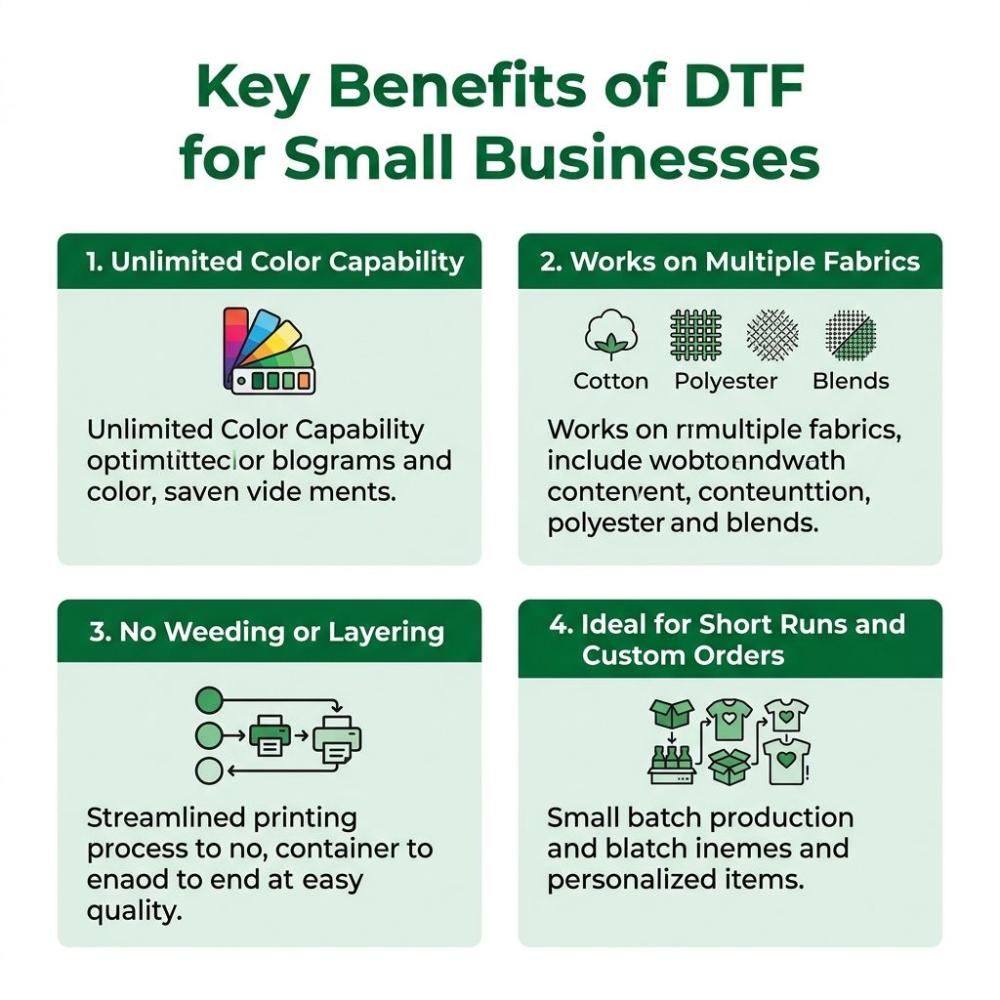
1. Unlimited Color Capability
One of the biggest advantages of DTF transfer technology is that design complexity does not increase production steps. Whether your artwork uses two colors or twenty, the process remains the same.
For small brands competing on creativity, this is a huge benefit. They can print innovative designs with the same process instead of investing in more equipment. This saves time and effort for small businesses, which is a huge cost benefit.
2. Works on Multiple Fabrics
Direct to film transfer adheres well to cotton, polyester, blends, nylon, and performance fabrics. This allows small businesses to expand product offerings without switching printing methods.
Your small business can use DTF to print:
-
T-shirts
-
Hoodies
-
Tote bags
-
Caps
-
Sportswear
This versatility with direct to film transfer reduces operational friction. You need not invest in other printing methods or equipment that saves cost and time. The existing setup can work for different apparel without any issues or adjustments.
3. No Weeding or Layering
Unlike vinyl printing, DTF printing eliminates the need for manual weeding, which is often one of the most time-consuming steps in traditional heat transfer methods.
By removing this labor-intensive process, production becomes faster and more streamlined. For small teams or solo entrepreneurs, this means reduced hands-on effort, quicker turnaround times, improved workflow efficiency, and fewer operational bottlenecks during busy order cycles.
4. Ideal for Short Runs and Custom Orders
Small apparel businesses often deal with low-volume orders. DTF handles short runs efficiently without setup changes.
If you don’t want to invest in equipment, you can order custom DTF transfers and simply heat press them in-house. This lowers entry barriers while maintaining professional quality.
Startup Requirements for DTF Printing
While DTF for small business offers many advantages, it does require proper setup.
Basic Equipment Needed:
-
DTF printer (with white ink system)
-
PET transfer film
-
DTF inks
-
Adhesive powder
-
Curing oven or heat press
-
RIP software
The initial investment can range from moderate to high depending on printer quality.
However, small brands can reduce upfront cost by purchasing bulk DTF transfers from suppliers instead of investing in full in-house production.
Cost Considerations: Is It Affordable?
When evaluating DTF for small businesses, cost is often the deciding factor.
Initial Investment
-
Entry-level DTF setup: $3,000–$10,000+
-
Heat press (if outsourcing transfers): $300–$800
Ongoing Costs
-
Film
-
Ink
-
Powder
-
Maintenance
-
Electricity
-
Labor
However, DTF becomes cost-efficient when:
-
Printing multi-color designs
-
Producing medium to large batches
-
Using gang sheet printing to maximize film usage
Gang sheet printing allows multiple designs to be arranged on one film sheet, reducing waste and lowering the cost per print. Small businesses using DTF can order custom transfers and print t-shirts, hoodies, or other apparel without taking the headache of buying and maintaining printers and other equipment.
Comparing DTF to Other Methods for Small Apparel Businesses
For small apparel brands, choosing the right printing method directly affects profit margins, production speed, and growth potential. When comparing DTF to other methods, its long-term advantages become clear.
DTF vs Vinyl
Vinyl printing is attractive for startups because it has a lower initial investment. However, from a small business perspective, vinyl quickly becomes labor-intensive as design complexity increases. Multi-color artwork requires layering and manual weeding, which slows production and increases labor costs.
DTF, while requiring more equipment upfront, eliminates weeding and handles full-color designs without additional steps. This allows small businesses to produce complex prints faster and with greater consistency. As order volumes grow, DTF supports smoother scaling with less manual bottleneck compared to vinyl.
DTF vs DTG
DTG (Direct-to-Garment) printing works well on cotton but requires garment pre-treatment and performs best on specific fabrics. This limits flexibility for brands offering diverse apparel lines.
Direct to film printing, on the other hand, works on cotton, polyester, blends, and performance fabrics without pre-treatment in most cases. This gives small businesses the freedom to expand product offerings without changing processes.
For growing apparel brands, DTF outperforms traditional methods by combining flexibility, efficiency, and scalability in one streamlined solution.
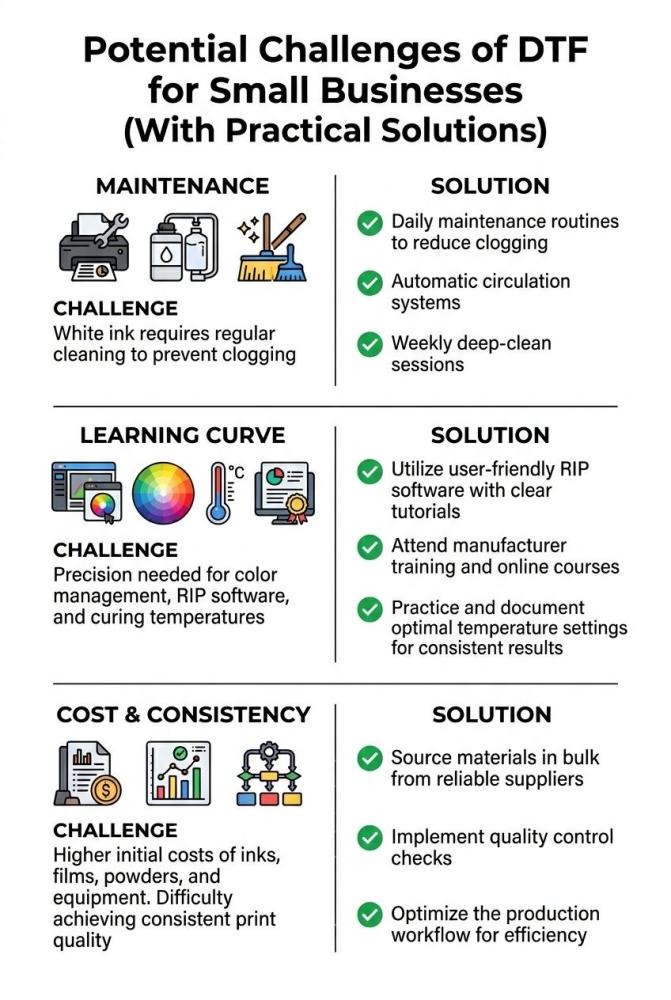
Potential Challenges of DTF for Small Businesses (With Practical Solutions)
Despite its advantages, DTF printing is not perfect. While DTF for small businesses offers scalability and flexibility, it does come with certain operational challenges. The good news is that each issue has a manageable solution.
1. Maintenance
Challenge:
White ink systems require regular cleaning to prevent clogging and inconsistent prints.
Solution:
Implement a daily maintenance routine and use automatic white ink circulation systems. Scheduling short weekly deep-clean sessions can prevent costly printhead damage and reduce downtime.
2. Learning Curve
Challenge:
Color management, RIP software settings, and curing temperatures must be precise to ensure durability and color accuracy.
Solution:
Invest time in proper training, use manufacturer-recommended profiles, and start with test prints to fine-tune settings. Many suppliers also provide technical support and setup guidance to reduce errors early on.
3. Space Requirements
Challenge:
DTF setup requires dedicated workspace for printing, powder application, curing, and heat pressing.
Solution:
Optimize layout with compact equipment and vertical shelving. Small businesses can also start by outsourcing transfers and only maintaining a heat press until scaling justifies a full in-house setup.
Small businesses must evaluate whether they have the capacity to manage technical maintenance, but with structured processes and gradual scaling, these challenges are completely manageable.
Who Should Invest in DTF?
DTF for small business is ideal if you:
-
Offer full-color designs regularly
-
Plan to scale production
-
Sell online with custom designs
-
Want fabric flexibility
-
Produce small to mid-size batches
It may not be necessary if:
-
You only print simple one-color logos
-
You produce very low order volumes
-
You want minimal equipment responsibility
Outsourcing vs In-House DTF
Many small apparel brands begin by outsourcing. Ordering custom DTF transfers allows you to:
-
Avoid printer investment
-
Eliminate maintenance
-
Focus on marketing and sales
As order volume grows, transitioning to in-house direct to film printing can increase margins.
Profit Potential for Small Apparel Brands
Because DTF allows high-detail prints with professional finish, businesses can price products competitively.
Example:
-
Average DTF transfer cost per shirt: $2–$5
-
Blank garment: $3–$7
-
Retail selling price: $20–$35
With efficient workflow and smart sourcing (like bulk DTF transfers), profit margins can remain strong even at smaller volumes.
Long-Term Scalability
The biggest advantage of DTF for small business is scalability.
As your brand grows:
-
Production remains consistent
-
Design complexity does not slow output
-
Multi-fabric expansion is simple
Using techniques like gang sheet printing further reduces cost per unit, supporting higher margins.
DTF bridges the gap between startup flexibility and production-level performance.
Is DTF the Future for Small Apparel Brands?
The apparel industry is moving toward:
-
Customization
-
Short-run production
-
Print-on-demand models
-
Multi-fabric compatibility
Direct to film transfer aligns perfectly with these trends.
For small businesses competing with larger brands, the ability to produce vibrant, durable designs without excessive labor offers a competitive edge.
Final Verdict: Is DTF Right for You?
So, is DTF for small business the right choice? If your brand values:
-
Creative flexibility
-
Multi-color design capability
-
Scalability
-
Professional finish
-
Fabric versatility
Then yes — direct to film printing can be a powerful investment.
However, success depends on:
-
Proper equipment setup
-
Quality materials
-
Consistent maintenance
-
Smart cost management
For many small apparel brands, starting with outsourced DTF transfer solutions and gradually moving in-house is the safest growth strategy.
In today’s competitive custom apparel market, DTF printing offers the balance of creativity, efficiency, and scalability that small businesses need to grow confidently.
The real question isn’t whether DTF works — it’s whether your business is ready to leverage its full potential.
FAQs
1. Is DTF for small business a good investment?
Yes, DTF is ideal for small businesses needing full-color flexibility and scalable production.
2. How much does it cost to start DTF printing?
A basic in-house DTF setup typically ranges from $3,000 to $10,000 or more.
3. Can I start without buying a DTF printer?
Yes, you can order custom DTF transfers and apply them using a heat press.
4. Does direct to film transfer work on all fabrics?
DTF works on cotton, polyester, blends, and many performance fabrics.
5. Is DTF printing better than vinyl for small brands?
DTF is better for complex, multi-color designs, while vinyl is cheaper for simple prints.