
August 25, 2026 · Connor McDonnell
Design Event T-Shirts with High-Quality DTF Transfers
Event T-shirts do more than identify participants—they create a shared sense of belonging, promote your event, and give attendees something memorable to take home. Whether you're organizing a charity run, corporate conference, school fundraiser, sports tournament, festival, or family reunion, the right apparel can make your event feel more professional and engaging.
For organizers looking for vibrant, detailed designs without investing in specialized printing equipment, event t-shirt printing with Direct-to-Film (DTF) transfers is a flexible option. DTF transfers can reproduce colorful graphics, logos, illustrations, and detailed artwork on a wide range of garments.
The key to getting professional results isn't simply choosing DTF. Your artwork, shirt selection, transfer size, placement, pressing process, and order quantity all matter.
Here's how to design and produce high-quality custom event T-shirts using DTF transfers.
Why DTF Transfers Are a Smart Choice for Event T-Shirt Printing
DTF printing has become a popular solution for custom apparel because it combines design flexibility with a relatively straightforward application process. Instead of printing directly onto the garment, the artwork is printed onto a special film, coated with adhesive powder, cured, and then transferred onto the shirt using a heat press.
Vibrant, Full-Color Event Graphics
One of the biggest advantages of DTF is its ability to reproduce detailed, full-color artwork. Your event shirt can include gradients, illustrations, multiple colors, logos, photographs, and intricate graphics.
This makes DTF especially useful when your design goes beyond a simple one-color logo.
For example, a charity event could feature an illustrated mascot, event name, sponsor logos, and a colorful background without requiring separate screens for each color.
DTF also uses a white underbase when appropriate, helping colors remain vibrant on dark garments.
Flexible for Small and Large Events
Not every event needs hundreds or thousands of identical shirts. You may need 25 shirts for a family reunion, 75 for a community fundraiser, or several hundred for a large tournament.
DTF offers flexibility for different quantities and designs. You can also create multiple designs or sizes depending on the needs of your event.
This flexibility is particularly useful when you want staff shirts, participant shirts, volunteer shirts, and promotional apparel with slightly different graphics.
Works Across Different Garment Types
DTF transfers can work with many commonly used apparel materials, including cotton, polyester, and blends, provided the transfer and pressing instructions are suitable for the garment.
That gives event organizers more freedom when choosing shirts based on comfort, appearance, performance, or budget.
For example, a summer charity run might benefit from lightweight performance shirts, while a fall festival could use heavier cotton T-shirts.
Professional Results Without Owning a DTF Printer
You don't necessarily need to purchase a DTF printer to use DTF for your event apparel.
Instead, you can order ready-to-press transfers and apply them using a heat press. This approach can reduce equipment requirements while giving you control over the final garment.
For organizers producing shirts themselves, DTF transfers for T-shirts can be a convenient way to turn finished artwork into wearable event merchandise.
Once you've decided that DTF is right for your project, the next step is creating artwork that will translate well onto a shirt.
How to Design Custom Event T-Shirts for DTF Printing
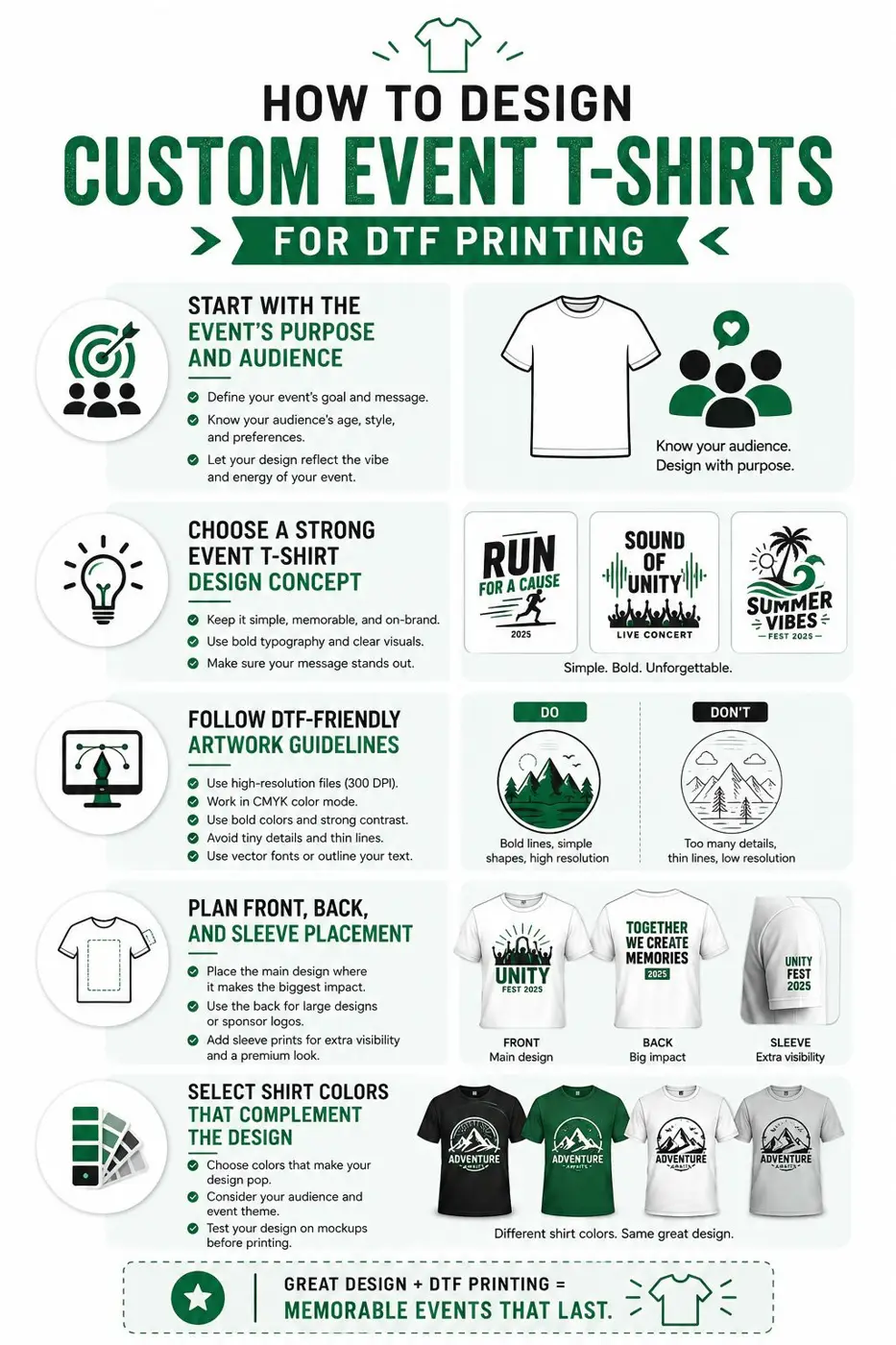
A successful event shirt starts with a strong concept. Before worrying about file formats or pressing temperatures, determine what the shirt should communicate.
Start With the Event's Purpose and Audience
Think about who will wear the shirt and why.
A corporate conference may benefit from a clean, professional design. A school spirit event could use bold colors and a mascot. A charity run might feature an energetic illustration and the event's cause.
Consider these common event types:
-
Corporate conferences
-
School and college events
-
Charity runs and fundraisers
-
Sports tournaments
-
Festivals
-
Family reunions
-
Community events
-
Product launches
Your design should feel appropriate for the occasion while remaining wearable after the event.
Choose a Strong Event T-Shirt Design Concept
A good event shirt doesn't need to contain every piece of information about the event.
Start with the most important elements, such as:
-
Event name
-
Logo or mascot
-
Date
-
Location
-
Theme or slogan
-
Sponsor logos
-
Relevant graphics
If you're designing a shirt for a charity run, for instance, the front could feature a bold event logo while the back includes sponsors and the event date.
Avoid turning the shirt into a poster. Too much text and too many graphics can make the design difficult to understand from a distance.
Follow DTF-Friendly Artwork Guidelines
For professional-looking DTF printing for T-shirts, prepare your artwork carefully before submitting it.
A good starting point is approximately 300 DPI at the intended print size. Use a transparent background when appropriate, especially when you don't want a rectangular block surrounding your design.
Clean edges, readable typography, and sufficient detail are also important.
Before submitting artwork, check:
-
Resolution
-
Dimensions
-
Transparency
-
Spelling
-
Logo accuracy
-
Color selection
-
Intended print size
-
Background requirements
It's also smart to view the artwork against the actual shirt color. A design that looks excellent on a white computer screen may not have enough contrast on a navy, black, or dark green garment.
Plan Front, Back, and Sleeve Placement
Placement can dramatically affect the final appearance of your event apparel.
Common options include:
-
Left-chest logo
-
Full-front graphic
-
Full-back event design
-
Sleeve logo
-
Front-and-back combination
-
Small neck or upper-back design
For detailed guidance on sizing and positioning, use a DTF transfer placement guide before finalizing your artwork.
Think about how the shirt will look when worn rather than simply how the artwork looks on your computer.
Select Shirt Colors That Complement the Design
Your garment color should support your design rather than compete with it.
Bright artwork often looks excellent on black, navy, or other dark shirts, while darker artwork may work better on lighter garments.
If your organization has established brand colors, use them consistently while making sure there's enough contrast between the design and shirt.
Once your artwork is ready, you can move on to creating the actual transfers.
How to Use Custom DTF Transfers for Event T-Shirts
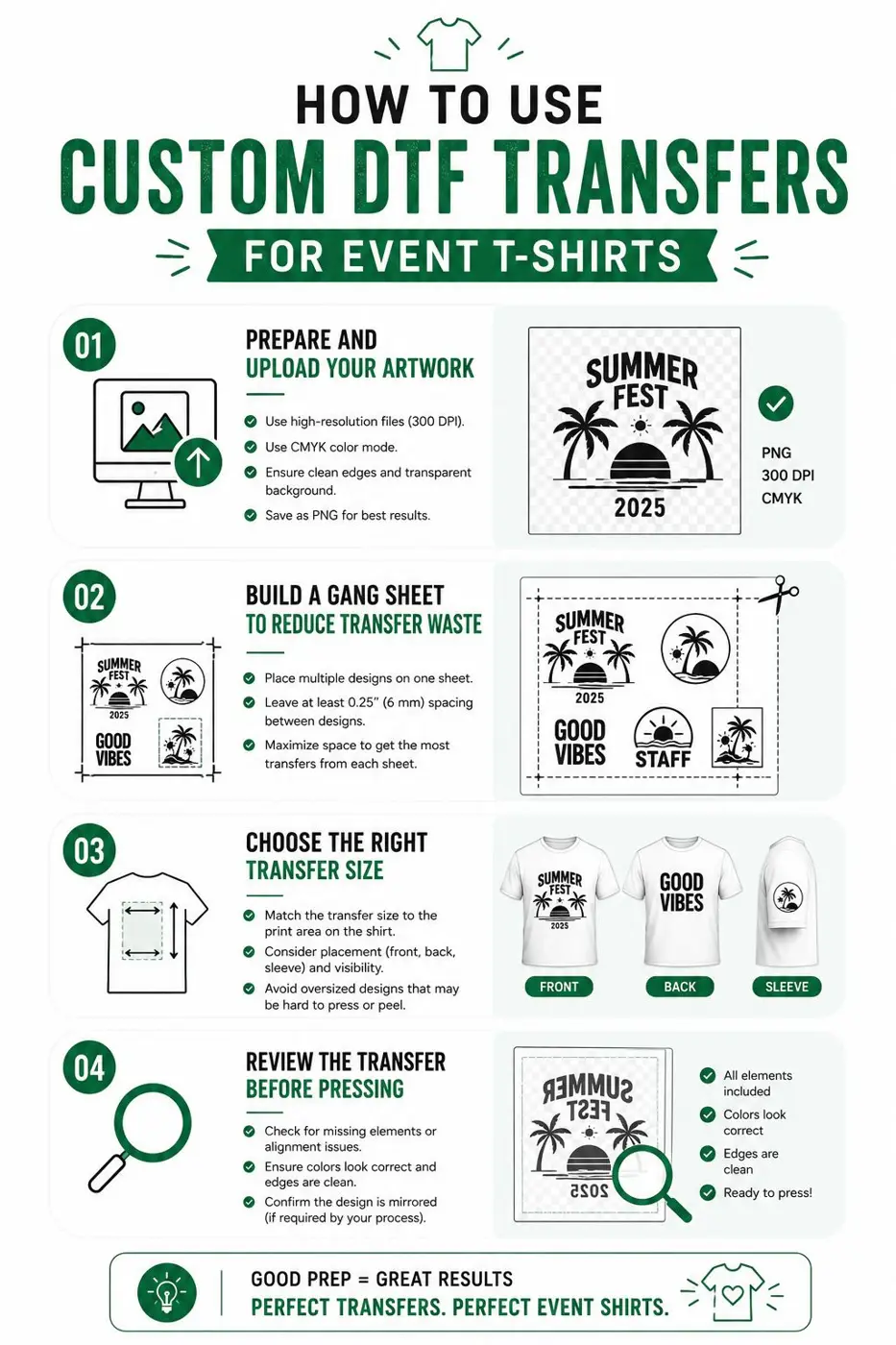
Once your design is finalized, the transfer-production process becomes much easier when you prepare your files and quantities carefully.
Prepare and Upload Your Artwork
Before ordering, double-check every detail.
A misspelled event name or incorrect date can turn into an expensive mistake when you're ordering shirts for an entire event.
Review:
-
Event name
-
Dates
-
Locations
-
Sponsor names
-
Logos
-
Design dimensions
-
Colors
-
Placement requirements
If the event is especially important or you're producing a large quantity, consider testing the design on one garment before completing the entire order.
You can explore custom DTF transfers when you need professionally produced transfers based on your own artwork.
Build a Gang Sheet to Reduce Transfer Waste
A gang sheet allows multiple designs or copies of a design to be arranged on a single sheet of transfer film.
This can be particularly useful for event apparel.
For example, you might place:
-
Small chest logos
-
Large back graphics
-
Sleeve logos
-
Multiple size variations
-
Sponsor logos
Instead of ordering each graphic separately, you can organize them efficiently on one sheet.
This can help make better use of transfer material and simplify production.
For projects involving multiple graphics, gang sheet printing is worth considering before placing your transfer order.
Choose the Right Transfer Size
The correct size depends on the garment and placement.
A small logo might work well on the left chest, while a detailed event illustration may need a larger full-front or back placement.
Avoid making graphics unnecessarily large. Oversized transfers can affect comfort and may make the shirt feel less balanced.
Likewise, graphics that are too small may become difficult to read.
Review the Transfer Before Pressing
Before applying your transfers, check the artwork one more time.
Look for:
-
Incorrect colors
-
Missing details
-
Wrong dimensions
-
Artwork orientation
-
Damaged film
-
Incorrect quantity
A few minutes of quality control can prevent dozens or hundreds of incorrect event shirts.
Pressing DTF Printing for T-Shirts: From Transfer to Finished Garment
Once you have your transfers and shirts, the heat-press stage turns the artwork into finished apparel.
Gather the Right Equipment
You'll generally need:
-
Heat press
-
DTF transfer
-
Compatible garment
-
Protective covering as recommended
-
Clean, flat pressing surface
The quality of the heat press matters because consistent temperature and pressure help produce reliable results.
Pre-Press the Shirt
Place the garment flat and pre-press it according to the recommended process.
This helps remove wrinkles and excess moisture while creating a smoother surface for the transfer.
Make sure the garment is positioned correctly before placing the transfer.
Apply the DTF Transfer
Position the transfer film according to your planned placement.
A typical DTF application may use a temperature around 305–310°F for approximately 10–15 seconds with medium-to-firm pressure, but the correct settings can vary depending on the transfer supplier, film, adhesive, and garment.
Always follow the supplier's specific instructions when they differ from general guidelines.
Peel and Finish the Transfer
Peeling instructions depend on the transfer film. Some transfers require cold peeling, while others can be peeled warm.
After peeling, a short finishing press may be recommended to improve the final result.
Do not guess at the peeling method. Follow the instructions supplied with your particular transfer.
For additional background on how the technology works, a Direct-to-Film transfers guide can help explain the overall process.
Test Before Producing the Full Order
A sample press is especially valuable for large events.
Check:
-
Transfer adhesion
-
Color appearance
-
Placement
-
Shirt compatibility
-
Overall design size
-
Wash and wear expectations
If something isn't right, you can correct it before pressing the rest of your order.
How to Plan Custom Shirts for Events Without Overordering
Ordering too few shirts can leave attendees disappointed. Ordering too many can leave you with unnecessary inventory.
The goal is to estimate demand realistically.
Estimate Quantities by Size
If attendees register in advance, use their requested sizes as your starting point.
For events without pre-registration, review previous attendance and order patterns when available.
You may also want a small buffer for:
-
Staff
-
Volunteers
-
Late registrations
-
Replacements
-
Unexpected attendees
Separate Staff, Participants, and Promotional Shirts
You don't necessarily need one identical design for everyone.
Staff members could wear a different shirt color or back design. Volunteers could have a distinct logo. Participants could receive the main event shirt.
This makes it easier to identify different groups while keeping the overall branding consistent.
Consider Bulk and Wholesale DTF Printing
Larger events may benefit from ordering transfers in bulk. Consistent production can simplify the process when hundreds of garments need the same or related designs.
Wholesale DTF printing can also be useful for print shops, apparel businesses, and organizations that regularly produce event merchandise.
The important considerations are consistency, turnaround time, quality control, and the ability to handle your required volume.
Common Mistakes to Avoid When Designing Event T-Shirts
Even a good idea can produce disappointing apparel if a few basic details are overlooked.
Using Low-Resolution Artwork
Low-resolution files can result in blurry or pixelated graphics.
Prepare artwork at an appropriate resolution and at the intended print size whenever possible.
Ignoring Shirt and Design Contrast
A dark design on a dark shirt may become difficult to see.
Before ordering, preview the design on the actual garment color and check whether important text and graphics remain readable.
Making the Design Too Complicated
More design elements don't necessarily mean a better shirt.
Too many fonts, colors, logos, and text blocks can make the design look cluttered.
A strong focal point is usually more effective.
Choosing the Wrong Transfer Size or Placement
A professionally printed transfer can still look wrong if it's positioned incorrectly.
Use established placement guidelines and measure the garment before pressing.
Skipping a Test Press
This is one of the easiest mistakes to prevent.
A test shirt gives you an opportunity to identify issues before committing to a large production run.
Using Incorrect Heat Press Settings
Temperature, pressure, and pressing time all influence transfer performance.
Don't automatically use one setting for every garment. Follow the transfer supplier's recommendations and account for the material you're pressing.
Event T-Shirt Design Ideas for Different Occasions
Need inspiration? Start with the purpose of your event.
Corporate Events and Conferences
Try a minimalist approach featuring the company logo, event name, year, and location.
A clean design is more likely to become everyday apparel after the conference.
Charity Runs and Fundraisers
Use energetic graphics, bold typography, and cause-related imagery.
You can place the main event graphic on the front and sponsor logos on the back.
Sports Events and Tournaments
Mascots, team colors, numbers, tournament dates, and athletic graphics can create a strong visual identity.
Consider separate designs for players, coaches, and spectators.
School and College Events
School colors, mascots, graduation years, and spirit-inspired artwork can turn event shirts into keepsakes.
DTF is particularly useful when your design includes multiple colors or detailed illustrations.
Festivals, Reunions, and Community Events
These events offer more creative freedom.
Try retro typography, illustrated graphics, local references, or a memorable slogan that participants will enjoy wearing after the event.
Should You Make Event T-Shirts Yourself or Order DTF Transfers?
There isn't one right production method for every event.
|
Option |
Best For |
Main Advantage |
|
DIY DTF transfers |
Small batches and hands-on projects |
Greater production control |
|
Ready-to-press DTF transfers |
Organizers with a heat press |
Simple application |
|
Bulk DTF printing |
Larger events |
Production efficiency |
|
Full-service printing |
Organizers who don't want to press shirts |
Less hands-on work |
If you already have a heat press and want control over production, ready-to-press transfers can be a practical choice.
If you're managing hundreds of shirts and don't have the necessary equipment or labor, working with a professional printing provider may be more convenient.
Print shops can also outsource transfer production rather than investing in a complete DTF printing setup.
For businesses that regularly handle event apparel, DTF transfers for print shops can provide another way to expand production capacity.
How to Get Better Results From Custom Event T-Shirts
High-quality event apparel starts with more than good printing. The entire process matters.
Keep Branding Consistent
Use approved logos, brand colors, and typography throughout your event materials.
Your shirt should feel like part of the larger event identity.
Prioritize Wearability
Choose comfortable garments that people will actually want to wear.
If the shirt is comfortable and the design looks good, attendees are more likely to continue wearing it after the event.
Order Early
Don't wait until the week before your event.
Give yourself enough time for:
-
Artwork creation
-
Artwork review
-
Transfer production
-
Sample pressing
-
Full production
-
Quality control
-
Packaging and distribution
A little planning can eliminate a lot of last-minute stress.
Work With a Reliable DTF Transfer Supplier
If you're outsourcing transfer production, look for a provider that can offer:
-
Consistent print quality
-
Clear artwork requirements
-
Reliable turnaround
-
Bulk-order capabilities
-
Quality control
-
Responsive support
For print shops and apparel businesses managing recurring orders, white-label production services can also help expand capacity while keeping fulfillment under your own brand.
Create Better Event T-Shirts With Custom DTF Transfers
Great event apparel starts with a thoughtful design and ends with careful production. From choosing the right shirt and preparing high-resolution artwork to selecting transfer sizes, planning gang sheets, and using the correct heat-press settings, every stage can influence the final result.
Event t-shirt printing with DTF transfers gives organizers a flexible way to create vibrant, detailed apparel for conferences, charity events, sports tournaments, school activities, festivals, reunions, and more.
If you're producing shirts yourself, ready-to-press custom DTF transfers can simplify the process. For larger orders, gang sheets and wholesale production can make the workflow more efficient.
The most important step is to plan before you press: finalize your artwork, test the design, confirm garment compatibility, and work with a reliable transfer supplier. With the right preparation, your custom event shirts can look professional, feel comfortable, and become something attendees are happy to wear long after the event ends.
Frequently Asked Questions About Event T-Shirt Printing
What is the best printing method for custom event T-shirts?
The best method depends on the design, quantity, garment, and budget. DTF is a strong option for detailed, colorful graphics and flexible quantities. Screen printing can be cost-effective for large orders with simple designs, while sublimation is useful for suitable polyester garments.
Are DTF transfers good for custom event shirts?
Yes. DTF transfers are well suited to event apparel because they can reproduce detailed, full-color graphics and can be applied to many commonly used garment types when the transfer and pressing process are compatible.
What resolution should an event T-shirt design be?
A common recommendation is 300 DPI at the intended print size. Always check the transfer supplier's specific artwork requirements before submitting your file.
Can DTF transfers be used on dark T-shirts?
Yes. DTF can be used on dark garments, with a white underbase helping preserve the vibrancy of the printed colors.
Can I put multiple event designs on one DTF gang sheet?
Yes. Multiple graphics, sizes, and logos can be arranged on a gang sheet. This can help you use available transfer space efficiently and is particularly useful when producing different graphics for one event.
How many event T-shirts should I order?
Start with confirmed registrations or expected attendance, then account for size distribution, staff, volunteers, replacements, and late participants. Your ideal quantity depends on the event and how shirts will be distributed.