
August 25, 2026 · Connor McDonnell
The Benefits of DTF Transfers for Branded Workwear
Branded workwear does more than put a company logo on a shirt. It helps employees look professional, makes teams easier for customers to identify, and keeps your brand visible wherever your staff work. But choosing the right decoration method can be challenging when uniforms need to handle regular wear, frequent washing, different fabrics, and changing employee needs.
DTF transfers for workwear offer a flexible way to create professional, detailed, and customizable uniforms. Direct-to-film (DTF) technology can reproduce full-color logos, detailed artwork, names, and other branding elements while working across many common apparel fabrics.
For businesses that need everything from a few replacement uniforms to larger team orders, DTF printing can also provide flexibility without requiring every order to be identical.
What Are DTF Transfers for Workwear?
Direct-to-film printing is a decoration process in which artwork is digitally printed onto a specialized transfer film. Adhesive powder is then applied and cured before the finished transfer is heat-pressed onto a garment.
Unlike traditional screen printing, DTF does not require a separate screen for each color. This makes it particularly useful for detailed artwork, multiple colors, gradients, and personalized designs.
For workwear, the process can be used on garments such as:
-
T-shirts
-
Polo shirts
-
Hoodies
-
Sweatshirts
-
Work jackets
-
Team apparel
-
Employee uniforms
The exact suitability depends on the garment material, construction, coating, and transfer specifications, so testing is always recommended before a large production run.
The biggest advantage is flexibility. A company can use the same core logo across multiple garments while adjusting the design size, employee name, department, or other details as needed.
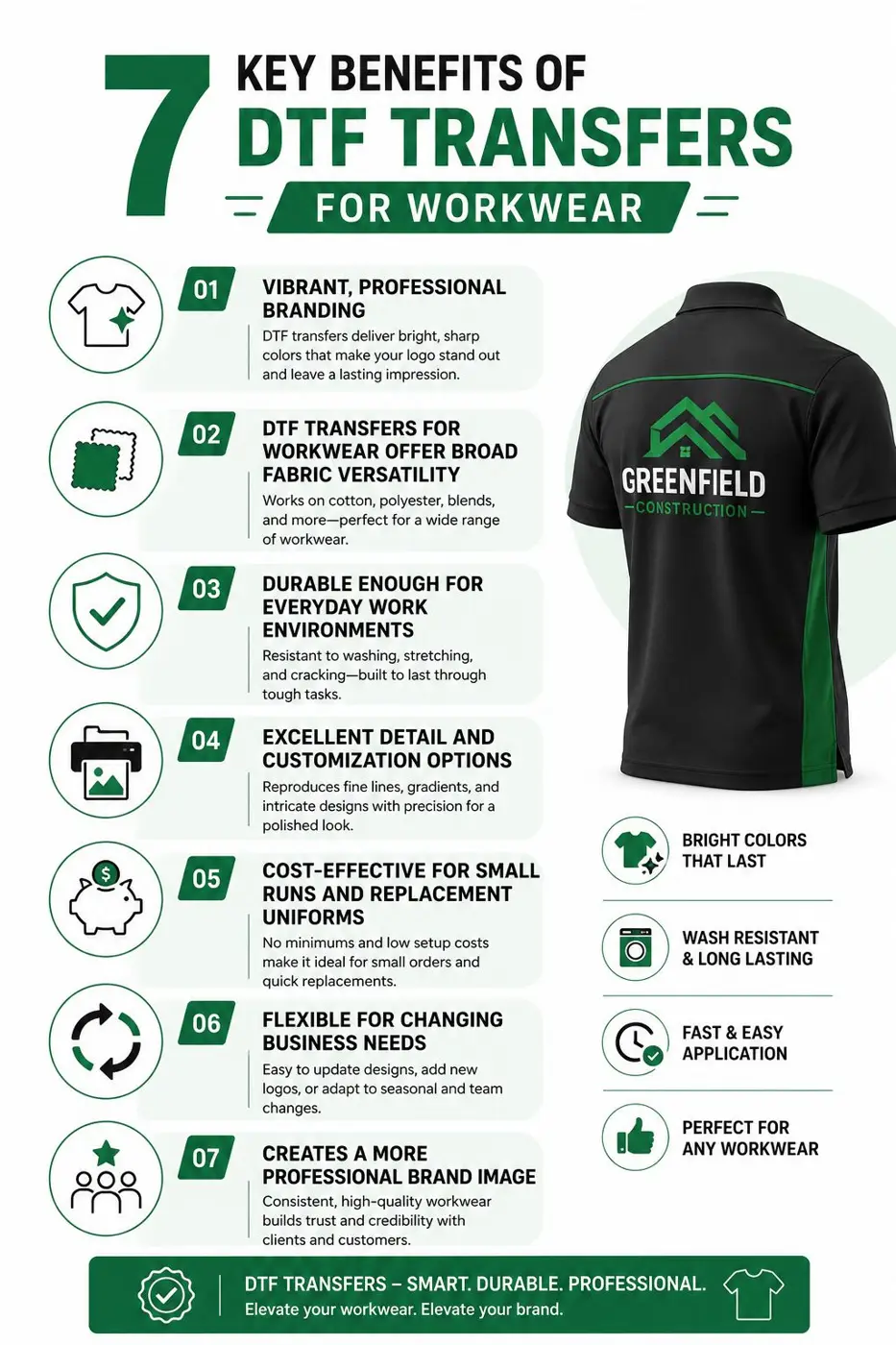
7 Key Benefits of DTF Transfers for Workwear
Work uniforms need to balance appearance and practicality. A logo that looks good on day one is not enough if it is difficult to reproduce, unsuitable for the fabric, or impractical to replace.
Here are seven reasons businesses are considering DTF for branded workwear.
1. Vibrant, Professional Branding
A company logo is often the most recognizable element of branded workwear. DTF printing is well suited to designs containing multiple colors, gradients, fine details, and complex graphics.
This gives businesses more creative freedom than designs that are limited to simple shapes or a small number of colors.
For example, a landscaping company might use a detailed full-color logo featuring trees and outdoor imagery. A construction company could use a bold logo combined with a detailed graphic. A restaurant might want a colorful illustrated brand mark.
DTF can reproduce these elements while maintaining a clean, professional appearance when the artwork and transfer are properly prepared.
This is particularly useful for custom workwear printing, where consistent branding is important across different garments.
2. DTF Transfers for Workwear Offer Broad Fabric Versatility
Workwear isn't made from one universal fabric. Businesses may use cotton T-shirts, polyester polos, blended garments, performance apparel, or heavier jackets depending on the working environment.
One of the attractions of DTF printing for workwear is its compatibility with many commonly used apparel fabrics.
DTF can be suitable for garments made from:
-
Cotton
-
Polyester
-
Cotton/polyester blends
-
Performance fabrics
-
Various apparel blends
However, compatibility should never be assumed simply because a garment is commonly used for uniforms. Fabric treatments, coatings, heat sensitivity, and garment construction can affect the application.
Before placing a large order, check the transfer supplier's application recommendations and test the transfer on the actual garment.
This makes DTF printing for workwear a versatile option for businesses that need branding across several types of apparel.
3. Durable Enough for Everyday Work Environments
Workwear often experiences more wear than casual clothing. Employees may wear the same branded garments throughout a working week, wash them repeatedly, and use them in physically demanding environments.
For this reason, durability is an important consideration when choosing a decoration method.
High-quality DTF transfers can provide strong adhesion and good wash durability when the transfer is properly produced and applied. The final performance depends on several factors, including transfer quality, garment fabric, heat-press settings, application technique, and washing practices.
Businesses should therefore avoid treating all DTF transfers as identical.
Proper application matters. Temperature, pressure, dwell time, peeling instructions, and post-press requirements should follow the supplier's specifications.
When these factors are controlled, DTF can be a practical option for everyday branded uniforms.
4. Excellent Detail and Customization Options
Some businesses need more than a simple company logo.
A uniform program might include:
-
Company logo
-
Employee name
-
Job title
-
Department
-
Team number
-
Location
-
Service division
DTF is particularly useful when designs contain detailed artwork or multiple colors. It can also make personalized workwear easier to manage because the artwork can be prepared digitally for different employees or teams.
For example, a company could maintain one standardized logo while adding individual employee names below it. Different departments could use variations of the same branding without redesigning the entire uniform system.
This makes custom DTF workwear useful for companies that want consistency without making every garment completely identical.
5. Cost-Effective for Small Runs and Replacement Uniforms
Not every business needs hundreds of identical uniforms.
A small company may have 10 employees. A growing company may need to add two new employees every few months. Another business may simply need to replace uniforms as employees leave, garments wear out, or new locations open.
These situations can make large minimum-order requirements inconvenient.
DTF can be particularly attractive for smaller production runs because the digital process provides flexibility without requiring the same traditional setup associated with some other decoration methods.
This can make DTF transfers for uniforms useful for:
-
Small businesses
-
New employee uniforms
-
Replacement garments
-
Seasonal teams
-
Short-term events
-
Small departments
-
Growing companies
Businesses should still compare total costs based on quantity, transfer size, garment price, application, and shipping rather than assuming DTF will always be the cheapest option.
6. Flexible for Changing Business Needs
A company's branding and staffing needs can change quickly.
You might open a new location, update your logo, hire new employees, introduce a new service, or launch a seasonal campaign. A uniform supplier that only works efficiently for large repeat orders may not be ideal in these situations.
Digital transfer production can make smaller updates easier to manage.
For example, instead of replacing an entire uniform inventory, a business may be able to produce new branded garments as they are needed. This can be useful for growing teams and companies that regularly onboard employees.
It also allows businesses to maintain a consistent visual identity while adapting individual garments to changing requirements.
7. Creates a More Professional Brand Image
Branded workwear can turn employees into highly visible representatives of a business.
Consider a customer opening the door to find a technician wearing a clean shirt with the company's logo and name. Or imagine a restaurant team wearing coordinated branded apparel. The uniform immediately communicates who the employee represents.
This can be particularly valuable for customer-facing industries such as:
-
Construction
-
HVAC
-
Plumbing
-
Landscaping
-
Cleaning services
-
Hospitality
-
Restaurants
-
Delivery services
-
Maintenance companies
-
Home services
Consistent branded workwear can make employees easier to recognize while reinforcing the company's visual identity.
The decoration method is only one part of this equation, but having clean, consistent, professional branding can make a noticeable difference.
DTF Transfers for Workwear vs. Embroidery and Screen Printing
DTF isn't automatically the best decoration method for every uniform. Embroidery and screen printing remain useful options, and the right choice depends on your artwork, garments, quantity, and desired appearance.
DTF vs. Embroidery
Embroidery creates a stitched appearance that many businesses associate with traditional professional uniforms. It can be an excellent choice for simple logos on polos, jackets, caps, and other garments.
DTF, however, has an advantage when artwork includes:
-
Multiple colors
-
Gradients
-
Fine details
-
Detailed illustrations
-
Photographic elements
-
Small design variations
Embroidery also adds physical texture and weight to a garment. DTF creates a printed surface instead.
For a simple corporate logo on a polo shirt, embroidery may be the preferred aesthetic. For a complex, colorful graphic, DTF may offer more design flexibility.
DTF vs. Screen Printing
Screen printing has long been a popular choice for large apparel orders. It can be highly effective when a business needs a large quantity of garments featuring the same relatively simple design.
DTF can be more flexible for smaller quantities and complex, full-color artwork.
Screen printing may be attractive when:
-
The order quantity is large
-
The artwork is relatively simple
-
The same design will be printed repeatedly
-
The production economics favor screen setup
DTF may be more attractive when:
-
Quantities are smaller
-
Designs contain many colors
-
Personalization is required
-
Multiple designs are needed
-
Replacement orders are common
The goal isn't to find one decoration method that replaces everything else. Instead, businesses should choose the method that fits their particular uniform program.
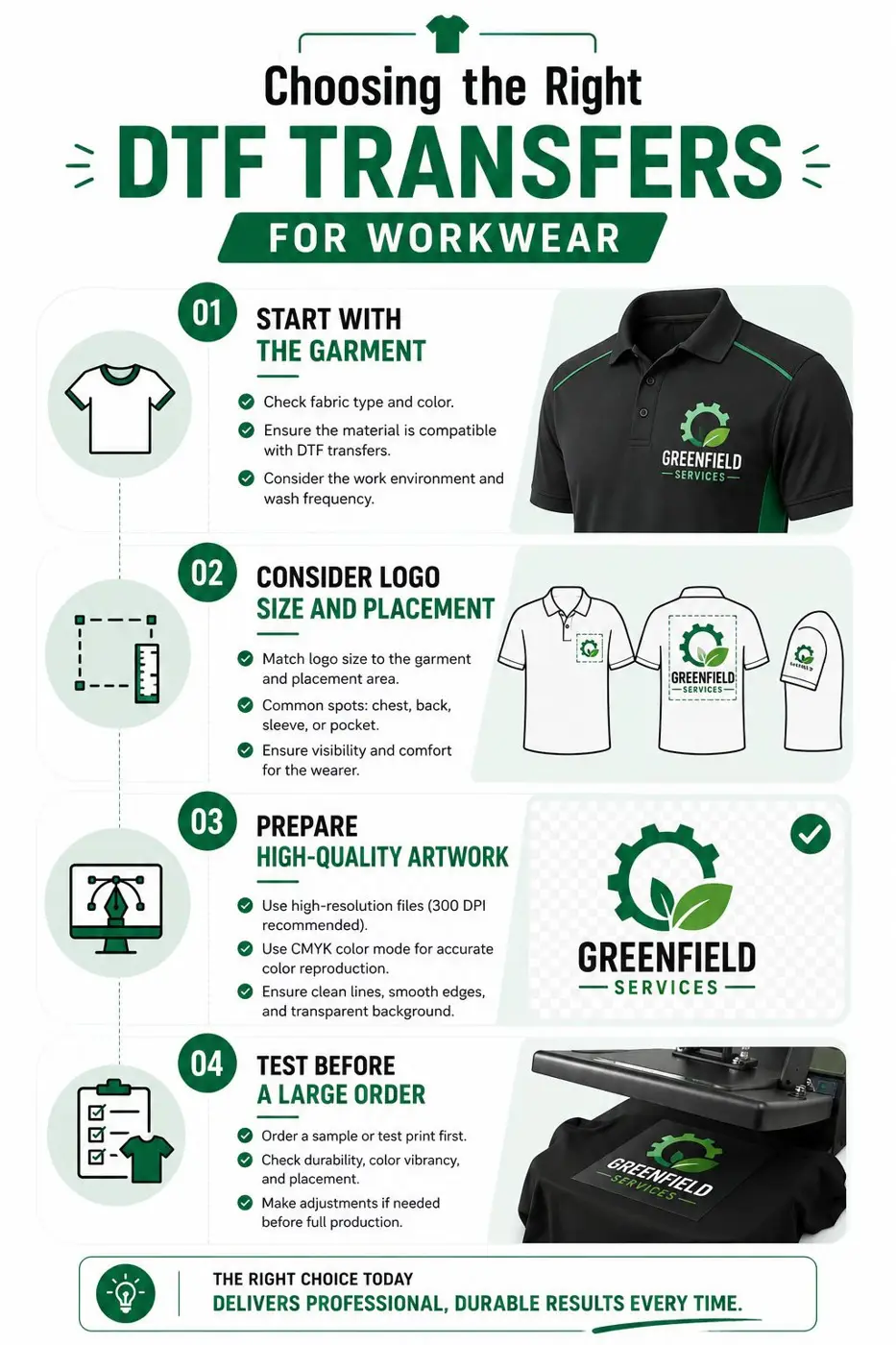
Choosing the Right DTF Transfers for Workwear
Once you decide to explore DTF, the next step is choosing transfers that match your actual garments and branding requirements.
Start With the Garment
Don't select a transfer based solely on the logo.
First identify the garment you plan to decorate. Check the fabric composition, garment construction, and manufacturer's heat recommendations.
A lightweight polyester performance shirt may require different application considerations than a cotton sweatshirt.
Consider Logo Size and Placement
Common workwear placements include:
-
Left chest
-
Right chest
-
Full front
-
Upper back
-
Full back
-
Sleeves
The best placement depends on the garment and how the uniform will be used.
For example, a small left-chest logo can create a subtle corporate appearance, while a large back design can provide greater visibility for service businesses working around customers.
Prepare High-Quality Artwork
Your transfer can only reproduce the artwork provided to the production team.
Use high-resolution artwork whenever possible and make sure the logo has clean edges and appropriate proportions.
Extremely small text and intricate details may need to be simplified or enlarged so they remain legible after application.
Test Before a Large Order
A sample is one of the smartest steps in a workwear program.
Test the transfer on the actual garment you plan to use and evaluate:
-
Appearance
-
Adhesion
-
Placement
-
Fabric compatibility
-
Wash performance
-
Overall feel
Testing helps identify problems before you commit to a larger production run.
How to Order DTF Transfers for Workwear Efficiently
Once your artwork and garments are ready, planning the order can make the process much easier.
Determine Your Quantity
Start by calculating how many employees need uniforms today and how many replacements you may reasonably need in the near future.
You may have different requirements for:
-
A 10-person team
-
A 100-person workforce
-
Seasonal employees
-
New hires
-
Multiple locations
-
Recurring replacement orders
Having a clear quantity estimate can help you compare small-batch and bulk ordering options.
Consider Gang Sheet Printing
Businesses with multiple designs can explore gang sheet printing, which allows several transfer designs to be arranged efficiently on a single sheet.
For example, a company could need a combination of:
-
Small chest logos
-
Employee names
-
Department designs
-
Larger back graphics
Rather than treating every design as a completely separate production project, gang sheet printing may provide a more organized approach for suitable orders.
You can learn more about the process through Gang Sheet Printing.
Compare Custom and Bulk Ordering
Small orders and large uniform programs have different requirements.
For a few custom uniforms, individual custom DTF transfers may be appropriate. Larger businesses may benefit from discussing bulk or wholesale production options.
Businesses should compare:
-
Transfer pricing
-
Quantity
-
Transfer dimensions
-
Artwork requirements
-
Turnaround
-
Shipping
-
Reorder consistency
You can explore Custom DTF Transfers or Wholesale DTF Printing when evaluating larger or recurring needs.
Common Workwear Applications for DTF Transfers
The flexibility of DTF makes it suitable for many types of branded apparel programs.
Construction and Skilled Trades
Construction companies, electricians, plumbers, HVAC technicians, and other trades can use branded shirts and jackets to identify employees and reinforce company branding.
Hospitality and Food Service
Restaurants, cafés, catering businesses, and hospitality teams can use customized shirts, polos, or other apparel for coordinated staff branding.
Cleaning and Maintenance Services
For mobile service businesses, visible branding can help customers identify employees when they arrive at a home or commercial property.
Corporate Teams
Companies can use branded apparel for employee events, internal teams, company celebrations, onboarding kits, and other occasions.
Events and Promotional Teams
Short-term campaigns, trade shows, community events, and brand activations may require custom apparel without the need for a permanent uniform program.
Mistakes to Avoid When Using DTF Transfers for Workwear
A successful workwear program isn't just about choosing a printing method.
Don't ignore fabric compatibility. Always check whether the garment is appropriate for the transfer and application process.
Don't use poor-quality artwork. Low-resolution graphics can affect the final appearance.
Don't skip application instructions. Incorrect temperature, pressure, or dwell time can negatively affect transfer performance.
Don't order a huge quantity without testing. A sample run can help identify problems early.
Don't assume every DTF supplier produces identical results. Production quality, materials, application guidance, and consistency can vary.
Don't forget future replacements. Keep your final artwork files and specifications organized so replacement uniforms can maintain the same appearance.
Are DTF Transfers Right for Your Branded Workwear?
DTF is worth considering if your business needs:
-
Full-color or detailed branding
-
Custom employee names or identifiers
-
Small or medium production runs
-
Multiple garment types
-
Flexible replacement orders
-
Vibrant graphics
-
Consistent branding across different apparel
Another decoration method may be better when you specifically want the stitched appearance of embroidery, need a very large run of simple designs, or have a garment that isn't suitable for DTF application.
The best choice depends on your artwork, garment, order quantity, budget, and intended use.
How DTFS.co Can Support Custom Workwear Printing
For businesses exploring DTF transfers for business uniforms, finding a supplier that can support both current and future needs is important.
DTFS.co provides resources and production options for businesses looking to incorporate DTF into their apparel programs. Depending on your requirements, you can explore custom transfers, bulk production, gang sheets, and white-label solutions.
For businesses managing larger or recurring orders, White-Label Production Services can also be worth exploring.
If you're researching DTF for broader branded merchandise, see our guide to DTF Transfers for Corporate Merch and Branded Swag.
Businesses interested in building a larger apparel operation can also explore Build a Custom Apparel Brand Using DTF Printing.
Final Takeaway
DTF transfers for workwear give businesses a flexible way to create professional, detailed, and customizable branded apparel. Their ability to reproduce full-color graphics, accommodate personalization, and work across many common garment types makes them a practical option for a wide range of industries.
They can be especially useful for small and growing businesses that need replacement uniforms, personalized employee apparel, or smaller production runs without sacrificing branding quality.
However, the best decoration method depends on your specific requirements. Consider your garment fabric, artwork, quantity, placement, budget, and expected wear before making a decision.
When the right transfer is paired with the right garment and proper application, DTF can help businesses create workwear that looks professional while supporting a consistent and recognizable brand.
FAQs
Are DTF transfers good for workwear?
Yes. High-quality DTF transfers can be a practical choice for workwear because they offer detailed, full-color branding and can provide good wash durability when properly produced and applied. Performance depends on the transfer, garment, application process, and care.
Can DTF transfers be used on uniforms?
Yes. DTF transfers can be used on many common uniform garments, including cotton, polyester, and blended apparel. Always verify fabric compatibility and application requirements before production.
How durable are DTF transfers on work clothes?
Properly produced and applied DTF transfers can provide good durability for everyday apparel use. Wash performance depends on transfer quality, garment material, pressing conditions, and laundering practices.
Are DTF transfers better than embroidery for workwear?
Neither method is universally better. Embroidery can be ideal for simple logos and a traditional stitched appearance, while DTF is often more suitable for detailed, colorful artwork, gradients, and personalized designs.
Can DTF transfers be used for small workwear orders?
Yes. DTF can be particularly useful for smaller orders, replacement uniforms, new employees, and customized garments because the process provides flexibility without relying on the same setup requirements as some traditional printing methods.
Can DTF transfers be used for company logos?
Yes. DTF can reproduce many company logos, including full-color graphics and detailed designs. Very small text or intricate artwork may need to be adjusted to produce the best result.