
October 6, 2026 · Connor McDonnell
Wholesale DTF Transfers vs Printing In-House: Cost Comparison
For most small apparel brands and new print businesses, wholesale DTF transfers cost less and carry less risk than buying a complete in-house printing setup. In-house printing can make sense when order volume is steady, equipment will be used often, and you are ready to manage maintenance, supplies, production time, and quality checks.
The right choice is not determined by the printer price alone. A fair comparison includes the machine, supplies, workspace, labor, maintenance, mistakes, storage, and the time required to produce each order. This guide compares those costs in plain English so you can decide whether to outsource DTF transfers through DTFS.co or build an in-house production operation.
Quick Answer: DTF Printer vs Outsourcing
Choose wholesale DTF transfers when you want a lower upfront commitment, predictable production, and a simpler way to sell custom apparel without operating a printer. Choose in-house printing when you have enough regular volume to keep the equipment busy, have a suitable workspace, and can handle daily production and upkeep.
Outsourcing is often the practical starting point for a new brand, Etsy or Shopify seller, event business, or print shop testing DTF products. It lets you focus on artwork, sales, garments, and customer service while a specialist produces the ready-to-press transfers.
In-house printing gives you more control over timing and production, but it also makes you responsible for the complete process. If the printer needs cleaning, a supply runs out, a design prints incorrectly, or a production day is lost, the cost affects your business directly.
What Does Outsourcing DTF Transfers Mean?
When you outsource DTF transfers, you send your artwork to a transfer supplier that prints the designs for you. The finished transfers arrive ready to press onto garments using a heat press. You do not need to purchase or operate a DTF printer for each order.
The supplier handles the printing steps, while you handle the parts of the business that are closest to your customer. Depending on your model, that may include choosing garments, pressing transfers, packing orders, selling finished products, or supplying transfers to other businesses.
Wholesale transfers can be ordered by size or arranged on a gang sheet. A gang sheet places multiple designs on one larger sheet, which can be useful when you have several logos, names, or graphics in the same order.
Ready to compare your next order? Order Transfers
What Does Printing DTF Transfers In-House Require?
Printing in-house means your business owns or operates the equipment used to create the transfers. A typical setup may include a DTF printer, a way to apply adhesive powder, a curing method, a heat press, a computer, design software, inks, film, powder, cleaning supplies, ventilation or workspace improvements, and storage.
The exact setup varies by printer and production method. Some businesses start with a small machine for limited work. Others use larger equipment designed for regular production. Either way, the purchase is only one part of the DTF business startup cost.
You also need time to learn the workflow and maintain the equipment. A printer that is not used or cared for correctly can develop problems. Your budget should account for training, test prints, failed transfers, supply changes, and the time spent keeping the setup ready.
The Full Cost Comparison
A useful comparison separates fixed costs from per-order costs. Fixed costs are expenses you pay to create and maintain the operation, even when order volume is low. Per-order costs increase as you produce more transfers.
Outsourcing generally shifts more of the production cost into the order price. In-house printing usually requires a larger fixed investment but may lower the direct cost per transfer after the equipment is used often enough. The break-even point depends on your actual order volume, labor rate, waste, equipment life, and selling price.
|
Cost area |
Wholesale DTF transfers |
Printing in-house |
|
Upfront equipment |
Low; usually a heat press and basic handling supplies. |
High; printer, powder, curing, heat press, computer, and setup. |
|
Per-order cost |
Clear transfer price plus shipping or related order costs. |
Film, ink, powder, labor, electricity, waste, and maintenance. |
|
Production responsibility |
Supplier produces the transfers. |
Your team manages every production step. |
|
Risk when volume is low |
Lower; order only what you need. |
Higher; equipment may sit unused while costs continue. |
|
Control over timing |
Depends on supplier turnaround and shipping. |
More direct control, if equipment and supplies are ready. |
|
Scaling |
Easy to increase orders without buying a larger printer. |
May require more equipment, space, staff, and upkeep. |
DTF Business Startup Cost: What to Include
The DTF business startup cost changes significantly depending on whether you outsource transfers or print them yourself. A new business should list every required cost before deciding that a machine is cheaper than buying completed transfers.
For an outsourced model, the starting costs may include a heat press, artwork or design tools, blank garments, packaging, a website or marketplace presence, samples, and the first transfer order. You can begin with a small product range and increase spending as sales become more consistent.
For an in-house model, add the printer and its supporting equipment to those same business costs. Include installation or setup, initial ink and film, powder, curing equipment, maintenance supplies, replacement parts, training, test garments, workspace changes, and a reserve for repairs.
Do not compare the price of a printer with the price of one transfer order. Compare the total amount needed to produce reliably for at least the first several months. This gives you a more realistic view of cash flow and risk.
Equipment Is Only the First In-House Expense
A printer may be advertised as the main purchase, but it cannot produce a sellable transfer by itself. You need the related supplies and a way to complete the workflow. If one part of the setup is missing, production may stop even though the printer is available.
Workspace, Storage, and Daily Upkeep
In-house production needs a clean, organized area for the printer, supplies, finished sheets, garments, and pressing work. You also need room to move safely and keep dust or clutter away from the equipment. A home business may need to give up valuable workspace before it sees any production benefit.
Budget for the Quiet Costs
Small expenses add up. Cleaning materials, replacement parts, test prints, damaged film, extra packaging, and unused supplies all affect your real cost. Record them instead of treating them as too minor to matter.
Make a Monthly Cost List
Write down equipment payments, software, supplies, utilities, maintenance, storage, labor, and shipping. A monthly list helps you compare the setup with the amount you would spend on outsourced transfers during the same period.
DTF Printing Machine vs Transfers: The Main Trade-Off
The decision between a DTF printing machine vs transfers is mainly a trade-off between control and commitment. A machine gives you direct control over production, but it requires money, time, space, and skill. Outsourced transfers give you a simpler process, but you depend on the supplier’s turnaround and ordering requirements.
A machine may be valuable when you have predictable demand and need frequent short runs. You may be able to print a new design quickly, test a sample, or adjust production without waiting for an outside order. That flexibility can matter for a busy shop with daily work.
Transfers may be more valuable when your orders are uneven, your designs change often, or you are still testing what customers will buy. You avoid paying for a machine during slow weeks and can order only the designs you need.
Compare More Than the Price Per Transfer
In-house printing can appear cheaper when you divide supply costs by the number of successful transfers. That calculation may leave out labor, failed prints, maintenance, equipment payments, and time spent preparing the machine. Include those costs before deciding that the in-house price is lower.
Outsourced pricing is easier to understand because the production cost is included in the transfer price. Your internal cost may then focus on the heat press, labor, garment, packaging, and shipping. That clarity can make it easier to price products and protect your margin.
How to Estimate DTF Printing Business Profit
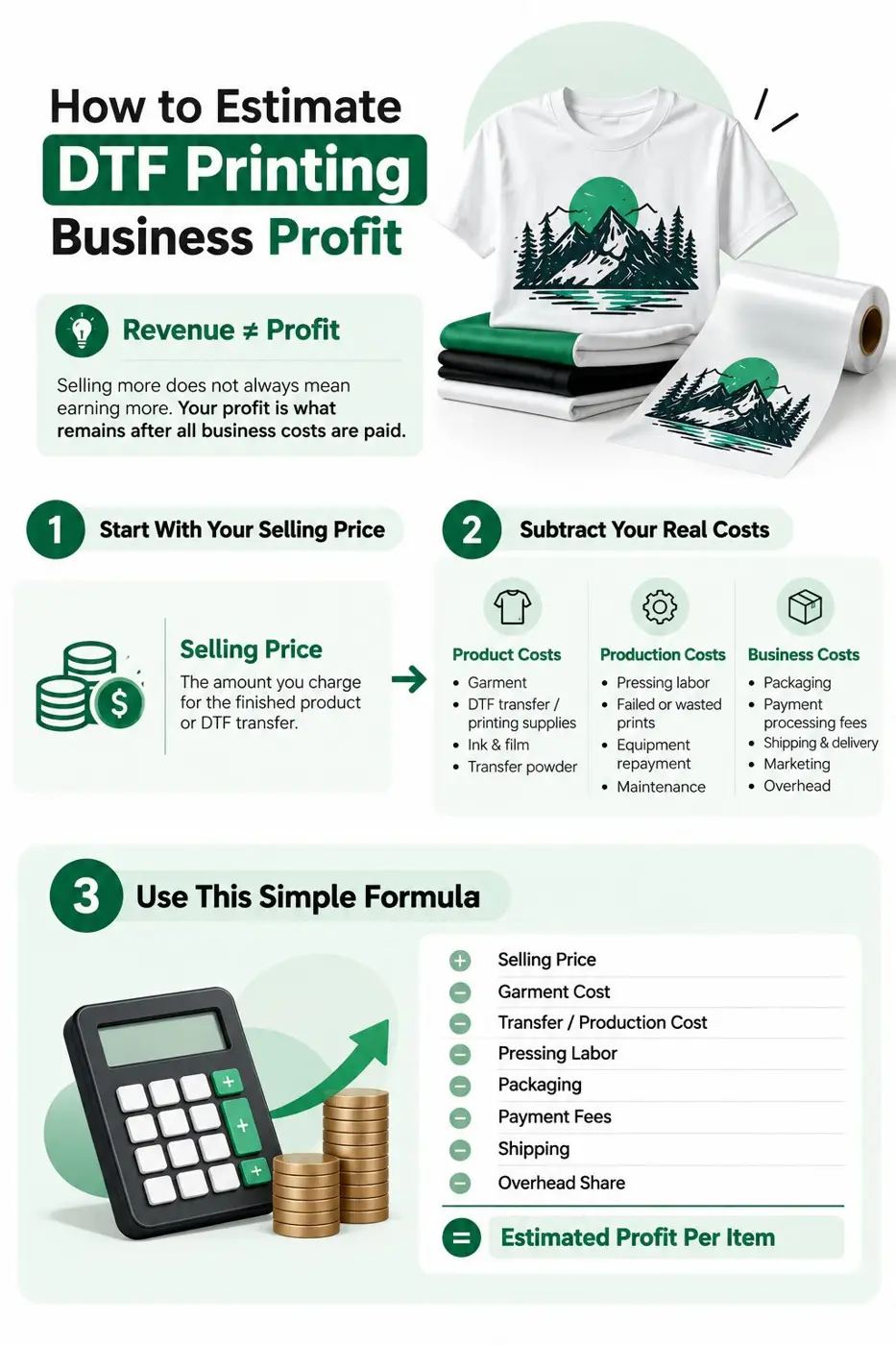
DTF printing business profit is not the same as revenue. Revenue is the money collected from customers. Profit is what remains after all costs are paid. A business can sell many shirts and still lose money if it ignores equipment, labor, waste, shipping, and overhead.
Start with the selling price of the finished product or transfer. Then subtract the garment, transfer or print supplies, pressing labor, packaging, payment fees, shipping, marketing, and a share of fixed costs. If you print in-house, include equipment repayment and maintenance. If you outsource, include the wholesale transfer price and delivery cost.
A simple per-item formula is:
Selling price − garment − transfer or production cost − pressing labor − packaging − fees − shipping − overhead share = estimated profit per item
Use real numbers from your own business. Do not assume that a lower supply cost automatically creates higher profit. If in-house printing adds hours of work or causes more failed pieces, the apparent savings may disappear.
Example: A Small Order Model
Imagine a new apparel seller receives a few custom orders each week. The seller needs transfers in different sizes and does not yet have a steady production schedule. Outsourcing may keep the total cost easier to predict because the seller buys only the transfers needed for confirmed orders.
In this situation, buying a machine may create a large monthly obligation before the seller has enough consistent work. The seller may spend time learning the equipment instead of selling products. The outsourced model may produce a better business result even if the transfer price is higher than the raw supply cost of an in-house print.
Example: A High-Volume Production Model
Now consider a print shop with regular daily demand, trained staff, a dedicated workspace, and repeat designs. The shop may use an in-house printer often enough to spread fixed costs across many successful orders. It may value faster access to production and more direct control over scheduling.
Even in this model, the shop should keep a backup plan. Equipment downtime can stop production, so the business may still outsource overflow orders or urgent work. A blended model can protect customer deadlines while keeping the machine focused on work it handles efficiently.
When Outsourcing DTF Transfers Is Usually the Better Choice
Outsource DTF transfers when you are starting small, testing products, handling irregular demand, or focusing on sales rather than production. Outsourcing is also useful when you do not have space for a complete setup or do not want to manage cleaning, troubleshooting, and supply storage.
It can be a good fit for apparel brands, online sellers, event planners, schools, teams, and promotional businesses. These businesses may need professional transfers but may not need a printer running every day.
Outsourcing can also help an established shop during busy periods. You can keep customer orders moving while your team handles pressing, packing, and fulfillment. This is often less disruptive than buying equipment for a temporary increase in demand.
Need a specific transfer size for a customer order? View DTF transfers by size
When In-House Printing May Make Sense
Printing in-house may make sense when you have repeat volume, a trained operator, a suitable workspace, and enough cash to handle repairs and supply purchases. The machine should be used regularly enough that fixed costs do not overwhelm each order.
It may also make sense when fast design changes are central to your business. A shop that creates frequent samples, same-day products, or short-run custom work may value direct access to printing. The benefit is strongest when the equipment supports a clear sales advantage rather than simply feeling like the next step.
Before buying, track how many transfers you currently order, what sizes you use, how often designs change, and how much time you spend waiting. The data will show whether the machine solves a real business problem.
The Hybrid Model: Outsource and Print
You do not have to choose one model forever. Many businesses outsource most transfers and add in-house printing later. Others own a machine for regular work but outsource large gang sheets, specialty jobs, overflow, or orders needed during maintenance.
A hybrid model can reduce risk because it gives you a backup source. It also lets you compare real production costs over time. You can keep records for outsourced orders and in-house orders, then review the total cost rather than relying on assumptions.
Need a quote for outsourced transfers while you compare options? Request a quote from DTFS.co
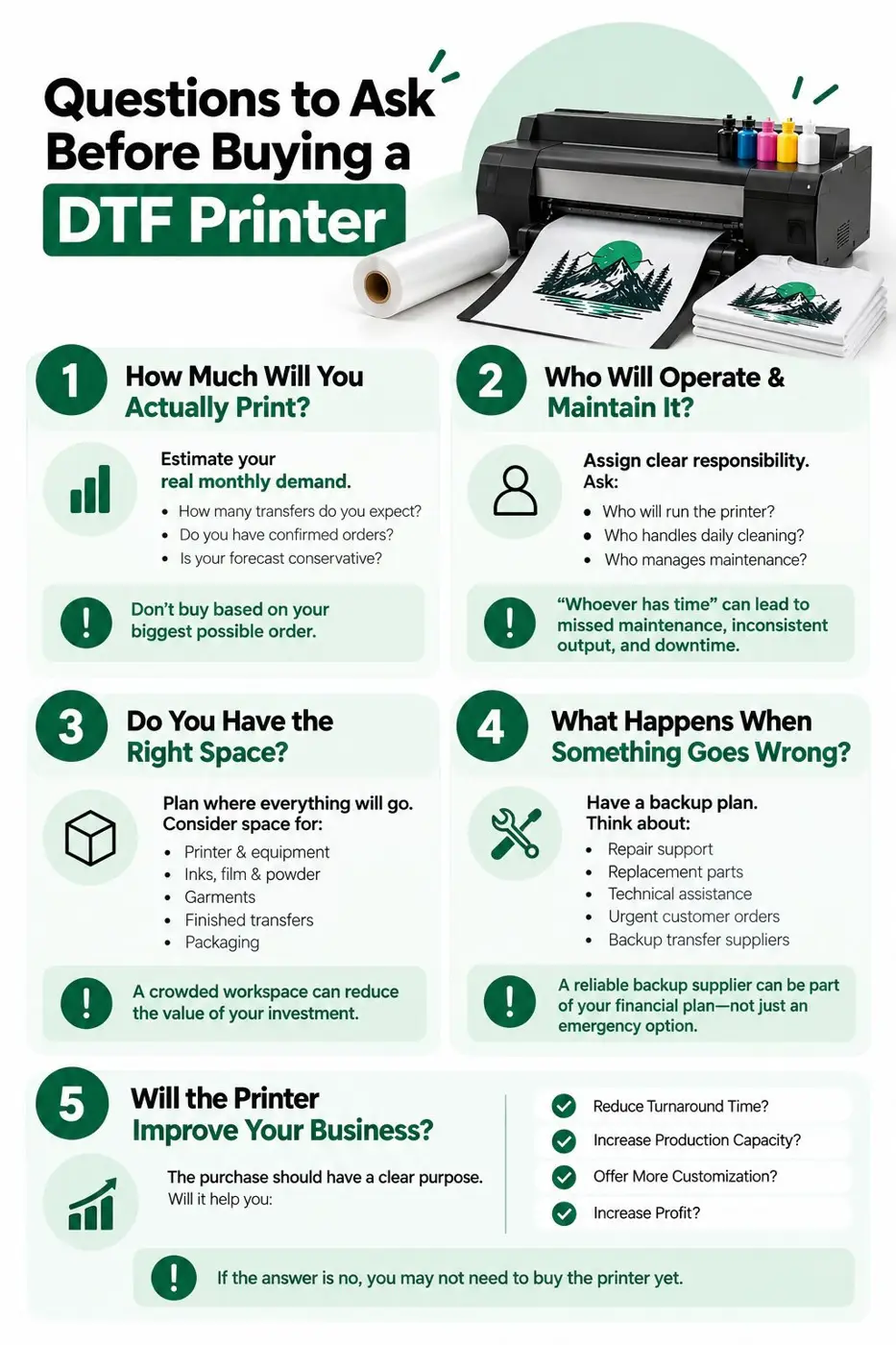
Questions to Ask Before Buying a DTF Printer
- Ask how many successful transfers you expect to produce each month. Use confirmed demand or a conservative forecast, not the largest possible order you hope to receive.
- Ask who will operate and maintain the equipment. If the answer is “whoever has time,” include the risk of missed cleaning, inconsistent production, and unplanned downtime.
- Ask where the equipment, supplies, and finished work will be stored. A crowded or unsuitable space can reduce the value of the purchase.
- Ask how you will handle repairs and urgent orders. A backup supplier can be part of the financial plan, not just an emergency option.
- Ask whether the machine improves your customer offer. If it does not reduce turnaround, expand capacity, improve customization, or increase profit, the purchase may not be necessary yet.
A Practical Cost-Comparison Worksheet
Use two columns when planning your decision. In the outsourcing column, record average transfer cost, shipping, pressing labor, garments, packaging, and fees. In the in-house column, record equipment payments, supplies, labor, electricity, maintenance, waste, repairs, and the same garment and fulfillment costs.
Then create three volume scenarios: low, expected, and high. A machine that looks affordable at high volume may be difficult to support at low volume. A supplier that works well at low volume may become less attractive if your order count grows every month.
Review the worksheet after several actual orders. Replace estimates with real numbers. This turns the decision into a business comparison based on your work instead of a general claim that one method is always cheaper.
Final Recommendation
For most new or small apparel businesses, wholesale DTF transfers are the lower-risk way to start. They reduce the DTF business startup cost, make production easier to plan, and let you build sales before taking on printer ownership.
In-house printing can become a smart investment when demand is steady and the business is prepared to manage the full process. The decision should be based on total operating cost, not only the machine price or the raw cost of ink and film.
If you are unsure, start by tracking outsourced orders and building a simple cost model. You can move to a hybrid or in-house setup when the numbers show that the equipment will be used consistently and will support a clear business goal.
Frequently Asked Questions
Is it cheaper to buy a DTF printer or outsource transfers?
There is no single answer for every business. Outsourcing usually costs less upfront and is easier to manage at low or uneven volume. A printer may lower the production cost per transfer at steady, high volume, but only after equipment, labor, maintenance, waste, and workspace are included.
What is included when I outsource DTF transfers?
You generally send artwork to a supplier and receive printed, ready-to-press transfers. Your exact order may be arranged by size or on a gang sheet. You should confirm artwork requirements, turnaround, shipping, and any order minimums before purchasing.
What is the biggest DTF business startup cost?
For an in-house operation, the printer and supporting equipment are often the largest upfront expenses, but the full startup cost also includes supplies, workspace, software, training, maintenance, samples, and working cash. For an outsourced model, the initial investment can be smaller because you may only need a heat press and selling or fulfillment supplies.
Can outsourcing improve DTF printing business profit?
Yes, if outsourcing lowers your risk, saves labor, prevents downtime, and lets you focus on selling more products. Profit depends on the complete cost of each order and the price customers are willing to pay, not simply on whether you own a printer.
Should a print shop use both a printer and outsourced transfers?
A hybrid model can be useful. The shop can use its own equipment for regular work and outsource overflow, large orders, specialty jobs, or production during maintenance. This provides flexibility without making one machine responsible for every deadline.