


DTF printing has quickly become one of the most popular methods for creating custom t-shirts, tote bags, caps, hoodies, and promotional merchandise. Its ability to produce vibrant, full-color designs on multiple fabrics makes it a favorite among small businesses and apparel brands.
But one question always comes up first: how much do DTF transfers cost? For a quick answer, the custom DTF transfers usually cost between $0.22 - $10 per square inch that further depends on the size and quantity.
Starting a direct to film printing business will cost between $3,000 - $20,000+ depending on whether you start small or go with the full setup. If you are planning to start your custom apparel business, understanding DTF transfer cost is essential before placing bulk orders.
From design size and color coverage to material quality and order quantity, several factors influence pricing. In this blog, we’ll break down everything you need to know about DTF transfer expenses.
Cost of DTF Printing: A Quick Comparison for In-house vs Outsourced Printing
Before any investment or placing any bulk orders, it’s important to first understand the potential costs of DTF transfers when producing yourself vs outsourcing them. The table below provides a quick overview of the potential costs for starting a direct to film printing business. It compares upfront investment, operational expenses, cost of DTF transfers, estimated DTF cost per print, and projected annual profit potential for both in-house and outsourced DTF printing models.
|
Factor |
In-House DTF Printing |
Outsourced DTF Printing |
|
Initial Investment |
$3,000 – $8,000 (printer, heat press, supplies, workspace setup) |
$0 – $500 (sample orders, marketing setup) |
|
Equipment Costs |
High (DTF printer, curing oven, RIP software) |
None |
|
Ongoing Supply Costs |
Film, ink, adhesive powder, maintenance |
Pay per transfer order |
|
Average DTF Cost Per Print |
$2.00 – $4.00 (depending on size & ink usage) |
$4.00 – $8.00 (depending on supplier & size) |
|
Production Control |
Full control over quality & turnaround |
Dependent on supplier timelines |
|
Labor Requirement |
Requires operator time & maintenance |
Minimal (press only) |
|
Profit Margin Per Shirt (Avg.) |
$8 – $15 |
$5 – $10 |
|
Monthly Production Example |
300 shirts/month |
300 shirts/month |
|
Estimated Annual Revenue (300 shirts × $20 avg.) |
$72,000 |
$72,000 |
|
Estimated Annual Operating Cost |
~$18,000 – $25,000 |
~$30,000 – $40,000 |
|
Estimated Annual Profit (After 1 Year) |
~$40,000 – $50,000 (after recovering equipment cost) |
~$25,000 – $35,000 |
Average Cost of DTF Transfers (2025 Pricing Guide)
In 2025, DTF transfer pricing continues to vary based on size, material usage, and order volume. On average, small transfers (3”x3” to 5”x5”) range between $2 to $4 per print. Medium designs (8”x10” to 10”x12”) typically cost $5 to $8 per print, while large full-front prints (12”x16” or bigger) range from $8 to $15 per transfer, depending on supplier and coverage.
When analyzing DTF cost per print, suppliers often calculate based on DTF cost per square inch, which generally falls between $0.04 to $0.08 per square inch. Some vendors instead price by DTF cost per sheet, especially for larger format film sizes like 22”x24” or 24”x36”.
For bulk buyers, gang sheet printing significantly reduces overall cost. A typical DTF gang sheet cost ranges from $15 to $30 per sheet, depending on sheet size and print density. Efficient layout planning on gang sheets lowers waste and improves profitability, making it ideal for brands printing multiple smaller designs in one run.
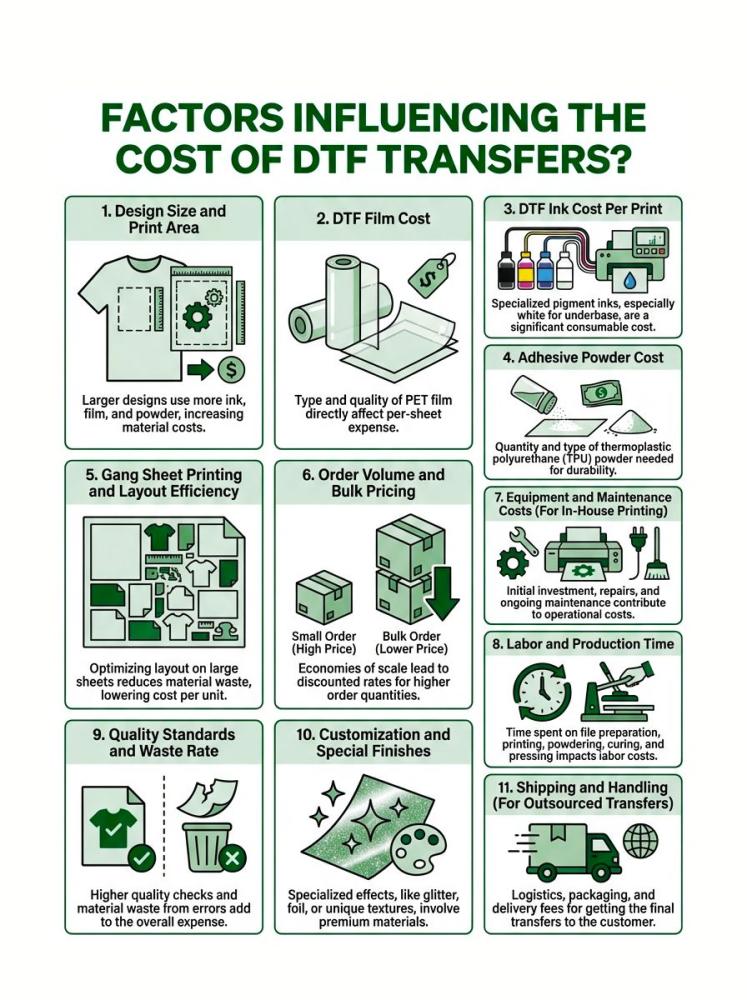
What Are the Factors Influencing the Cost of DTF Transfers?
Understanding the DTF transfer cost is essential whether you're a small apparel brand, print shop owner, or entrepreneur planning to start a direct-to-film printing business. While DTF is known for flexibility and vibrant output, the actual DTF transfer pricing varies significantly depending on multiple production and material factors. Below is a detailed breakdown of what truly determines the cost of DTF transfers and how each element affects your overall profitability.
1. Design Size and Print Area
One of the biggest factors in DTF printing cost per design is the size of the artwork. Larger designs require more ink, more adhesive powder, and more film surface area. Many suppliers calculate pricing based on DTF cost per square inch, meaning the larger your design, the higher the cost.
For example:
-
A small left-chest logo costs significantly less than a full-front 12”x16” print.
-
Oversized back prints dramatically increase material consumption.
If you're ordering transfers, always check whether pricing is based on flat size tiers or DTF cost per sheet.
2. DTF Film Cost
The DTF film cost plays a foundational role in overall production expenses. High-quality PET films provide better ink absorption, smoother peeling, and improved durability. However, premium films are more expensive.
Film pricing depends on:
-
Roll width (A3, A4, 24-inch, etc.)
-
Brand quality
-
Hot peel vs cold peel type
-
Bulk purchasing discounts
Low-cost film may reduce short-term DTF transfer production cost, but it can cause adhesion issues, wasted prints, and customer complaints — ultimately increasing long-term expenses.
3. DTF Ink Cost Per Print
Ink usage is one of the most underestimated components of DTF cost per print. The DTF ink cost per print varies depending on:
-
Color coverage percentage
-
Use of white underbase
-
Print resolution settings
-
Ink brand quality
White ink consumption is especially high because it acts as the opacity base for dark garments. A high-color, heavy-coverage design can significantly increase DTF printing cost per design compared to a simple line graphic.
Premium pigment inks cost more upfront but improve vibrancy, wash durability, and overall print quality.
4. Adhesive Powder Cost
The DTF powder cost directly affects transfer adhesion and durability. Adhesive powder is applied to the wet ink layer and cured before pressing onto garments.
Factors influencing powder cost include:
-
Melt grade and particle size
-
Stretch capability
-
Wash durability performance
-
Brand quality
Higher-grade TPU powders offer better elasticity and crack resistance but come at a higher price. Lower-quality powder can lead to peeling, which increases returns and reprints — raising your effective DTF transfer production cost.
5. Gang Sheet Printing and Layout Efficiency
If you’re ordering multiple small designs, DTF gang sheet cost becomes highly relevant. Gang sheet printing allows multiple designs to be arranged on a single film sheet to maximize space usage.
This reduces:
-
Material waste
-
Film consumption
-
Overall DTF cost per sheet
Efficient layout planning can significantly lower your total DTF transfer cost, especially for brands printing multiple logos or smaller graphics in one batch.
Poor layout = wasted film = higher cost per usable print.
6. Order Volume and Bulk Pricing
Like most print processes, volume directly affects DTF transfer pricing. Larger orders reduce the per-unit DTF cost per print because:
-
Setup time spreads across more transfers
-
Material is purchased in bulk
-
Production becomes more efficient
Small custom orders (10–20 transfers) typically cost more per piece than bulk orders of 200–500 prints.
If you're running a print-on-demand model, expect higher per-print pricing compared to wholesale batch production.
7. Equipment and Maintenance Costs (For In-House Printing)
If you produce transfers in-house, your DTF transfer production cost includes more than materials.
Hidden costs include:
-
Printer depreciation
-
Printhead replacements
-
Cleaning solution
-
RIP software licensing
-
Electricity consumption
-
Labor
Printer maintenance alone can significantly impact your true DTF cost per print, especially if white ink clogs or printheads require frequent servicing.
8. Labor and Production Time
Time equals money. Labor cost influences overall cost of DTF transfers, particularly in in-house setups.
Production steps include:
-
Artwork setup
-
Printing
-
Powder application
-
Curing
-
Quality inspection
-
Cutting and packaging
Automated powder shakers and curing ovens reduce labor time but increase initial equipment investment.
9. Quality Standards and Waste Rate
Not every print comes out perfectly. Misprints, curing errors, or powder inconsistencies can increase your actual DTF printing cost per design.
Higher waste rates increase:
-
Film usage
-
Ink consumption
-
Powder waste
-
Labor hours
Professional operations maintain strict quality control to keep waste low and stabilize DTF transfer pricing.
10. Customization and Special Finishes
Specialty effects increase costs. These may include:
-
Glitter powder
-
Puff effect transfers
-
Neon inks
-
Metallic finishes
These enhancements increase both material costs and DTF transfer production cost, but they also allow higher retail pricing.
11. Shipping and Handling (For Outsourced Transfers)
If you're outsourcing, shipping adds to your overall DTF transfer cost. Express delivery for rush orders further increases total expenses.
Packaging quality and damage risk also affect profitability.
The true cost of DTF transfers depends on a combination of material quality, design size, ink usage, layout efficiency, labor, and production scale. Whether you calculate by DTF cost per square inch, DTF cost per sheet, or total DTF cost per print, understanding these variables allows you to price your products confidently and protect profit margins.
In short:
-
Bigger designs = higher ink & film usage
-
Premium materials = higher upfront cost but better durability
-
Bulk orders = lower per-print cost
-
Efficient gang sheets = lower waste
When you understand every factor influencing DTF transfer pricing, you gain control over profitability instead of guessing your margins.
Hidden Costs in DTF Printing
When calculating the cost of DTF transfers, many businesses focus only on film, ink, and powder. However, hidden operational expenses can significantly impact your true profitability.
Waste & Misprints
DTF printing requires precision. Incorrect temperature, uneven powder application, clogged nozzles, or artwork setup errors can result in failed prints. Each misprint wastes film, ink, and powder — quietly increasing your overall production cost. Even a small 5–10% waste rate can noticeably raise the real cost per usable transfer.
Maintenance
DTF printers, especially white ink systems, require regular cleaning and maintenance. Printhead replacements, cleaning solutions, downtime, and technical servicing all add ongoing expenses. Neglecting maintenance can increase reprints and long-term repair costs.
Labor Time
Artwork preparation, printing, powdering, curing, cutting, and packaging all require manual effort. Labor hours directly affect operational efficiency and the actual cost of DTF transfers.
Reprints & Quality Issues
Improper curing or low-quality materials can cause peeling or cracking, leading to customer complaints and costly reprints — reducing profit margins further.
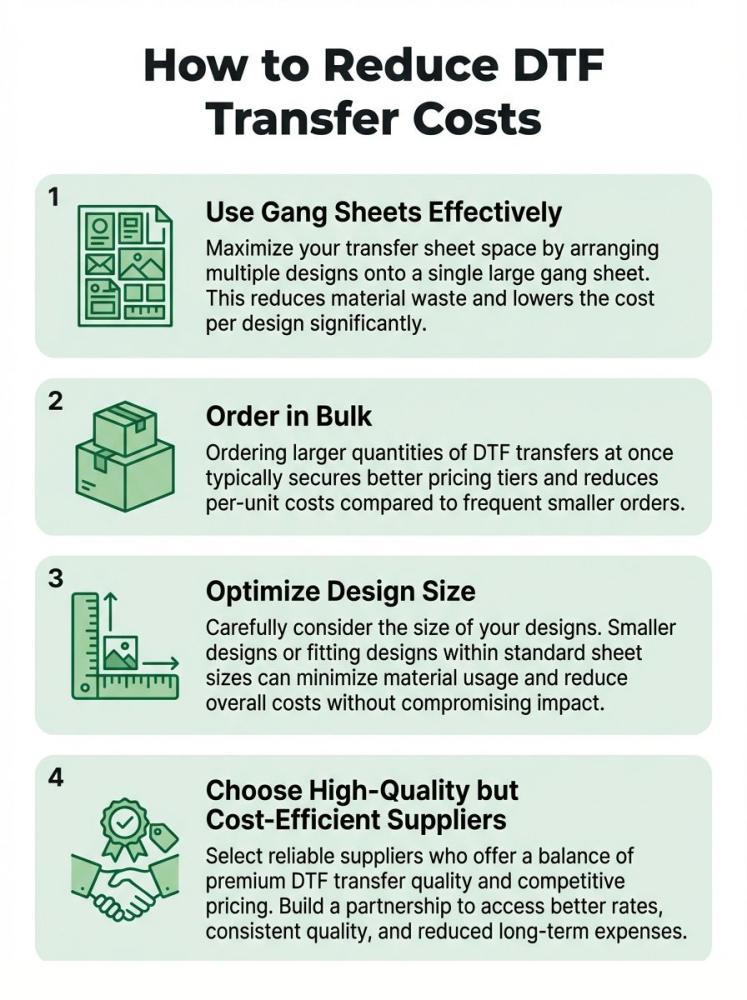
How to Reduce DTF Transfer Costs
Managing DTF transfers cost effectively is key to protecting your profit margins. With the right strategy, you can significantly lower production expenses without compromising quality.
Use Gang Sheets Effectively
Maximize every inch of film by arranging multiple small designs on one sheet. Efficient layout planning reduces wasted space and lowers your cost per design. Smart gang sheet usage is one of the fastest ways to decrease overall transfer expenses.
Order in Bulk
Suppliers often provide discounted pricing for higher quantities. Choosing bulk DTF printing helps reduce the per-unit rate, shipping costs, and production overhead. Bulk orders are especially beneficial for brands running repeat designs or seasonal collections.
Optimize Design Size
Larger prints consume more ink, powder, and film. Adjust artwork dimensions strategically to fit garment placement without unnecessary excess space. Even minor size reductions can noticeably reduce DTF transfers cost over time.
Choose High-Quality but Cost-Efficient Suppliers
Low prices can lead to reprints and wasted materials. Instead, select suppliers that balance competitive pricing with consistent transfer durability and color performance to avoid hidden long-term expenses.
Conclusion
Understanding your true DTF transfer cost is essential before launching or scaling a custom apparel business. While base pricing may seem straightforward, factors like design size, ink usage, gang sheet efficiency, maintenance, and waste can significantly impact overall expenses.
By ordering in bulk, optimizing layouts, and choosing reliable suppliers, you can control costs and protect your profit margins. Whether you print in-house or outsource, knowing how pricing works allows you to set competitive retail prices confidently.
When managed strategically, DTF printing remains a profitable and scalable solution for modern apparel brands.
FAQs : DTF Transfers Cost
1. How much does a DTF transfer cost on average?
DTF transfers typically cost between $2 and $15 per print, depending on size and order quantity.
2. Is DTF printing cheaper than screen printing?
DTF is cheaper for small orders, while screen printing becomes more cost-effective for large bulk runs.
3. What affects DTF transfer cost the most?
Design size, ink coverage (especially white ink), film quality, and order volume have the biggest impact on pricing.
4. Does ordering in bulk reduce DTF transfer cost?
Yes, bulk orders significantly lower the cost per print due to volume discounts and reduced overhead.
5. Are gang sheets more affordable than individual transfers?
Yes, gang sheets reduce material waste and lower the overall cost per design when printing multiple graphics together.