


If you're starting a t-shirt business in the US or scaling an apparel brand, one question keeps coming up: DTF vs screen printing — which one should you choose?
Both methods dominate the custom apparel space. Both produce vibrant prints. Both can be profitable. But they serve different goals.
Some business owners prioritize bulk production. Others need flexibility for small orders. Some ask, “Does DTF feel better than screen print?” Others want to know which method lasts longer after 50 washes.
This guide breaks it all down clearly — cost, durability, texture, startup investment, production speed, and real-world use cases.
Let’s start with the basics.
What is DTF Printing?
DTF (Direct-to-Film) printing is a digital heat transfer method that allows you to print full-color designs onto almost any fabric without complex setup. Instead of printing directly onto the garment, the artwork is first printed onto a special PET film using water-based pigment inks. A white ink layer is added underneath the colors to ensure opacity, especially on dark garments.
After printing, a TPU adhesive powder is evenly applied to the wet ink. The film is then cured with heat, activating the adhesive. Once cured, the transfer is placed onto the garment and pressed using a heat press. After cooling or hot peeling (depending on the film type), the design bonds to the fabric.
Unlike screen printing, DTF does not require separate screens for each color, making it ideal for businesses ordering custom DTF transfers for small batches and detailed artwork. This makes it ideal for complex, multi-color, or photographic designs with minimal setup time.
How DTF Works:
-
Create a digital design.
-
Print it onto PET film.
-
Apply adhesive powder.
-
Cure the powder.
-
Heat press onto fabric.
-
Peel the film.
Why DTF is Popular:
-
Unlimited colors
-
Ideal for detailed artwork
-
Great for small batches
-
Works on cotton, polyester, blends, nylon, and more
-
Excellent for print-on-demand businesses
DTF is often compared to DTG, sublimation, and screen printing — but its biggest competitor for apparel businesses remains screen printing.
What is Screen Printing?
Screen printing is a traditional apparel decoration method widely used in the US for bulk t-shirt printing and commercial garment production. It has remained popular because of its durability, bold color output, and low cost per shirt in high-volume orders.
The process works by creating a stencil (also called a screen) on a fine mesh frame. Ink is pushed through the open areas of the mesh using a squeegee, transferring the design directly onto the fabric. Each color in the artwork requires a separate screen, which means multi-color designs involve multiple setup steps.
This printing method is ideal for simple logos, solid graphics, and large batch production. Plastisol ink is commonly used, producing vibrant colors and long-lasting prints that resist fading and cracking. For businesses comparing DTF vs screen printing, screen printing stands out for bulk efficiency and durability.
How Screen Printing Works:
-
Separate artwork by color.
-
Create a stencil (screen) for each color.
-
Place screen over garment.
-
Push ink through using a squeegee.
-
Cure ink with heat.
Why Screen Printing is Popular:
-
Extremely durable prints
-
Bold, vibrant colors
-
Low cost per shirt in bulk
-
Ideal for large uniform orders
-
Proven reliability
Screen printing is still the dominant method for high-volume production in the US.
What Are Screen Print Transfers?
Screen print transfers are pre-printed designs made using traditional screen printing inks, but applied later using a heat press instead of printing directly onto the garment. The design is first printed onto a special release paper using plastisol ink. It is partially cured, allowing it to remain transferable. Later, the transfer is heat-pressed onto a shirt, bonding the ink permanently to the fabric.
This method gives businesses the durability of screen printing with the flexibility of on-demand production. Unlike direct garment printing, transfers can be stored and applied when needed, making them ideal for team apparel, event merch, and contract decorators.
When comparing DTF vs screen printing, screen print transfers sit in between. In the debate of DTF transfer vs screen print transfer, screen print transfers offer stronger durability, while DTF offers more color flexibility and design complexity.
DTF vs Screen Printing for Businesses
If you’re evaluating DTF vs screen printing as a print shop owner, the decision comes down to cost structure, workflow efficiency, and order volume. Below is a deeper breakdown of how these two printing methods compare in real business scenarios.
1. Startup Investment & Equipment Setup
In the US market, entry-level DTF systems typically range from $1,500 to $3,000+, while screen printing setups can range from $1,000 to $5,000+, depending on manual or automatic equipment. DTF requires a printer, PET film, adhesive powder, curing solution, and a heat press. Screen printing requires screens, exposure units, inks, dryers, and press stations. For beginners, DTF has fewer moving parts and less physical setup complexity.
2. Cost Per Shirt & Profit Margins
The real difference in DTF vs screen printing cost comparison appears in per-unit economics. DTF has a relatively fixed cost per transfer, making it ideal for small batches. Screen printing has high setup labor but extremely low cost per shirt in bulk. Printing 500 identical shirts favors screen printing. Printing 10 personalized designs strongly favors DTF. Volume determines profitability.
3. Production Speed & Workflow Efficiency
For single custom orders or print-on-demand stores, DTF is faster. There is no screen burning or color separation required. You print, powder, cure, and press. However, for large bulk production, screen printing becomes more efficient. Once screens are created, hundreds of shirts can be printed rapidly. In high-volume environments, screen printing dominates production speed.
4. Design Flexibility & Color Capability
When comparing DTF vs screen printing for detailed designs, DTF clearly leads. It handles gradients, fine lines, and full-color artwork without additional setup. Screen printing requires one screen per color, increasing labor and cost for complex graphics. For simple logos or bold two-color designs, screen printing remains efficient. For photorealistic art, DTF is far more practical.
5. Scalability & Order Types
DTF works exceptionally well for short runs, on-demand businesses, Etsy sellers, and personalized apparel brands. Screen printing scales better for corporate uniforms, school spirit wear, and event merchandise where hundreds of identical prints are required. In DTF vs screen printing for small businesses, DTF offers flexibility, while screen printing offers long-term bulk scalability.
DTF vs Screen Printing for Individuals and Brands
For entrepreneurs, streetwear brands, and POD businesses, the comparison shifts toward quality, feel, durability, and versatility.
6. Print Feel & Texture (Does DTF Feel Better Than Screen Print?)
One of the most searched US queries is: Does DTF feel better than screen print? DTF prints feel smooth and slightly flexible because of the adhesive layer bonding to the fabric surface. Screen printing, especially with plastisol ink, feels thicker and slightly raised. However, premium soft-hand screen printing can feel extremely soft. In DTF vs screen printing, feel depends heavily on ink quality and curing method.
7. Durability & Wash Resistance
Screen printing generally lasts longer under heavy washing conditions. Plastisol ink cures into a durable layer that resists cracking and fading. DTF prints are durable when pressed correctly but may crack or peel if improperly cured. In high-stress garments like workwear, screen printing typically wins. In moderate-use fashion apparel, DTF durability is usually sufficient.
8. Fabric Compatibility & Versatility
DTF is highly versatile. It works effectively on cotton, polyester, blends, nylon, and even leather. This makes it strong for mixed-fabric brands. Screen printing also works on most fabrics but may require different inks and techniques. In the direct to film transfer vs screen print transfer discussion, DTF offers easier multi-material flexibility, while screen printing may require adjustments.
9. Artwork Complexity & Creative Freedom
If your brand relies on detailed illustrations, gradients, or photorealistic prints, DTF simplifies production. There are no color limitations or complex separations required. Screen printing becomes labor-intensive with multi-color artwork because each color requires a screen. In DTF transfer vs screen print transfer, DTF offers more creative freedom without increasing setup cost per color.
|
Category |
DTF Printing |
Screen Printing |
|
Startup Cost |
Moderate |
Moderate to High |
|
Cost Per Shirt |
Higher (small runs) |
Lower (bulk runs) |
|
Best For |
Small orders, POD |
Bulk production |
|
Setup Time |
Minimal |
High |
|
Design Complexity |
Excellent for detailed art |
Best for simple designs |
|
Durability |
Good |
Excellent |
|
Print Feel |
Smooth, flexible |
Thicker, textured |
|
Fabric Versatility |
Very high |
High |
In the debate of DTF vs screen printing, neither method is universally better. The right choice depends on order size, artwork complexity, durability expectations, and long-term business goals.
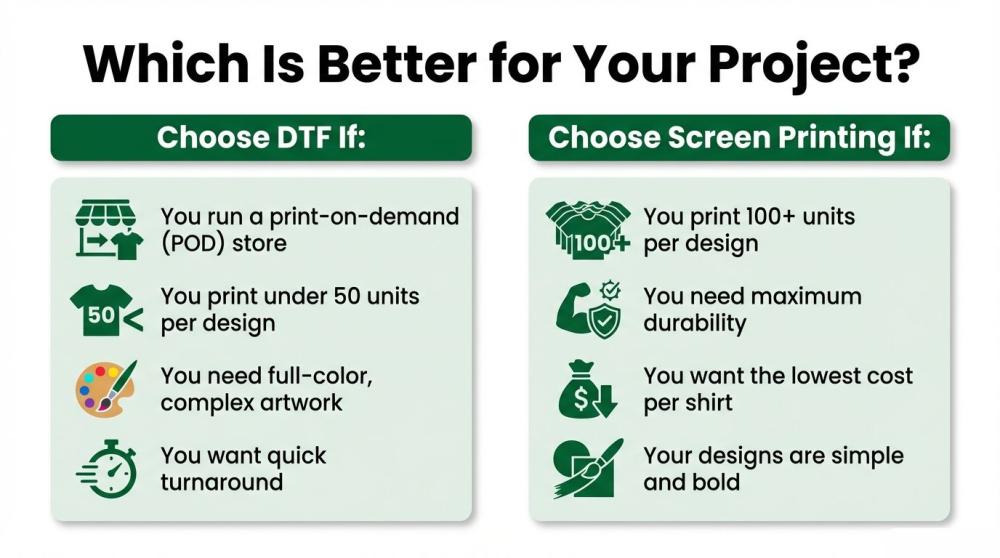
Which Is Better for Your Project?
When comparing DTF vs screen printing, the real question isn’t which method is better overall — it’s which one fits your production model, budget, and customer expectations. Each method solves a different business problem. Choosing correctly can protect your margins and improve print quality consistency.
Choose DTF If:
You run a print-on-demand (POD) store.
DTF printing is ideal for POD businesses because it eliminates complex setup. You can print one shirt at a time without burning screens or separating colors. This flexibility makes DTF highly efficient for Etsy sellers, Shopify brands, and small US-based apparel startups handling custom orders daily.
You print under 50 units per design.
In small runs, screen printing setup costs eat into profit margins, especially when compared to efficient gang sheet printing that allows multiple designs to be printed on one DTF sheet. DTF has a stable per-print cost, making it more economical for low-volume production. For short runs, personalization, or frequent design changes, DTF reduces labor and turnaround time significantly.
You need full-color, complex artwork.
If your designs include gradients, detailed illustrations, photorealistic graphics, or multi-color artwork, DTF is easier and more affordable. Unlike screen printing, DTF does not require one screen per color. This makes it the smarter choice for creative-heavy brands.
You want quick turnaround.
DTF requires minimal setup. Once the design is ready, printing and pressing can begin immediately. For rush orders or on-demand fulfillment, DTF outperforms traditional screen printing workflows.
Choose Screen Printing If:
You print 100+ units per design.
For bulk production, screen printing becomes significantly more cost-effective, although bulk DTF printing can still be practical for multi-design or variable data orders. Once screens are created, you can print hundreds of shirts quickly. In the DTF vs screen printing cost comparison, screen printing wins in high-volume environments.
You need maximum durability.
Screen printed garments, especially with plastisol inks, are known for long-term wash resistance. If you produce uniforms, workwear, or merchandise that will undergo heavy use, screen printing offers stronger durability.
You want the lowest cost per shirt.
In large batches, the setup cost spreads across volume, dramatically lowering the per-unit price. This makes screen printing ideal for schools, corporate events, and promotional apparel.
Your designs are simple and bold.
Logos, text-based designs, and solid spot colors are perfect for screen printing. The result is vibrant, bold, and consistent across hundreds of garments.
Conclusion
When comparing DTF vs screen printing, the right choice depends on your business model, order size, design complexity, and long-term goals. Direct to film printing vs screen printing is not about which method is superior — it’s about which one fits your workflow.
Choose DTF printing if you handle small batches, print-on-demand orders, or detailed full-color artwork. It offers flexibility, fast turnaround, and unlimited color capability.
Choose screen printing if you focus on bulk production, bold simple designs, and maximum durability. It delivers the lowest cost per shirt at high volumes and strong wash resistance.
In the DTF vs screen printing debate, volume favors screen printing, while versatility favors DTF. Evaluate your startup budget, production scale, artwork style, and customer expectations. The right printing method protects margins, ensures quality, and sets your custom apparel business up for long-term success.
Frequently Asked Questions
1. Does DTF last longer than screen printing?
No. Screen printing generally lasts longer over repeated wash cycles.
2. Does DTF feel better than screen print?
DTF feels smoother and thinner, while screen printing feels thicker and more textured.
3. Is DTF cheaper than screen printing?
DTF is cheaper for small orders. Screen printing is cheaper for large bulk runs.
4. Which is better for a small business?
DTF is often better for startups due to flexibility and lower setup complexity.
5. Can DTF crack after washing?
Yes, if not pressed properly or if low-quality materials are used.
6. Is screen printing outdated?
No. It remains the industry standard for bulk production in the US.
7. Which method has better color vibrancy?
Both can be highly vibrant. DTF handles gradients better. Screen printing excels in solid bold colors.