


Choosing between DTF transfers vs in-house printing is one of the biggest decisions a print shop, apparel brand, or merchandise business will make. While owning DTF equipment offers complete production control, it also comes with significant investment, ongoing maintenance, and operational responsibilities.
On the other hand, outsourcing production allows businesses to focus on sales and fulfillment while reducing overhead costs. The right choice depends on your production volume, budget, growth plans, and available resources. This guide compares both models in terms of equipment costs, scalability, maintenance, and long-term profitability so you can decide which option delivers the best return on investment.
Key Takeaways
-
Outsourcing DTF printing eliminates equipment investment and daily printer maintenance.
-
In-house DTF printing offers greater production control but requires higher operational costs.
-
Small businesses usually achieve faster profitability by buying ready-to-press transfers.
-
High-volume production may justify in-house printing once consistent order volume is established.
-
Equipment maintenance, labor, and failed prints should be included when calculating total printing costs.
-
The best solution depends on your business size, production goals, and long-term growth strategy.
DTF Transfers vs In-house Printing: Understanding Both Models
Before comparing costs, it's important to understand what each production model actually involves. While both ultimately produce the same finished garment, the way businesses reach that result is completely different.
What Is Outsourced DTF Printing?
Outsourced DTF printing means purchasing professionally manufactured transfers from a specialized supplier instead of printing them yourself. These custom DTF transfers arrive fully printed, cured, and ready to press onto garments using a heat press.
This model is widely used by:
-
Print shops
-
Apparel startups
-
Etsy sellers
-
Promotional product distributors
-
Corporate merchandise suppliers
-
Small clothing brands
Instead of managing printers, inks, and maintenance schedules, businesses simply receive transfers, apply them to garments, and ship completed orders.
If you're new to DTF technology, this detailed DTF printing guide explains the complete production process and how transfers are manufactured.
What Is In-house DTF Printing?
In-house DTF printing means your business owns and operates every stage of production. Artwork is printed directly onto PET film, adhesive powder is applied, the transfer is cured, and finally heat pressed onto garments.
This approach provides complete production control but also requires trained operators, dedicated workspace, regular equipment maintenance, and ongoing supply management.
It is typically chosen by businesses with:
-
High daily production volume
-
Dedicated production staff
-
Large commercial facilities
-
Long-term manufacturing strategies
DTF Transfers vs In-house Printing: Equipment Investment
One of the biggest differences between these two models is the initial investment. Many businesses underestimate the true cost of setting up an in-house DTF operation because they focus only on the printer itself.
What You Need for In-house DTF Printing
A complete commercial setup usually requires:
|
Equipment |
Purpose |
|
DTF Printer |
Prints artwork onto PET film |
|
Powder Shaker & Oven |
Applies and cures adhesive powder |
|
RIP Software |
Processes artwork and manages white ink layers |
|
Air Compressor |
Supports certain commercial printing systems |
|
Heat Press |
Applies finished transfers to garments |
|
Ventilation System |
Removes powder fumes and improves workplace safety |
|
White Ink Circulation System |
Prevents white ink from settling and clogging printheads |
Beyond purchasing equipment, businesses must also allocate space for production, curing, storage, and maintenance.
Ongoing Maintenance Adds to the Cost
Unlike outsourcing, owning DTF equipment requires daily attention. White ink must circulate continuously to prevent sediment from clogging printheads. Printers need regular cleaning, nozzle checks, and calibration to maintain color accuracy.
Even when no customer orders are being produced, the equipment still demands maintenance to remain operational. Ignoring these routines can result in expensive repairs, wasted materials, and production downtime.
How Outsourcing Changes the Investment
When businesses outsource DTF production, nearly all of these responsibilities disappear. There's no need to purchase printers, install ventilation systems, maintain curing equipment, or replace clogged printheads.
Instead, businesses invest primarily in blank garments and a quality heat press while allowing the supplier to manage the technical aspects of production. This significantly lowers financial risk and allows growing businesses to scale without committing substantial capital to manufacturing equipment.
DTF Transfers vs In-house Printing: Operating Costs
The initial investment is only one part of the equation. Long-term DTF printing costs often determine whether owning equipment remains profitable over time. Daily operating expenses can gradually exceed expectations if they aren't included in your financial planning.
Where In-house Costs Come From
Every print produced in-house consumes multiple resources, including:
-
DTF ink
-
PET transfer film
-
Adhesive powder
-
Electricity
-
Cleaning solution
-
Printer maintenance supplies
-
Labor hours
-
Equipment depreciation
Businesses also need to account for failed prints caused by clogged nozzles, incorrect settings, artwork adjustments, or production errors. These hidden expenses directly affect profitability but are frequently overlooked when comparing printing methods.
Outsourced Production Offers Predictable Costs
When you purchase ready-to-press DTF transfers, most production costs are already built into the transfer price. Ink, film, powder, machine maintenance, labor, quality control, and curing are all handled by the supplier, making budgeting much simpler.
Instead of calculating dozens of individual production expenses, businesses know exactly what each transfer costs before accepting customer orders.
Cost Comparison
|
Operating Expense |
In-house DTF Printing |
Outsourced DTF Transfers |
|
Ink |
✓ |
Included |
|
PET Film |
✓ |
Included |
|
Adhesive Powder |
✓ |
Included |
|
Electricity |
✓ |
None |
|
Equipment Repairs |
✓ |
None |
|
Labor |
High |
Low |
|
Failed Prints |
Business absorbs loss |
Supplier quality control minimizes risk |
|
Printhead Cleaning |
Daily |
None |
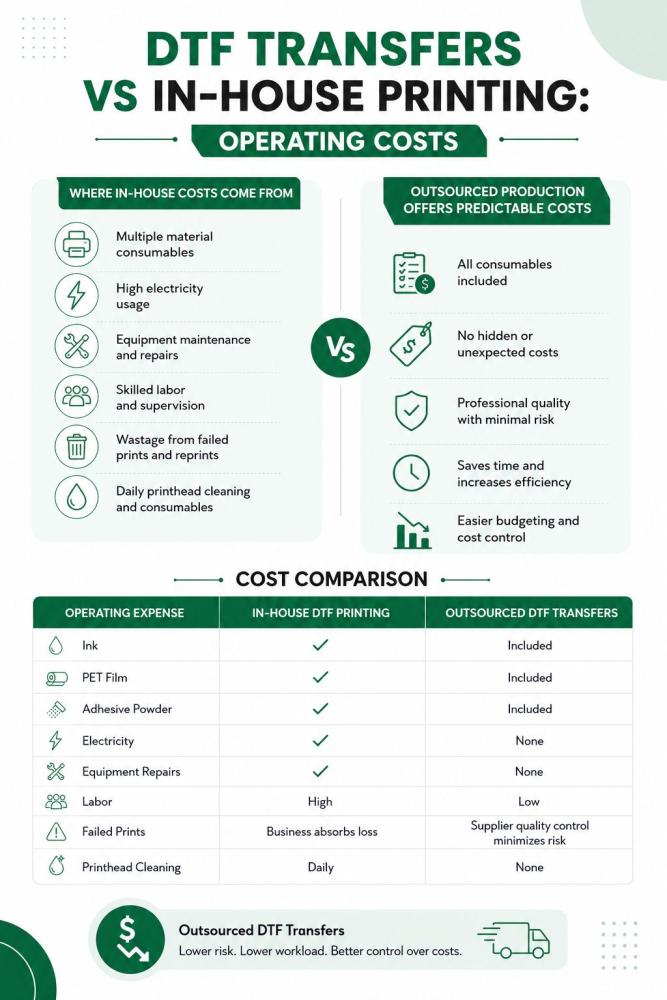
Although large production facilities may eventually reduce their per-print costs through equipment ownership, many smaller businesses discover that outsourcing delivers stronger overall profitability because it removes unpredictable operational expenses.
DTF Transfers vs In-house Printing: Time & Productivity
Time is one of the most overlooked business costs. The faster your workflow, the more customer orders you can complete without increasing staff or working longer hours.
Printing Everything Yourself
Running production in-house involves several individual steps:
-
Prepare artwork.
-
Print onto PET film.
-
Apply adhesive powder.
-
Cure the transfer.
-
Perform quality checks.
-
Heat press onto garments.
-
Clean equipment before the next production run.
While each step may seem manageable individually, together they create production bottlenecks, particularly during busy periods or when machines require maintenance.
Using Ready-to-Press Transfers
Businesses using ready-to-press DTF transfers receive completed transfers that have already been printed, powdered, cured, and inspected. Production begins immediately with garment positioning and heat pressing.
This streamlined workflow significantly reduces preparation time while increasing daily production capacity.
For businesses unfamiliar with professionally manufactured transfers, this guide explaining ready-to-press DTF transfers provides additional insight into how they simplify apparel decoration.
Better Productivity Means Better Customer Service
Shorter production workflows also improve customer experience. Businesses can process repeat orders faster, accept urgent projects with greater confidence, and spend less time managing production equipment. Instead of troubleshooting printers, staff can focus on customer communication, quality control, and business development.
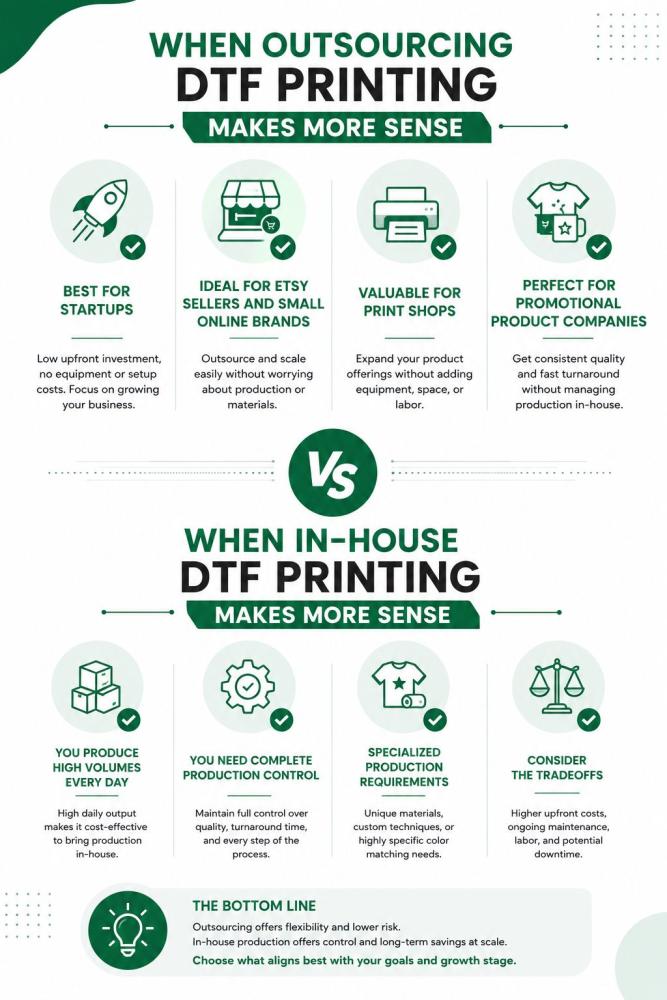
When Outsourcing DTF Printing Makes More Sense
Not every business needs to own production equipment. In fact, for many companies, outsourcing provides a more practical path to growth.
Best for Startups
New apparel businesses often need to preserve capital. Rather than spending thousands on production equipment, startups can launch products immediately by ordering wholesale transfers and investing their budget into marketing and customer acquisition.
Ideal for Etsy Sellers and Small Online Brands
Many Etsy businesses and independent clothing brands experience unpredictable order volumes. Outsourcing allows them to produce only what they sell, reducing financial risk while maintaining professional print quality.
Valuable for Print Shops
Traditional print shops can expand their service offerings without adding another production department. Outsourcing allows them to accept DTF orders without purchasing additional machinery or hiring specialized operators.
Perfect for Promotional Product Companies
Promotional product suppliers frequently decorate a wide variety of garments and accessories. Ordering transfers externally simplifies fulfillment while allowing them to focus on serving clients rather than operating print equipment.
Businesses handling recurring client work often benefit from bulk wholesale printing, which provides consistent production quality across large orders without increasing internal manufacturing costs.
Similarly, agencies and merchandise providers that want to grow without operating their own factory frequently rely on white-label production to deliver professionally produced transfers under their own brand, creating a seamless customer experience while maintaining operational efficiency.
When In-house DTF Printing Makes More Sense
Although outsourcing works well for many businesses, there are situations where in-house DTF printing becomes the smarter long-term investment. The decision largely depends on production volume, operational goals, and the level of control your business requires.
You Produce High Volumes Every Day
Businesses decorating hundreds or even thousands of garments every day can often recover their equipment investment over time. Once production reaches a consistent level, the cost per print may gradually decrease because the equipment is operating close to full capacity. This model is common among large apparel manufacturers and established print facilities with predictable order flow.
You Need Complete Production Control
Some businesses handle highly confidential artwork, urgent same-day orders, or products requiring frequent design changes. Producing transfers internally allows them to prioritize jobs, adjust schedules instantly, and monitor quality throughout every production stage without relying on external turnaround times.
Specialized Production Requirements
Certain commercial operations produce niche products that require constant testing, color calibration, or custom workflows. Businesses serving industrial clients or developing proprietary apparel collections sometimes benefit from maintaining complete control over the printing process.
Consider the Tradeoffs
Owning production equipment also means accepting its responsibilities. Equipment maintenance, printhead cleaning, white ink circulation, staff training, machine downtime, and replacement parts become part of daily operations. Even during slower business periods, these costs continue. For many growing businesses, outsourcing remains the more profitable option because it eliminates these operational burdens while still delivering professional-quality transfers.
Cost Comparison: Buying DTF Transfers vs Printing
Comparing the cost of ownership against outsourcing provides a clearer picture than looking at transfer pricing alone. The table below illustrates a simplified example for businesses decorating cotton T-shirts.
|
Cost Factor |
50 Shirts |
100 Shirts |
500 Shirts |
|
Equipment Depreciation |
High |
Medium |
Lower per garment |
|
Ink, Film & Powder |
Moderate |
Moderate |
Lower per garment |
|
Labor |
Moderate |
High |
High |
|
Utilities |
Low |
Medium |
Higher |
|
Production Waste |
Moderate |
Moderate |
Lower with experience |
|
Outsourced Transfer Cost |
Predictable |
Lower bulk pricing |
Lowest bulk pricing |
|
Estimated Profit Margin |
Higher with outsourcing |
Similar |
In-house may become more economical at very high volumes |
For most small businesses, outsourcing keeps costs predictable because there are no unexpected repair bills, maintenance interruptions, or material waste. Only businesses producing very high daily volumes generally see meaningful cost advantages from operating a full in-house production department.
Common Mistakes Businesses Make
Businesses often compare outsourcing and equipment ownership using incomplete information. Avoiding these common mistakes can save thousands of dollars and prevent unnecessary operational challenges.
Buying Equipment Too Early
Many startups invest in printers before establishing a stable customer base. The equipment sits idle while maintenance costs continue, reducing profitability instead of increasing it. It's often wiser to validate demand first before purchasing production machinery.
Ignoring Maintenance Costs
Daily printer maintenance is not optional. White ink circulation, nozzle cleaning, calibration, and preventive servicing all consume time and resources. Businesses that overlook these ongoing responsibilities frequently underestimate their true operating expenses.
Choosing the Cheapest Transfers
The lowest-priced supplier rarely provides the best value. Poor adhesion, inaccurate colors, inconsistent film quality, and peeling transfers often create customer complaints that cost far more than the initial savings.
Working with an Unreliable Supplier
Missed deadlines and inconsistent production quality damage customer relationships quickly. A reliable DTF transfer supplier should demonstrate consistent print quality, dependable turnaround times, and responsive customer support.
Calculating ROI Incorrectly
Many businesses compare only printer cost versus transfer price. A realistic ROI calculation should include labor, utilities, consumables, production failures, equipment depreciation, maintenance, and downtime. Looking at the complete financial picture usually leads to a more informed decision.
How to Choose a Reliable DTF Transfer Supplier
Selecting the right supplier directly affects product quality, customer satisfaction, and long-term profitability. Instead of comparing prices alone, evaluate suppliers using several practical criteria.
Consistent Print Quality
Every transfer should reproduce colors accurately, maintain sharp details, and withstand repeated washing. Request production samples before committing to larger wholesale orders to verify print quality firsthand.
Efficient Gang Sheet Production
Suppliers offering professional gang sheet optimization help reduce production waste while lowering the cost per design. This is especially valuable for businesses decorating multiple small graphics or recurring client orders.
Businesses can maximize material efficiency through gang sheet printing, which combines multiple designs onto a single transfer sheet without sacrificing print quality.
Reliable Turnaround Times
Production speed matters only when it's consistent. A supplier that reliably ships on schedule helps businesses confidently promise delivery dates to their own customers, even during busy seasons.
Strong Customer Support
Artwork adjustments, urgent orders, and production questions inevitably arise. Responsive support helps resolve issues quickly while minimizing disruptions to your workflow.
White-label Capabilities
Businesses planning to scale often benefit from suppliers offering white-label production, allowing them to expand services while maintaining their own branding and customer relationships without investing in manufacturing equipment.
If you're evaluating potential partners, this guide on choosing the best DTF provider in the USA explains the most important selection criteria in greater detail.
To Wrap Up
Choosing between DTF transfers vs in-house printing ultimately depends on your production volume, available resources, and long-term business strategy. Large manufacturers with consistent daily demand may benefit from owning equipment, while most print shops, apparel brands, startups, and promotional product businesses achieve greater flexibility and lower operational risk through outsourced production.
Understanding the true costs of equipment ownership—including maintenance, labor, and downtime—helps businesses make informed investment decisions. By partnering with a reliable supplier that delivers consistent quality and dependable service, companies can scale confidently while focusing on growth instead of managing production challenges.
Frequently Asked Questions
1. Is it cheaper to outsource DTF printing or print in-house?
For most startups, print shops, and growing apparel businesses, outsourcing DTF printing is usually more affordable. It eliminates equipment costs, maintenance, labor, and material waste while providing predictable production costs. In-house printing becomes cost-effective mainly for businesses producing high volumes every day.
2. How much does it cost to start in-house DTF printing?
A commercial in-house DTF setup requires investment in a printer, curing oven, RIP software, heat press, ventilation, white ink circulation system, and ongoing consumables. The total investment can range from several thousand dollars to tens of thousands depending on production capacity.
3. Who should buy ready-to-press DTF transfers?
Ready-to-press DTF transfers are ideal for apparel startups, Etsy sellers, promotional product companies, schools, sports teams, print shops, and businesses that want professional-quality decoration without operating their own printing equipment.
4. What should I look for in a DTF transfer supplier?
Choose a supplier that offers consistent print quality, durable transfers, fast turnaround, gang sheet options, responsive customer support, wholesale capabilities, and reliable production processes. Always request samples before placing large wholesale orders.
5. When does in-house DTF printing become profitable?
In-house DTF printing generally becomes more economical once a business consistently produces hundreds of garments every day. At lower production volumes, outsourcing often delivers higher profit margins because it removes equipment depreciation and maintenance expenses.
6. Can outsourced DTF transfers match in-house print quality?
Yes. Professional manufacturers often operate commercial-grade equipment with strict quality control, producing transfers that equal or exceed the consistency achieved by many smaller in-house operations.