
March 5, 2026 · Connor McDonnell
DTF Transfer Curing: What It Is and How It Affects Print Durability
Today, direct to film printing is a popular method for producing custom apparel not just in the USA but around the globe. It offers better color vibrancy, sharp and bright designs, as well as the choice for printing on a wide range of fabrics.
If your DTF prints are cracking, peeling, fading too soon, or failing the stretch test, the problem is rarely the artwork. In most cases, it comes down to one critical step: DTF transfer curing. It is a critical step in direct-to-film (DTF) printing that could make or break your product.
Many print shops in the USA or elsewhere focus heavily on artwork resolution, ink quality, and film type, but they often overlook the curing stage. Whether you're new to DTF printing or scaling production with gang sheet printing, understanding the DTF curing process is essential to ensure strong print and long-lasting DTF transfer durability.
Improper curing directly impacts adhesion, wash resistance, stretch performance, and overall print feel. If you’ve been wondering what is DTF curing, how to use DTF powder correctly, or how to cure DTF powder with heat press, this guide will break it down in detail.
Let’s start with the basics.
What Is Curing in DTF Printing?
Before we dive into the discussion about durability, we must first understand what is DTF curing.
DTF transfer curing stands for the process of melting and activating the “adhesive powder” applied to a printed DTF film. This step enables you to bond the ink layer to the adhesive, creating a stable transfer that can properly adhere to fabric during heat pressing.
In short, curing is an essential process to ensure direct to film transfer print quality and durability. Without proper curing, the adhesive will not bond effectively. Consequently, it will result in poor durability of your DTF transfers.
In Simple Terms:
Curing in DTF printing means:
-
Melting the adhesive powder evenly
-
Activating bonding properties
-
Preparing the transfer for heat pressing
-
Ensuring maximum adhesion strength
The DTF curing process typically involves controlled heat exposure using a curing oven or heat press hover method at a specific temperature for DTF powder curing.
When you perform curing correctly, it will significantly enhance your DTF print durability and ensure that your designs survive many repeat washes.
The Role of Pressure, Time, and Temperature in DTF Transfer Curing
There is a significant role of how you press, what temperature you use, and how long the process takes. If you want strong durability of your prints, mastering temperature, pressure, and time is non-negotiable. Let’s see how they impact the final product below.
1. Temperature
The correct DTF powder curing temperature typically ranges between:
-
250°F–320°F (120°C–160°C)
At this temperature range, you can ensure proper DTF adhesive curing. It also avoids the risk of burning the ink or film. What if it’s low or above this range?
If temperature is too low:
-
Powder won’t melt fully
-
Adhesion weakens
-
Prints peel after wash
If temperature is too high:
-
Adhesive over-melts
-
Film may warp
-
Ink may discolor
Precise temperature is critical for the best results. It directly impacts long-term durability of your DTF prints.
2. Time
Curing time is another crucial factor in the DTF curing process, typically ranging from 2–5 minutes depending on the equipment and temperature settings. The exact duration varies based on the curing method used, such as an oven, heat press hover technique, or automatic shaker system. Maintaining the correct curing time allows the adhesive powder to melt evenly and bond properly with the ink layer.
Short curing time:
-
Leads to undercuring
-
Causes poor bonding
Excess curing time:
-
Can damage adhesive properties
-
Reduces flexibility
The right balance ensures consistent durability of direct to film transfers.
3. Pressure (During Final Press)
While curing activates the adhesive powder, the pressure applied during the final heat press stage secures the design firmly onto the fabric. Proper, even pressure helps the adhesive layer bond smoothly with the garment fibers, improving overall DTF transfer longevity, stretch performance, and long-term wash resistance without damaging the print surface.
Inadequate pressure:
-
Creates incomplete bonding
-
Reduces stretch strength
Proper pressure:
-
Ensures even adhesion
-
Maximizes wash resistance
This trio — time, temperature, and pressure — determines overall DTF print durability.
Why DTF Transfer Curing Matters So Much
Proper DTF transfer curing is the foundation of durable and professional-quality prints. It ensures that the adhesive powder is properly melt and evenly distributed across the direct to film transfer. Consequently, the final transfer will be stable and bond correctly when heat pressed on an apparel.
Here’s why doing it correctly matters:
-
Ensures maximum durability of your DTF transfers
-
Prevents cracking after washing
-
Improves stretch performance
-
Enhances color vibrancy
-
Reduces return rates
-
Protects your brand reputation
-
Maintains consistency in bulk DTF printing
If you buy custom DTF transfers or bulk DTF printing, curing consistency becomes even more critical because production volume increases risk of errors.
Correct curing equals predictable results.
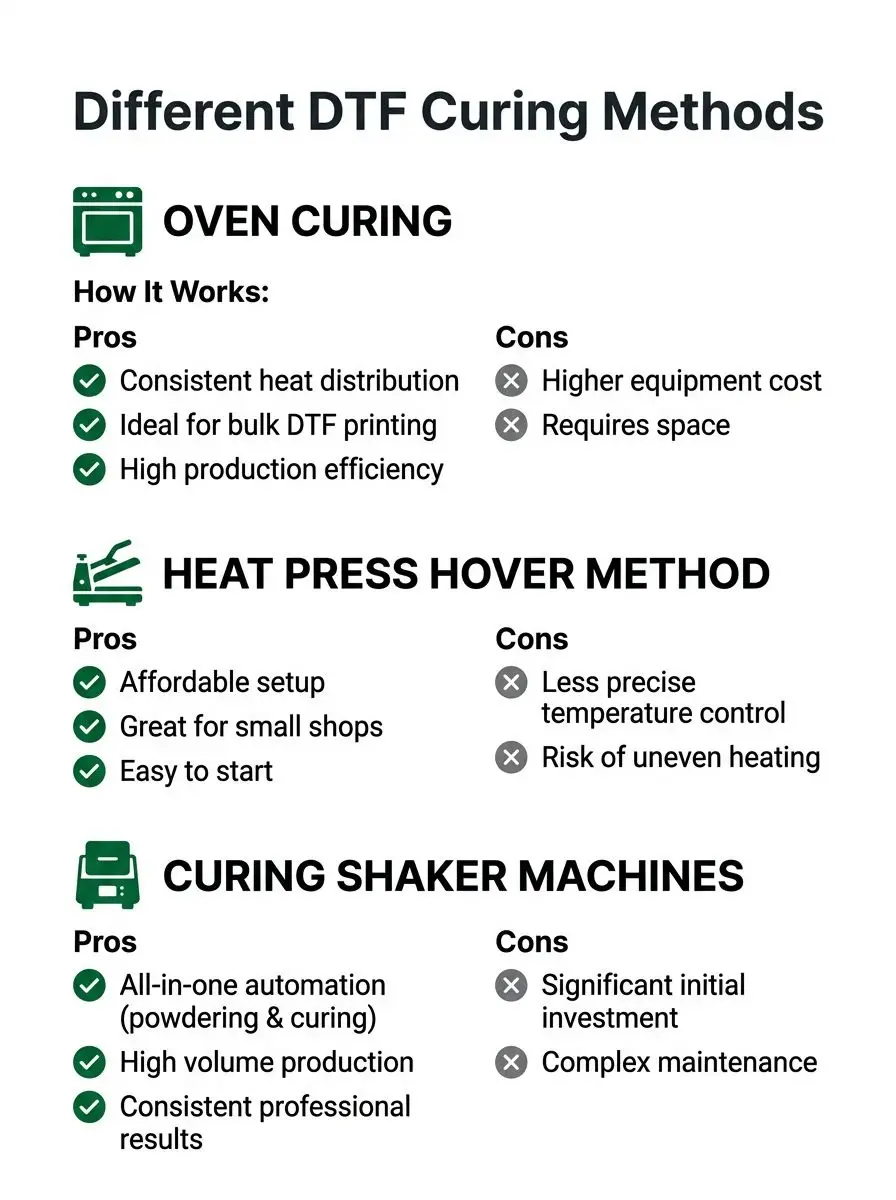
Different DTF Curing Methods (With Pros & Cons)
There are multiple ways to handle DTF transfer curing, and the method you choose can significantly influence production efficiency, adhesive bonding, and overall durability of your DTF transfer.
From small startup setups to fully automated production lines, each curing method offers different levels of temperature control, consistency, and scalability. Selecting the right curing approach helps maintain the correct temperature, ensures proper curing, and ultimately improves print durability across different order volumes and production environments.
1. Oven Curing
How It Works:
Transfer passes through conveyor oven at controlled DTF powder curing temperature.
Pros:
-
Consistent heat distribution
-
Ideal for bulk DTF printing
-
High production efficiency
Cons:
-
Higher equipment cost
-
Requires space
Pro Tip:
Calibrate oven weekly to maintain consistent durability of direct to film transfers.
2. Heat Press Hover Method
Many beginners ask how to cure DTF powder with heat press.
How It Works:
Heat press hovers slightly above film without touching it.
Pros:
-
Affordable setup
-
Great for small shops
-
Easy to start
Cons:
-
Less precise temperature control
-
Risk of uneven heating
Pro Tip:
Use infrared thermometer to verify platen heat consistency.
3. Curing Shaker Machines
Automated systems combine powdering and curing.
Pros:
-
Ideal for custom DTF transfers production
-
Uniform adhesive curing
-
Best for scalability
Cons:
-
Expensive investment
-
Requires maintenance
Pro Tip:
Perfect for businesses focused on gang sheet printing and high-volume orders.
Undercuring vs Overcuring: Two Durability Killers in DTF Transfer Curing
One of the biggest challenges in the process of DTF transfer curing is finding the perfect balance. It means you need to work with the right harmony between the temperature, pressure, and timing to avoid overcuring or undercuring. Both undercuring and overcuring damage DTF print quality and durability.
When the curing conditions are not optimized, prints can quickly lose their strength and appearance. Both undercuring and overcuring interfere with proper curing of your DTF transfers that ultimately reduce overall print durability and long-term performance.
Let’s break it down.
Undercuring in DTF Printing
Undercuring happens when adhesive powder does not fully melt.
Signs of Undercuring:
-
Powder appears grainy
-
Transfer feels rough
-
Peeling after first wash
-
Ink lifting from fabric
-
Weak stretch performance
Impact on Printing:
-
Poor DTF adhesive curing
-
Reduced DTF transfer durability
-
Customer complaints
-
High return rates
Solutions for Undercuring:
-
Increase curing time gradually
-
Verify correct DTF powder curing temperature
-
Use thermometer to confirm heat accuracy
-
Ensure even heat distribution
If you’re learning how to cure DTF powder with heat press, always test small batches first.
Overcuring in DTF Printing
Overcuring occurs when excessive heat or time breaks down adhesive strength.
Signs of Overcuring:
-
Burnt powder smell
-
Film distortion
-
Reduced flexibility
-
Brittle print texture
Impact on Printing:
-
Decreased stretch ability
-
Premature cracking
-
Compromised DTF print durability
Solutions for Overcuring:
-
Reduce curing time
-
Lower temperature slightly
-
Avoid direct platen contact during hover curing
-
Monitor film appearance carefully
Balance is key for optimal durability for DTF transfers.
How to Use DTF Powder Correctly
Understanding how to use DTF powder correctly is also essential for achieving consistent bonding between the printed ink and the fabric surface. Even small mistakes in powder coverage, storage, or handling can weaken adhesion and reduce the overall lifespan of the transfer. Proper technique ensures smoother curing, stronger bonding, and improved durability of your direct to film transfers even after repeated washing and stretching.
Steps:
-
Print design onto PET film
-
Apply powder evenly over wet ink
-
Shake off excess powder
-
Ensure full coverage of printed areas
-
Begin DTF curing process
Improper powder application causes uneven adhesion and affects your transfers’ durability.
Pro Tip: Store powder in low-humidity environment to prevent clumping.
How Proper Curing Impacts Long-Term Durability
When executed correctly, DTF transfer curing delivers:
-
High wash resistance (40–50+ washes)
-
Strong stretch recovery
-
Crack-resistant finish
-
Soft hand feel
-
Professional-grade appearance
Incorrect curing leads to rapid deterioration and low customer trust.
Whether you're printing for small orders or bulk DTF printing, curing consistency directly defines durability of DTF transfer and print.
Final Advice: Master Curing Before Scaling
If you want reliable, long-lasting prints, mastering DTF transfer curing must become your priority.
Remember:
-
Maintain correct DTF powder curing temperature
-
Monitor time carefully
-
Apply even pressure
-
Avoid undercuring and overcuring
-
Use proper powder application techniques
-
Test frequently before large runs
Whether you're using custom DTF transfers or printing transfers yourself, curing quality determines your final product’s durability.
In DTF printing, the difference between average and professional-grade output often comes down to one step: curing precision.
Get that right — and your DTF print durability will speak for itself.
FAQs
1. What temperature is required for DTF powder curing?
The ideal DTF powder curing temperature typically ranges between 250°F and 320°F (120°C–160°C) depending on the film, powder type, and curing method used.
2. Can you cure DTF powder with a heat press?
Yes. Many printers cure DTF powder using the heat press hover method, where the press hovers over the transfer without touching it to evenly melt the adhesive.
3. How does curing affect DTF print durability?
Proper curing ensures the adhesive fully melts and bonds with the ink layer, which improves DTF transfer longevity, wash resistance, stretch performance, and long-term print stability.
4. What happens if DTF powder is undercured?
Undercuring causes weak adhesion, resulting in peeling, cracking, powder residue, and reduced wash durability after the garment is pressed and washed.
5. What is the best curing method for bulk DTF printing?
For high-volume production like gang sheet printing or bulk DTF printing, conveyor ovens or automated shaker curing machines provide the most consistent temperature control and reliable results.