
September 22, 2026 · Connor McDonnell
DTF Gang Sheets for Growing Apparel Businesses: The Practical Bulk-Order Operations Guide
A DTF gang sheet is more than a way to place several graphics on one piece of film. For a growing apparel business, it can become the foundation of a repeatable production system.
The difference matters. A first-time buyer may only need to fit artwork onto a sheet. A print shop, clothing brand, or promotional supplier needs to answer more practical questions: Which customer orders should be grouped together? How many copies of each design are needed? What is the real cost per usable transfer? How should transfers be labeled after cutting? When should a supplier be tested or replaced?
This guide focuses on those operational decisions. It explains how to use DTF gang sheets to plan production, control costs, reduce errors, and create a reliable process for bulk DTF transfers, DTF transfers in bulk, and wholesale DTF transfers.
Why bulk DTF transfers require a system
Ordering one transfer at a time is manageable when you are producing occasional garments. As order volume increases, the main challenge is no longer simply getting a design printed. The challenge is coordinating artwork, quantities, garments, deadlines, transfer inventory, heat-press work, and quality checks without losing margin.
A well-managed gang-sheet workflow helps by grouping compatible work into planned batches. It can reduce repeated ordering steps, make transfer inventory easier to forecast, and give your team a consistent way to process similar jobs.
The goal is not to fill every available inch at any cost. The goal is to create the lowest-cost, lowest-error production batch that can be cut, sorted, pressed, and delivered efficiently.
That distinction prevents a common mistake: measuring success only by how tightly artwork fits on the film. A crowded layout may save material but take longer to cut or create more sorting errors. Your best layout balances film utilization with labor, accuracy, and turnaround.
The five decisions to make before ordering DTF transfers in bulk
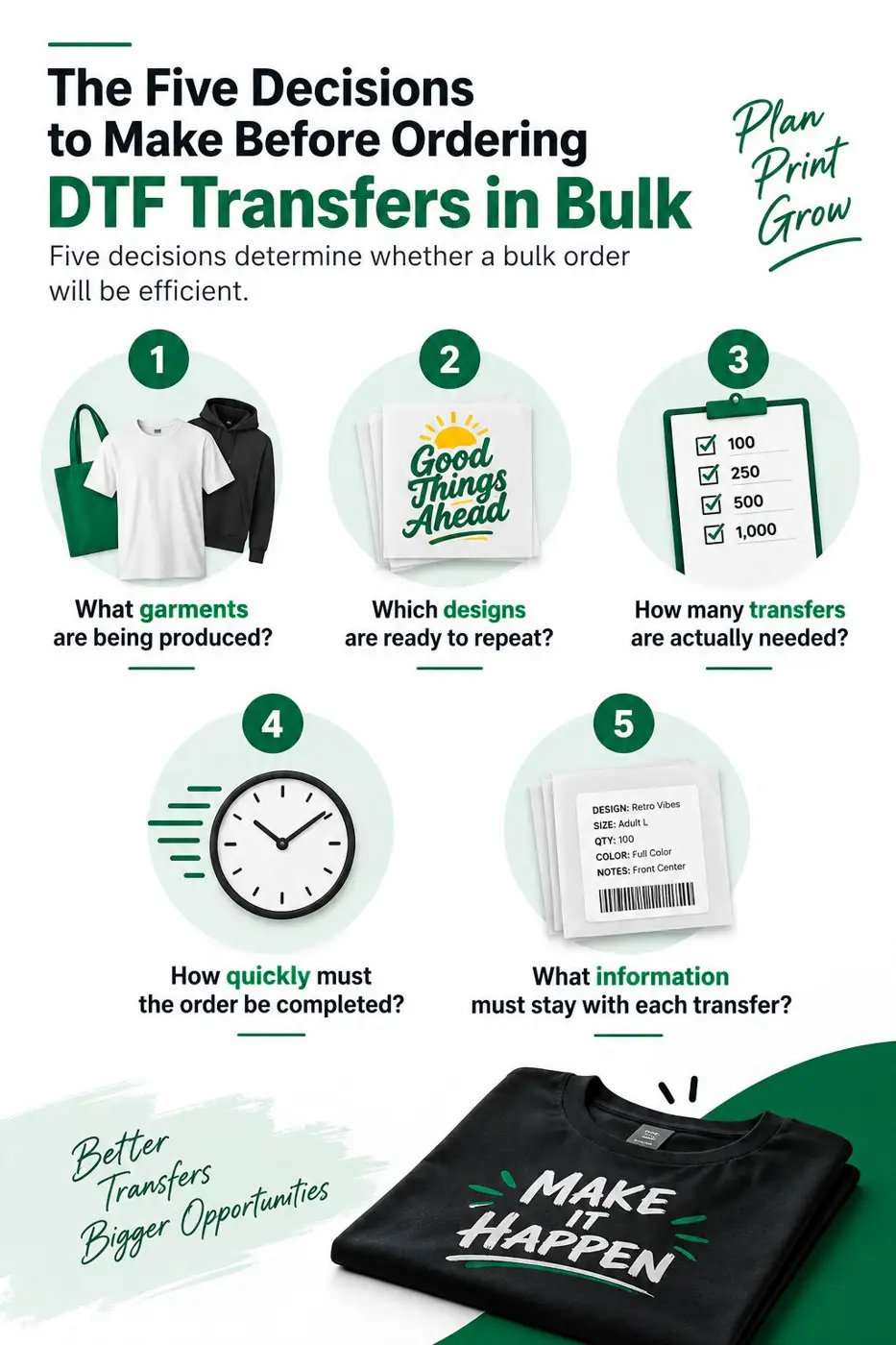
Before preparing a file or choosing a sheet size, document the production requirements. Five decisions determine whether a bulk order will be efficient.
1. What garments are being produced?
Separate the order by garment type and placement. A left-chest logo for a T-shirt, a full-back graphic for a hoodie, and a sleeve design may use different dimensions and may not belong in the same operational batch.
Record the garment style, color, size range, print placement, and number of finished pieces. This prevents a common fulfillment problem: having the correct artwork but the wrong quantity or placement for the garments waiting on the production table.
2. Which designs are ready to repeat?
Create a list of approved artwork rather than rebuilding every design for every order. Give each design a consistent internal name, such as brand-name-left-chest, event-front-11-inch, or team-number-sleeve.
A repeatable naming system makes reorders faster and reduces the chance of using an outdated logo, incorrect spelling, or unapproved color version.
3. How many transfers are actually needed?
Count required transfers by design, size, placement, and customer. Add a small number of spares only when the value of avoiding a replacement is greater than the cost of the extra transfers.
Avoid ordering large quantities simply because a design is popular. Demand forecasts should be based on confirmed orders, planned launches, or documented reorder history. Excess transfer inventory ties up cash and may become obsolete when a logo, event date, or product design changes.
4. How quickly must the order be completed?
A large gang sheet may look economical, but it can be the wrong choice for an urgent order if waiting for the complete batch delays production. Divide work by deadline when necessary.
A useful schedule separates jobs into three groups:
• Immediate production: confirmed orders with near-term delivery dates.
• Planned production: approved work scheduled for the next production cycle.
• Speculative production: designs being tested or held for possible future demand.
Only the first two categories should normally be included in a committed production batch.
5. What information must stay with each transfer?
Decide how the finished transfers will be identified after the gang sheet is cut. If one sheet contains artwork for several customers, the team needs a reliable sorting method.
Use order numbers, design codes, placement labels, or a simple batch sheet. A few minutes of organization can prevent a much more expensive mistake, such as pressing a customer’s logo on the wrong garment.
A practical way to calculate the cost of a DTF gang sheet
The advertised sheet price is only one part of the cost. To understand whether DTF transfers in bulk are profitable, calculate the cost of the usable transfers that the order will produce.
Use this basic formula:
Cost per usable transfer = Total batch cost ÷ Number of usable transfers
Total batch cost may include the transfer sheet, artwork preparation, shipping, cutting time, sorting time, and an allowance for failed or damaged pieces. You can start with the sheet and shipping costs, then add labor as your production volume grows.
For example, suppose a sheet and its shipping allocation cost $48.
The layout produces 32 usable transfers, so the film-and-shipping cost is:
$48 ÷ 32 = $1.50 per usable transfer
Now compare that with a sheet that costs $36 but produces only 16 usable transfers:
$36 ÷ 16 = $2.25 per usable transfer
The cheaper sheet has the higher effective transfer cost. This is why utilization should be measured by usable output rather than by the lowest total invoice.
Include labor in larger production calculations
When volume increases, cutting and sorting can become significant production costs. If one layout saves a small amount of film but adds substantial handling time, it may not improve the final margin.
Track the time required to:
• Prepare and check the artwork.
• Build or review the sheet layout.
• Cut the printed sheet.
• Sort transfers by order and placement.
• Press the garments.
• Inspect and pack the finished items.
You do not need a complicated accounting system. A spreadsheet with batch number, sheet cost, quantity, labor minutes, shipping, waste, and finished output is enough to reveal which workflows are actually profitable.
How to batch customer orders without creating confusion
Combining customer orders is one of the most useful applications of gang-sheet production. It is also where many avoidable mistakes occur.
Group compatible work, not just available work
Two jobs can share a gang sheet only if their artwork dimensions, deadline, and handling requirements make sense together. Do not combine every open order simply to fill the sheet.
Good batching groups may include:
• Several small left-chest logos.
• Multiple versions of one clothing-brand label.
• Similar event or team designs with the same deadline.
• Repeated sleeve graphics and neck prints.
• Small customer orders that can be cut and sorted using the same process.
Avoid mixing urgent work with speculative designs, or placing a fragile deadline-dependent order inside a batch that will not be processed immediately.
Use a batch record
For every sheet, record the batch number, date, supplier, sheet size, design codes, quantities, and associated order numbers. Keep the record with the sheet until all transfers have been cut and sorted.
A batch record should answer three questions at a glance:
1 What is on this sheet?
2 Which customer or product does each transfer belong to?
3 Has every design been accounted for?
This small control makes bulk DTF transfers much easier to manage as the team grows.
A better inventory system for recurring DTF transfers
Businesses that order repeatedly should separate artwork approval from transfer inventory. A design can be approved and stored digitally without being printed in advance.
Maintain three simple lists:
Approved artwork
This list contains the current, production-ready file for each design. Include its final size, placement, color version, and date of approval.
In-production orders
This list contains the transfers that have been ordered but not yet received, cut, or pressed. Include the supplier, order number, expected arrival date, and quantity.
Available transfer inventory
This list records unused transfers that are ready for future garments. Track the design, size, placement, quantity, and storage location. For easier inventory planning, refer to the DTFS DTF Transfer by Size page when organizing transfers by size and order requirements.
Use a first-in, first-out approach for stored transfers when practical. It reduces the chance of overlooking older inventory and makes it easier to identify which batch produced a quality issue.
How to evaluate a wholesale DTF transfer supplier
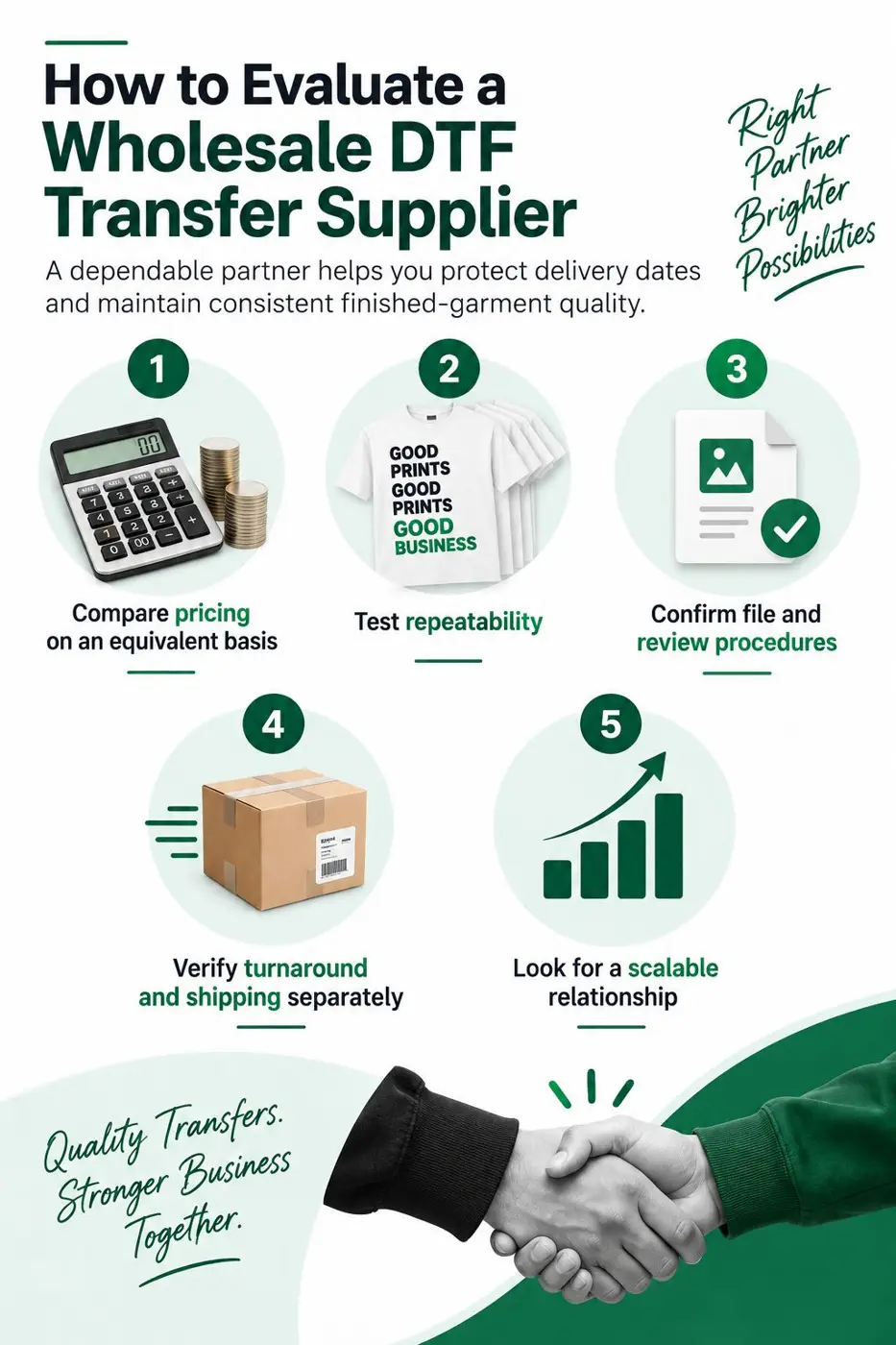
A supplier for wholesale DTF transfers should be judged on the complete production experience, not only on the advertised price. A dependable partner helps you protect delivery dates and maintain consistent finished-garment quality.
Compare pricing on an equivalent basis
Ask what the price includes. Compare suppliers using the same sheet dimensions, artwork coverage, quantity, shipping method, and turnaround target. A price per sheet is not meaningful if one supplier includes services or shipping that another lists separately.
Test repeatability
A sample tells you whether a supplier can produce one acceptable transfer. A better test is to order the same design in more than one batch and compare color, detail, adhesive coverage, edges, and pressing performance.
Repeatability becomes more important as your business grows. Your customers expect a reorder to look like the original product.
Confirm file and review procedures
Find out whether files are automatically produced, manually reviewed, or held for clarification. Ask how the supplier handles transparent backgrounds, small text, fine details, incorrect dimensions, and artwork that does not meet specifications.
Clear procedures reduce surprises and give your team a consistent way to submit files.
Verify turnaround and shipping separately
Production turnaround is not the same as total delivery time. Confirm when production begins, whether the order is held for artwork approval, and how long shipping usually takes to your location.
Build a buffer into customer deadlines. A supplier that is slightly more expensive but consistently meets its stated schedule may be more valuable than a supplier with a lower price and unpredictable delivery.
Look for a scalable relationship
Your requirements may change from occasional sheets to recurring DTF transfers in bulk. Ask whether the supplier can support larger volumes, recurring designs, wholesale pricing, and consistent quality-control expectations as your business expands.
DTFS.co presents its service as supporting print shops, apparel brands, creators, and growing businesses with press-ready DTF transfers, from individual gang sheets through wholesale production.
Receiving and inspecting a bulk order
Do not move a new shipment directly from the box to the press. A short receiving inspection can catch issues before the transfers are mixed with inventory or applied to customer garments.
Check the following:
• Order quantity and sheet dimensions.
• Design names, versions, and quantities.
• Visible color or registration problems.
• Missing areas, tears, or damaged film.
• Edges and fine details.
• Adhesive coverage where visible or testable.
• Packaging and moisture exposure.
• Transfer instructions supplied by the printer.
Press a sample on the intended garment type before beginning a large batch. Follow the supplier’s temperature, pressure, time, and peel instructions. Application guidance commonly emphasizes removing lint and moisture, pre-pressing the garment briefly, using sufficient pressure, following the correct peel method, and waiting before the first wash.
If a problem appears, photograph the transfer, garment, press settings, and packaging. Record the batch number and contact the supplier promptly. A clear record makes troubleshooting faster and helps determine whether the issue came from the artwork, transfer, garment, or application process.
How to reduce bulk-order errors after cutting
The most expensive mistake is often not a printing defect. It is a correct transfer applied to the wrong garment.
Use a physical or digital workflow that keeps each transfer connected to its order. For example, place cut transfers into labeled bags by customer and then subdivide them by placement. Keep a printed production ticket with each garment bundle.
Before pressing, verify three items:
4 The garment order or ticket.
5 The transfer design and placement.
6 The size and color of the garment.
For high-volume jobs, have a second person verify the first few pieces of each design. This is particularly important when several artwork versions look similar.
When should you reorder DTF transfers in bulk?
Reorder timing should be based on demand and supplier lead time, not on guesswork. A simple reorder point is:
Average usage during supplier lead time + safety stock = reorder point
If you use 20 transfers per week and a supplier usually needs two weeks to produce and ship an order, your lead-time demand is approximately 40 transfers. Add a safety stock that reflects seasonal demand and the cost of running out.
Do not use the same safety stock for every design. A frequently reordered evergreen logo may deserve more coverage than a dated event graphic. Review inventory after major launches, seasonal peaks, and changes in customer demand.
What to do with the original draft content
The broad educational sections from a general gang-sheet guide are still useful, but they should support this operations-focused article rather than dominate it. Keep definitions short, link to DTFS.co’s existing guides for detailed layout instructions, and use this page for the decision-making work that those articles do not fully cover.
Recommended internal links include:
• The existing guide explains how to make a DTF gang sheet.
• The existing article comparing gang sheets with individual transfers.
• The existing article explaining wholesale DTF transfers.
• The existing article about bulk gang-sheet orders for print shops.
This structure gives each page a clear role instead of publishing another article that repeats the same introduction, artwork checklist, and definition.
Final bulk-order checklist
Before placing your next order, confirm the following:
• The customer orders and deadlines are documented.
• Every design has an approved file and design code.
• Required quantities are separated by placement and size.
• The batch contains compatible work.
• The estimated cost per usable transfer is acceptable.
• Artwork versions and names have been checked.
• The supplier’s current file requirements are confirmed.
• Turnaround and shipping time fit the production schedule.
• A receiving and quality-control plan is ready.
• Each cut transfer can be traced back to an order.
• Reorder quantities are based on usage history.
Build a more reliable DTF gang-sheet workflow with DTFS.co
The value of DTF gang sheets increases when they are treated as part of a production system rather than as a one-time layout exercise. Plan the batch, measure usable output, document the order, inspect the shipment, and record what should be repeated.
That process helps print shops and apparel brands use bulk DTF transfers with fewer avoidable errors and more predictable margins. It also creates a clearer path to wholesale DTF transfers when order volume becomes consistent.
For press-ready transfers and scalable production support, visit DTFS.co to explore your options for DTF gang sheets and recurring transfer orders.
Frequently asked questions
What is the best way to manage DTF gang sheets for multiple customers?
Assign every sheet a batch number and record the design, quantity, and customer order associated with each section. After cutting, sort transfers into labeled order bags before pressing any garments.
Are DTF transfers in bulk always cheaper?
Not automatically. Bulk ordering can reduce the cost per usable design when the artwork uses the sheet efficiently, but large unused areas, unnecessary inventory, extra handling, or expedited shipping can reduce the savings.
When should a small business start buying wholesale DTF transfers?
Consider wholesale purchasing when you have repeatable monthly demand, recurring designs, or a need for predictable pricing and capacity. Base the decision on documented usage rather than a single unusually large order.
How many extra transfers should I order?
Order only the number of spares justified by the value of avoiding a replacement and the likelihood of application or handling errors. For dated or highly customized designs, avoid building excess inventory.
Should every design go on the same gang sheet?
No. Group designs that share a deadline, handling process, and production priority. Combining incompatible work can create sorting delays and increase the risk of applying the wrong transfer.
How can I compare two bulk DTF suppliers?
Compare equivalent sheet sizes, total landed cost, production turnaround, shipping time, file review, reprint policy, application performance, and repeatability across more than one order.
How should I store unused DTF transfers?
Keep them flat, clean, dry, and protected from excessive heat, moisture, dust, and direct sunlight. Label the design, size, placement, quantity, and batch number so the inventory can be identified later.