
September 18, 2026 · Connor McDonnell
DTF Gang Sheet Pricing Guide for Wholesale Buyers: Costs, Pricing, and Bulk Order Savings
If you are comparing DTF gang sheet pricing for a wholesale apparel business, the headline price is only one part of the decision. Your real cost depends on the sheet size, artwork arrangement, usable print area, quantity, shipping, application time, and the number of finished garments you can produce from each order. A supplier with a slightly higher sheet price may still give you a lower cost per shirt if the transfers are consistently printed, efficiently nested, and ready to press.
This guide explains DTF gang sheet cost, wholesale pricing factors, cost per transfer, and practical ways to protect your margin. It also shows how to use the Order Transfers, DTF Transfer by Size page, and Bulk & Wholesale Printing page when planning a commercial order.
What Is a DTF Gang Sheet?
A DTF gang sheet is a sheet of direct-to-film transfers that contains multiple designs arranged together on one printed film. Instead of ordering each logo or graphic as a separate transfer, a buyer uses the available sheet area to combine several designs. The designs may be different sizes, repeated logos, left-chest prints, sleeve graphics, names, numbers, or illustrations for a single apparel collection.
The key commercial advantage is space utilization. When several designs share one sheet, you can reduce wasted film and spread setup and production costs across more transfers. This makes gang sheets especially useful for wholesale buyers who need a mix of designs or many copies of the same design.
A gang sheet does not automatically produce the lowest price. Poor spacing, oversized artwork, excessive empty space, or a mismatch between sheet size and order quantity can reduce the value of the purchase. The goal is not simply to buy the largest sheet. The goal is to create the most usable transfers per sheet while preserving quality and making pressing efficient.
DTF Gang Sheet Pricing: What Determines the Final Price?
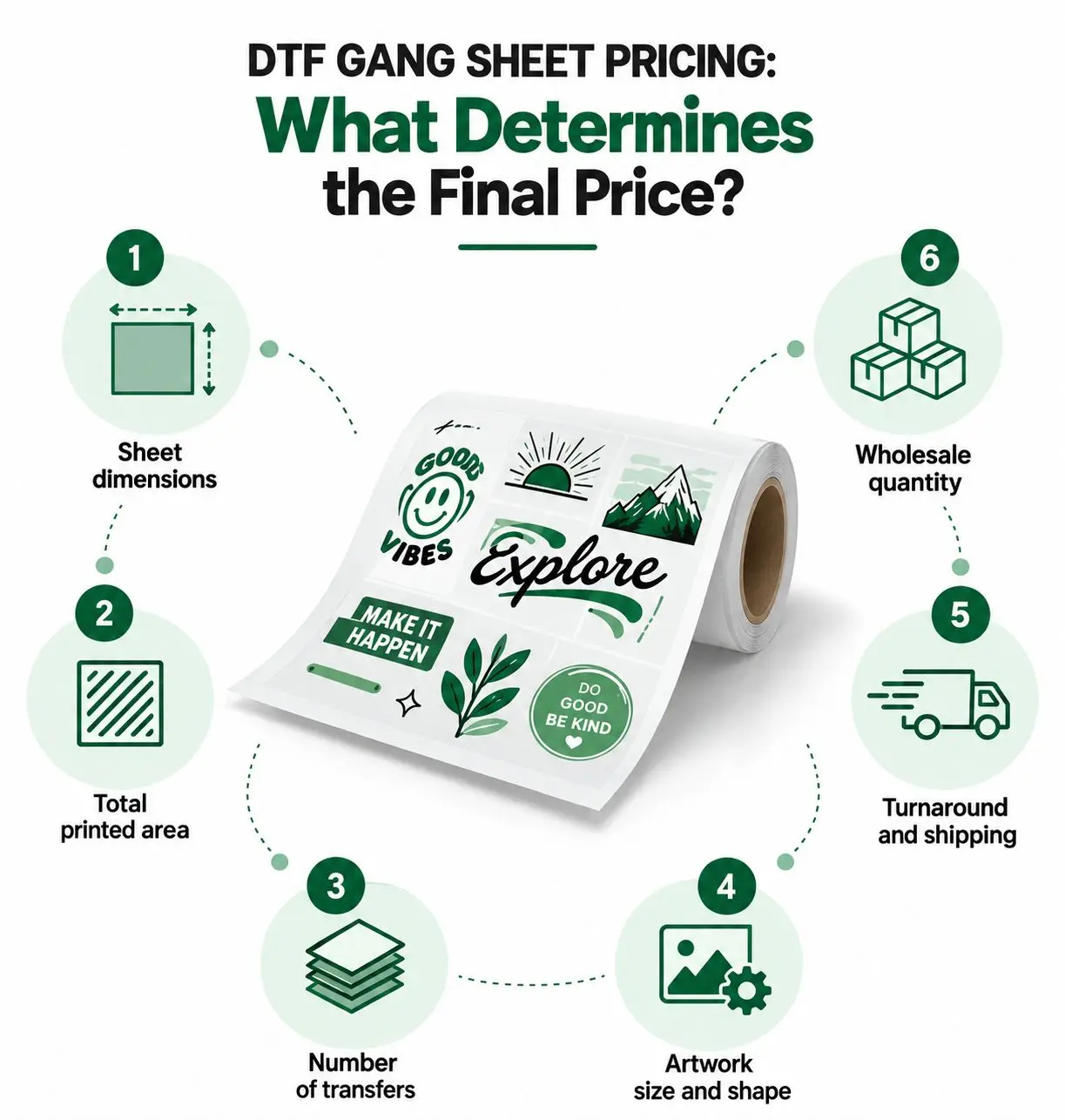
DTF gang sheet pricing is usually influenced by six major factors: sheet dimensions, printed area, quantity, artwork complexity, turnaround requirements, and shipping. Suppliers may display pricing in different ways, so compare the final delivered order rather than one number in isolation.
1. Sheet dimensions
Larger sheets contain more printable area and can hold more artwork. A small sheet may be suitable for sample orders, individual logos, or a limited number of garments. Larger sheets are usually more efficient for production runs because they let you place more transfers in one order.
The most suitable size depends on your actual artwork. If your designs are small, several smaller sheets may be easier to handle than one oversized sheet. If you are printing large front graphics or many repeated logos, a larger sheet may lower your cost per transfer.
2. Total printed area
Some suppliers price by sheet size, while others calculate by the length or total area used. Read the pricing model carefully. A quote based on a full sheet may be attractive when the artwork fills the sheet, but less attractive if half of the film remains empty.
Before ordering, place your designs into a gang-sheet layout and estimate the usable area. A visual builder can make this process easier because it shows how much space your artwork uses and where additional copies may fit.
3. Number of transfers
The number of finished transfers is often more important than the sheet price. If a sheet costs $40 and produces 20 usable transfers, the film cost is $2 per transfer. If better nesting allows 30 usable transfers on the same sheet, the film cost falls to approximately $1.33 per transfer.
This is why buyers should calculate the cost per usable transfer rather than assuming the lowest sheet price is the best option.
4. Artwork size and shape
A rectangular design may be easier to nest than a wide, irregular illustration. Large gaps between artwork elements also reduce the number of transfers that fit on a sheet. Prepare artwork at the intended production size before calculating your order.
5. Turnaround and shipping
Fast production and shipping can be valuable when you have a deadline, but they may change your landed cost. Include shipping in your calculation, especially when comparing suppliers or ordering several sheets separately.
6. Wholesale quantity
Wholesale pricing often improves when order quantities increase. Ask whether volume discounts apply by sheet, by order value, by repeat purchase, or by monthly spend. A supplier may offer a better rate for a larger single order, while another may reward recurring orders over time.
DTF Gang Sheet Cost: How to Calculate It Correctly
To understand dtf gang sheet cost, use a simple landed-cost formula:
Landed cost per transfer = (sheet price + shipping + applicable fees) ÷ number of usable transfers
For a finished-shirt calculation, add the garment and pressing cost:
Estimated transfer-based shirt cost = transfer cost + garment cost + application labor + packaging + payment or marketplace fees
For example, suppose a gang sheet costs $45, shipping is $8, and the sheet contains 25 usable transfers.
The landed transfer cost is:
($45 + $8) ÷ 25 = $2.12 per usable transfer
If the blank garment costs $4.50, application labor is $1.25, packaging is $0.35, and transaction fees average $0.40, the direct production cost becomes approximately $8.62 before overhead and profit. This figure helps you set a selling price based on actual economics instead of guessing from the transfer price alone.
The calculation changes when a sheet contains different designs. If ten large front prints and twenty small sleeve or left-chest prints share the same sheet, assign the sheet cost according to the area used by each design.
You can use a simple area allocation method:
Allocated design cost = design area ÷ total used sheet area × sheet cost
This is not the only accounting method, but it is more accurate than assigning an identical cost to every design when the sizes are very different.
How Much Does a DTF Gang Sheet Cost?
The answer to how much does a DTF gang sheet cost depends on the sheet format and supplier. A small sample sheet may cost far less in absolute dollars than a full production sheet, but its cost per transfer can be higher. A full sheet may require more upfront cash but produce a lower unit cost when fully utilized.
For planning purposes, compare three scenarios:
|
Order scenario |
Main advantage |
Main risk |
Best use |
|
Small or sample sheet |
Lower upfront commitment |
Higher cost per transfer |
Testing artwork or launching a new product |
|
Medium gang sheet |
Balanced cash flow and output |
Requires reasonable design planning |
Regular small-business orders |
|
Large wholesale sheet |
Strongest unit economics when filled |
Higher upfront spend and handling |
Repeat production and bulk orders |
Do not choose a sheet solely because it has the lowest advertised price. Confirm the printable dimensions, minimum order, number of designs allowed, peel type, expected turnaround, shipping charge, and artwork requirements.
For a business targeting higher monthly order value, a larger gang sheet may also increase average order value. However, only order more than you can sell or use if the designs are evergreen. Buying excessive quantities of seasonal or untested artwork can create inventory risk.
DTF Wholesale Pricing: How Volume Discounts Work
DTF wholesale pricing is designed for buyers who order repeatedly or purchase larger quantities. The discount may be structured around the number of sheets, total printed area, number of transfers, or total monthly spend.
When asking for wholesale pricing, provide enough information for the supplier to quote accurately. Include the average sheet size, estimated monthly quantity, common artwork dimensions, preferred turnaround, and whether you need mixed designs on a sheet. A vague request for the “best price” may produce a quote that cannot be compared fairly.
Ask these questions before placing a wholesale order:
1 Is the quoted price based on a full sheet or the actual printed area?
2 Can different designs be combined on one sheet?
3 Are repeat orders eligible for a lower rate?
4 Is shipping included in the quote?
5 Are artwork checks or revisions included?
6 What is the expected production turnaround?
7 Is there a minimum order quantity?
8 How are damaged or misprinted transfers handled?
9 Are the transfers supplied ready to press?
10 Can the supplier support a growing monthly order volume?
Wholesale pricing should improve your economics without reducing reliability. If poor color consistency, peeling, delayed shipping, or incorrect sizing causes rework, the apparent discount may disappear.
For recurring print-shop demand, review the DTFS Bulk & Wholesale Printing service and contact the supplier with your expected order pattern. A commercial quote can then be based on your actual production requirements rather than a generic retail price.
DTF Transfer Price per Shirt: From Film to Finished Product
The DTF transfer price per shirt is only one component of your final product cost. A transfer that costs $1.50 does not mean the shirt costs $1.50 to produce. Include the blank shirt, pressing labor, packaging, payment processing, marketplace commissions, artwork preparation, spoilage, and overhead.
Use this pricing model:
Selling price = total direct cost + operating overhead allocation + desired profit
If your direct cost is $8.62 and you want a 40% gross margin, do not simply add 40% to the cost. Gross margin is calculated from the selling price:
Selling price = direct cost ÷ (1 − target margin)
At a 40% gross margin, an $8.62 direct cost produces a price of approximately $14.37 before any special shipping or sales-tax treatment. Your market, garment quality, design complexity, and customer service can justify a higher price.
For wholesale customers, you may offer tiered pricing. For example, the unit price may be higher for ten shirts, lower for 25 shirts, and lower again for 100 shirts. Make sure every tier remains profitable after labor and fees. Volume should improve production efficiency, not create unpaid work.
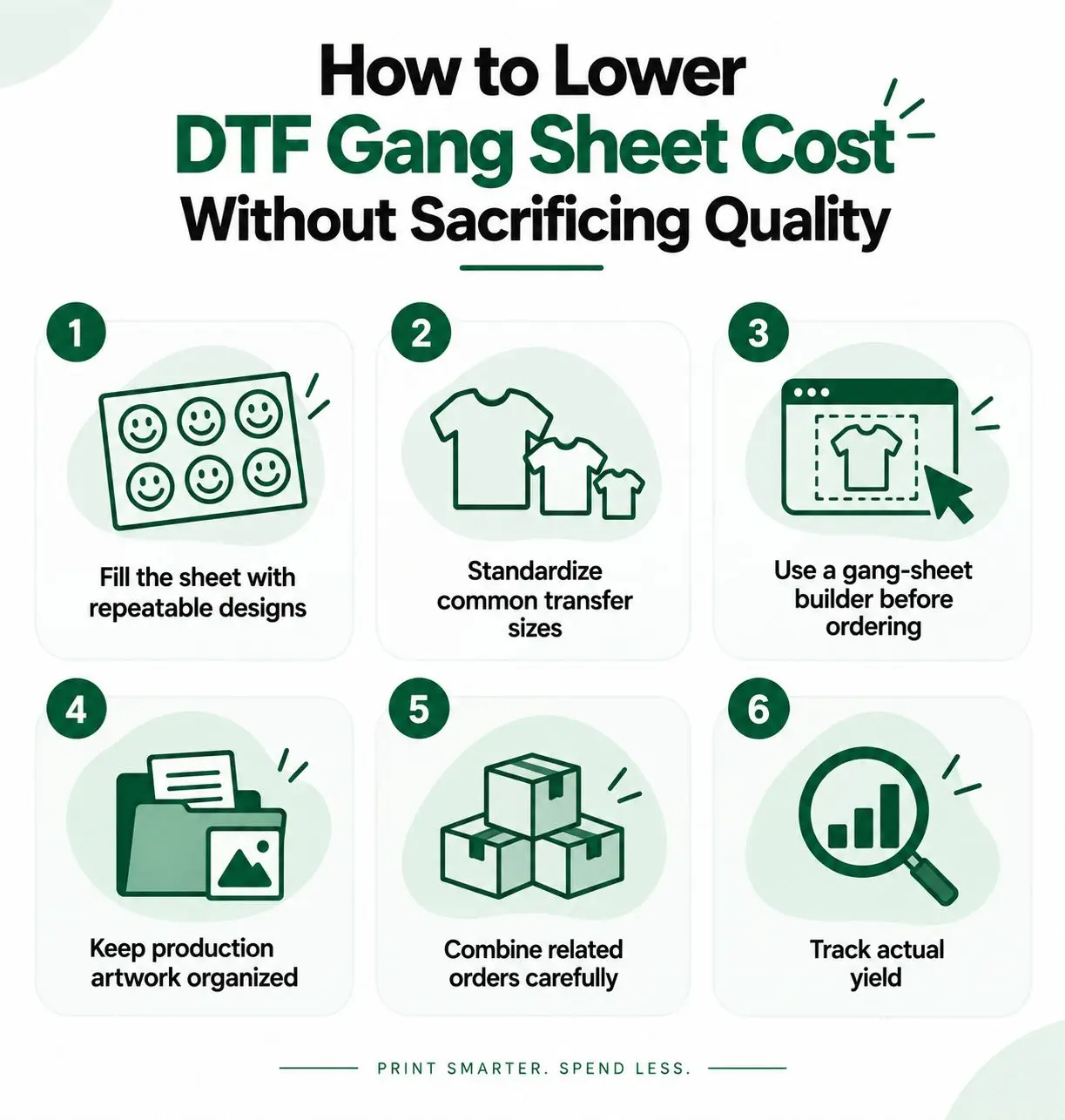
How to Lower DTF Gang Sheet Cost Without Sacrificing Quality
The most effective savings usually come from better planning rather than choosing the cheapest supplier.
Fill the sheet with repeatable designs
If you sell a popular logo or seasonal design, add enough copies to use the available space. Repeated designs are easier to press and inventory than a large collection of untested graphics.
Standardize common transfer sizes
Create standard size categories for left-chest, full-front, back, sleeve, and youth garments. Standardization reduces artwork revisions and makes gang-sheet planning faster. The DTFS DTF Transfer by Size page can support this type of product planning.
Use a gang-sheet builder before ordering
A builder helps you see whether a design is too large, whether spacing is excessive, and whether another copy can fit. Use the Order Transfers to organize artwork before requesting or placing an order.
Keep production artwork organized
Name files clearly and store approved artwork separately from drafts. Include the intended print size in the filename. This reduces the chance of sending the wrong version or requiring a last-minute correction.
Combine related orders carefully
Combining several customer orders can reduce sheet waste, but label each design clearly. The administrative cost of sorting mixed transfers can exceed the film savings if the sheet is not organized.
Track actual yield
After each order, record the sheet price, shipping, number of usable transfers, damaged transfers, and production time. Your historical data will create a more reliable cost model than a general online estimate.
Common DTF Gang Sheet Pricing Mistakes
A frequent mistake is comparing only the advertised sheet price. Buyers should compare landed cost and usable yield.
Another mistake is leaving large empty spaces because the artwork was uploaded at inconsistent sizes. Standardize artwork dimensions before building the sheet.
Some buyers also overlook shipping. A low sheet price can become less competitive when shipping is added to a small order. Compare the total delivered cost.
Ordering too much inventory is another risk. Bulk pricing helps only when the transfers are used or sold. Test new designs with a smaller order before committing to a large volume.
Finally, do not sacrifice transfer quality to achieve a low nominal price. A transfer that cracks, peels, or produces inconsistent color can create replacements, refunds, and customer-service costs. Reliability is part of wholesale value.
Is a DTF Gang Sheet Worth It for Wholesale Buyers?
A gang sheet is often worthwhile when you have multiple designs, repeat orders, or enough volume to use most of the printable area. It is particularly useful for print shops, apparel brands, school or team orders, promotional campaigns, and event merchandise.
A gang sheet may be less suitable when you are testing an unproven design, ordering only one large graphic, or lacking a clear plan for the remaining transfers. In those situations, a smaller order or size-based product may reduce risk.
The correct decision depends on three questions:
11 Can you use most of the sheet?
12 Does the unit cost improve after shipping and labor?
13 Can the finished products sell at a margin that supports your business?
If the answer is yes, gang sheets can help increase production efficiency and average order value.
Wholesale DTF Order Planning Checklist
Before submitting a bulk order, confirm the following:
• The artwork is approved and sized for the intended garment.
• The transparent background is correct.
• The sheet dimensions match the expected output.
• The gang sheet is filled efficiently without unsafe spacing.
• The quantity of usable transfers is recorded.
• The total landed cost includes shipping and fees.
• The expected production turnaround matches the customer deadline.
• The garments and pressing equipment are ready.
• The selling price includes labor, packaging, and overhead.
• The order has a clear quality-check process.
This checklist prevents the most common causes of avoidable cost increases.
Conclusion: Build a Pricing System, Not Just a Cheap Order
Successful wholesale DTF buying is based on repeatable unit economics. DTF gang sheet pricing should be judged by usable output, landed cost, transfer quality, turnaround, and the selling price of the finished apparel. The lowest sheet price is not always the lowest business cost.
Start by arranging your artwork efficiently. Then calculate DTF gang sheet cost using the number of usable transfers, not just the sheet total. Compare DTF wholesale pricing across suppliers using the same sheet dimensions, quantity, shipping assumptions, and quality requirements. Finally, calculate your DTF transfer price per shirt alongside garment, labor, packaging, and fees.
If you are ready to plan a commercial order, use the Order Transfers, review transfer sizes at DTFS DTF Transfer by Size, and explore DTFS Bulk & Wholesale Printing. These pages can help you move from keyword research and cost planning to a more efficient bulk-order workflow.
Frequently Asked Questions
What is the biggest factor in DTF gang sheet pricing?
The biggest factor is usually how efficiently you use the printable area. A well-nested sheet produces more usable transfers and reduces the cost per transfer.
How can I calculate DTF gang sheet cost?
Add the sheet price, shipping, and applicable fees, then divide that total by the number of usable transfers. Add garment, labor, packaging, and other expenses when calculating the finished-shirt cost.
Is DTF wholesale pricing available for small businesses?
Many suppliers can support growing businesses, but the discount structure varies. Ask about minimums, repeat-order discounts, mixed designs, and monthly volume.
How do I reduce DTF transfer price per shirt?
Use standard sizes, fill sheets efficiently, combine compatible repeat orders, reduce artwork revisions, and track the actual number of usable transfers from each sheet.
How much does a DTF gang sheet cost?
The price varies by dimensions, supplier, quantity, artwork arrangement, turnaround, and shipping. Compare the final delivered cost per usable transfer rather than the sheet price alone.
Should I buy a full gang sheet for a new design?
Usually, test a new design at a smaller quantity unless you already have confirmed demand. Full sheets are most efficient for repeatable designs and known customer orders.