
August 11, 2026 · Connor McDonnell
Best Surfaces for UV DTF Transfers: Glass, Metal, Plastic & More
Choosing the best surfaces for UV DTF transfers is just as important as choosing a high-quality transfer. UV DTF has become popular because it lets businesses decorate hard goods without a heat press, opening opportunities across drinkware, signage, packaging, promotional products, gifts, and accessories. But “works on hard surfaces” does not mean every hard surface will produce the same result.
The strongest candidates are generally smooth, clean, sealed, and non-porous materials. Surface texture, coatings, oils, curvature, and intended use can all affect adhesion and durability. This guide explains which materials work best, which require preparation, which create higher risks, and how to test a blank before production.
Key Takeaways
-
The best UV DTF surfaces are usually smooth, hard, sealed, and non-porous.
-
Glass, acrylic, ceramic, coated metal, stainless steel, and hard plastic are strong candidates.
-
Sealed wood can work, while raw porous wood is much less reliable.
-
Surface preparation is critical because dust, oils, and coatings can weaken adhesion.
-
Curved products such as tumblers can work when the transfer is applied gradually and evenly.
-
Always test the exact blank before committing to commercial production.
Best Surfaces for UV DTF Transfers: What Makes a Surface Compatible?
UV DTF transfers are fundamentally different from conventional DTF transfers. Standard DTF is designed for fabric and normally requires heat and pressure to bond a transfer to textile fibers. UV DTF is designed for hard goods and uses UV-cured ink with an adhesive-based transfer construction.
That difference explains why UV DTF works particularly well on rigid products that cannot conveniently be placed under a heat press. Smooth surfaces give the adhesive a more consistent contact area, while excessive texture, contamination, or porosity can create weak points.
For businesses, the real question is not simply “what surfaces can UV DTF transfers be applied to?” It is:
Will this specific surface provide repeatable adhesion for the intended product and customer use?
A blank that looks smooth may still have a coating, release agent, oil, or low-surface-energy finish that changes the result. Recent industry guidance similarly emphasizes that substrate compatibility depends on surface condition as much as the underlying material.
UV DTF Transfers on Glass
Glass is one of the most reliable substrates for UV DTF applications because it is hard, smooth, and non-porous. This makes it suitable for products such as glass mugs, jars, ornaments, bottles, candle containers, vases, and decorative panels.
The biggest advantage is the consistency of the surface. When the glass is properly cleaned, the transfer can make broad, even contact without needing to penetrate a textured or porous material.
However, glass should not be treated as automatically application-ready. Fingerprints, dust, grease, adhesive residue, and cleaning-product films can interfere with adhesion.
Before applying to glass:
-
Clean the application area thoroughly.
-
Use a lint-free cloth.
-
Remove fingerprints and oils.
-
Allow the surface to dry completely.
-
Avoid touching the cleaned area immediately before application.
-
Test the exact glass blank before large production runs.
For transparent glass, also consider the artwork itself. White ink and color density can dramatically affect how visible a design appears against a clear background.
UV DTF Transfers on Metal and Stainless Steel
Metal is another strong category, particularly when the surface is smooth, finished, painted, coated, or powder-coated in a way that is compatible with the adhesive.
UV DTF transfers on metal are commonly used for signs, tins, bottles, promotional products, water bottles, and drinkware. Stainless steel is especially popular because many consumer products already have smooth finished surfaces.
The important distinction is between the metal itself and its finish. A polished stainless-steel surface may behave differently from a painted steel surface, anodized aluminum, or a heavily textured coating.
For UV DTF transfers on stainless steel, inspect the finish before production. If the surface has a coating, confirm that the adhesive bonds reliably to that coating rather than assuming the underlying metal determines performance.
Metal application checklist
-
Check whether the surface is bare, painted, coated, or powder-coated.
-
Clean away manufacturing oils.
-
Inspect for texture or raised coatings.
-
Test adhesion on the exact product.
-
Test abrasion if the item will experience frequent handling.
-
Consider the customer's cleaning and care routine.
A low-cost metal blank with an inconsistent coating can create more production problems than a slightly more expensive blank with a predictable finish.
UV DTF Transfers on Plastic
Hard plastic can be an excellent substrate, but plastic is one category where “smooth” does not always mean “easy.”
UV DTF transfers on plastic can work well on rigid, polished surfaces such as cases, containers, organizers, signs, accessories, and promotional products. But different plastic formulations have different surface characteristics.
Some plastics provide a much better adhesive bond than others. Products made from low-energy plastics or plastics carrying mold-release residue may require additional testing or preparation.
Common plastic risks
-
Mold-release residue
-
Manufacturing oils
-
Flexible or rubberized finishes
-
Extremely smooth low-energy surfaces
-
Textured plastic
-
Scratched or contaminated surfaces
If you sell decorated plastic products commercially, test multiple blanks from the same supplier rather than testing only one sample. Consistency between production batches matters.
UV DTF Transfers on Acrylic
Acrylic, including Plexiglass-type materials, is particularly useful for signs, keychains, displays, awards, ornaments, nameplates, and decorative products.
Smooth acrylic generally provides a good application surface. Clear acrylic also creates interesting design possibilities because the background can become part of the finished look.
For UV DTF transfers on acrylic, pay attention to the protective film. Remove it from the application area and make sure the adhesive is contacting the acrylic itself rather than a remaining film layer.
Best practices for acrylic
-
Remove protective film where appropriate.
-
Clean the surface.
-
Avoid harsh contamination.
-
Keep the application area free from dust.
-
Use firm, even pressure.
-
Test transparent and colored acrylic separately.
Clear acrylic can also make tiny imperfections more noticeable, so careful application is especially important for premium products.
UV DTF Transfers on Ceramic
Ceramic is generally a good candidate when the surface is smooth and glazed. This makes UV DTF transfers on ceramic useful for mugs, tiles, decorative pieces, containers, and gift products.
The key word is glazed.
Raw or porous ceramic has a very different surface from a smooth glazed mug. The glaze creates the sealed surface that makes application more predictable.
For mugs and drinkware, businesses should also consider the intended cleaning method. A transfer that looks perfect immediately after application may experience more wear when exposed to frequent washing, abrasion, detergents, or dishwasher cycles.
Before selling a decorated ceramic product, test:
-
Initial adhesion.
-
Edge stability.
-
Hand-washing.
-
Normal handling.
-
Any customer-specific care process.
Do not promise dishwasher durability unless the complete product-and-transfer combination has been tested for that use.
UV DTF Transfers on Wood
Wood requires more caution than glass, metal, acrylic, or glazed ceramic.
UV DTF transfers on wood generally perform better when the wood is sealed, smooth, painted, varnished, or otherwise given a stable non-porous surface.
Raw wood is naturally porous and uneven. The adhesive may not make consistent contact, while wood fibers and surface irregularities can create weak areas.
Better wood candidates
-
Sealed plywood
-
Finished hardwood
-
Painted wood
-
Varnished products
-
Smooth coated blanks
Higher-risk wood candidates
-
Raw unfinished wood
-
Rough-sanded wood
-
Deeply textured surfaces
-
Highly absorbent surfaces
If wood is central to your product line, select blanks specifically for decoration rather than choosing the cheapest untreated option.
UV DTF Transfers on Tumblers
Tumblers are among the most popular UV DTF applications because they combine a smooth decorative surface with a product shape that can be difficult to decorate using conventional heat-transfer equipment. Current industry guides consistently identify stainless-steel and powder-coated tumblers as major UV DTF use cases.
The challenge is curvature.
A flat transfer is easier to position than a large graphic wrapped around a cylinder. On a curved tumbler, applying too much of the transfer at once can trap air or create wrinkles.
For tumbler applications:
-
Clean the tumbler thoroughly.
-
Dry-fit the transfer first.
-
Mark alignment points when needed.
-
Start from one edge.
-
Apply gradually rather than dropping the entire graphic at once.
-
Use firm, even pressure.
-
Avoid stretching the transfer.
-
Inspect edges after application.
Large wraps deserve extra attention because curvature increases the consequences of poor alignment.
UV DTF Transfers on Mugs
Mugs are another practical application because glazed ceramic provides a smooth surface suitable for adhesive transfer decoration.
For UV DTF transfers on mugs, consider the handle, taper, curvature, and intended cleaning method before selecting the artwork.
A design that fits perfectly on the front of a flat-sided mug may not work well near the handle or around a strongly tapered shape.
When selling customized mugs, test the actual mug model rather than assuming every ceramic mug will behave identically.
Comparing UV DTF Compatible Surfaces
|
Surface |
General Suitability |
Main Consideration |
|
Glass |
Excellent |
Cleanliness |
|
Stainless steel |
Excellent |
Finish and coating |
|
Acrylic |
Excellent |
Protective film and scratches |
|
Hard plastic |
Very good |
Plastic formulation |
|
Glazed ceramic |
Very good |
Glaze quality |
|
Coated metal |
Very good |
Coating compatibility |
|
Sealed wood |
Good |
Seal quality |
|
Raw wood |
Poor |
Porosity |
|
Fabric |
Not recommended |
Use standard DTF |
|
Silicone/rubber |
High risk |
Poor or inconsistent adhesion |
|
Rough textured surfaces |
High risk |
Incomplete adhesive contact |
This distinction is important: a material category can be suitable while a particular product finish is not.
What Surfaces Should You Avoid?
UV DTF is versatile, but it is not universal. The most problematic substrates are generally porous, soft, oily, highly textured, or chemically incompatible with the adhesive.
Avoid treating a transfer as production-ready simply because it sticks during an initial test. Early adhesion does not automatically prove long-term durability.
High-risk examples include:
-
Fabric
-
Raw unfinished wood
-
Porous stone
-
Rough concrete
-
Silicone
-
Rubberized surfaces
-
Greasy plastics
-
Deeply textured blanks
-
Wet or cold products
For unusual materials, perform a controlled adhesion test before committing inventory. Recent compatibility research specifically recommends testing surfaces that fall outside the standard smooth, sealed substrate group.
How Surface Preparation Affects UV DTF Transfer Applications
Even one of the best surfaces for UV DTF transfers can fail if it is contaminated.
The goal is to create a clean, dry, stable contact area. Dust can create small voids, while oils and fingerprints can prevent the adhesive from making reliable contact.
A practical preparation process is:
-
Inspect the blank for scratches, coatings, and texture.
-
Clean the application area with an appropriate alcohol-based cleaner.
-
Use a lint-free cloth.
-
Allow the surface to dry fully.
-
Avoid touching the cleaned area.
-
Apply the transfer using controlled pressure.
-
Inspect the entire design before releasing the finished item.
For troubleshooting recurring failures, reviewing your process—not just changing the transfer—is often the fastest way to identify the root cause.
If you are new to the process, you can also learn how to order custom UV DTF transfers online before selecting your production materials.
How to Test a New Surface Before Production
A commercial application should never depend entirely on a generic compatibility list.
Test the exact combination of:
transfer + blank + finish + application method + intended use.
For example, two tumblers that appear identical may have different coatings. Two acrylic products may have different protective films. Two plastic products may use different formulations.
A simple testing protocol can include:
-
Apply several samples.
-
Inspect immediately.
-
Check edges after 24 hours.
-
Rub or lightly abrade the design where appropriate.
-
Test the customer's expected cleaning method.
-
Record which blank and transfer combination was used.
Testing is particularly important when launching a new product line or switching blank suppliers.
Choosing Quality Transfers for Different UV DTF Transfer Surfaces
Surface compatibility is only half of the equation. The transfer itself also matters.
A poorly produced transfer can make a good substrate look like a bad substrate. Inconsistent adhesive coverage, damaged film, poor curing, or low-quality printing can create application problems even when the blank is suitable.
For repeat production, custom DTF transfers from a consistent supplier can make it easier to control artwork quality and application results.
When production volume increases, businesses can also organize multiple designs efficiently through gang sheet printing, particularly when several small graphics are being applied across different products.
Commercial UV DTF Applications: Choosing the Right Surface
UV DTF can support a wide range of product categories, including:
-
Tumblers and bottles
-
Mugs and drinkware
-
Glass jars
-
Acrylic signs
-
Keychains
-
Phone cases
-
Packaging
-
Promotional products
-
Metal accessories
-
Decorative gifts
-
Sealed wood products
The best choice depends on more than whether the transfer adheres. Consider the product's shape, finish, customer usage, expected abrasion, cleaning requirements, and selling price.
For larger production runs, bulk DTF printing can help businesses maintain a more consistent supply of transfers while planning around repeat product demand.
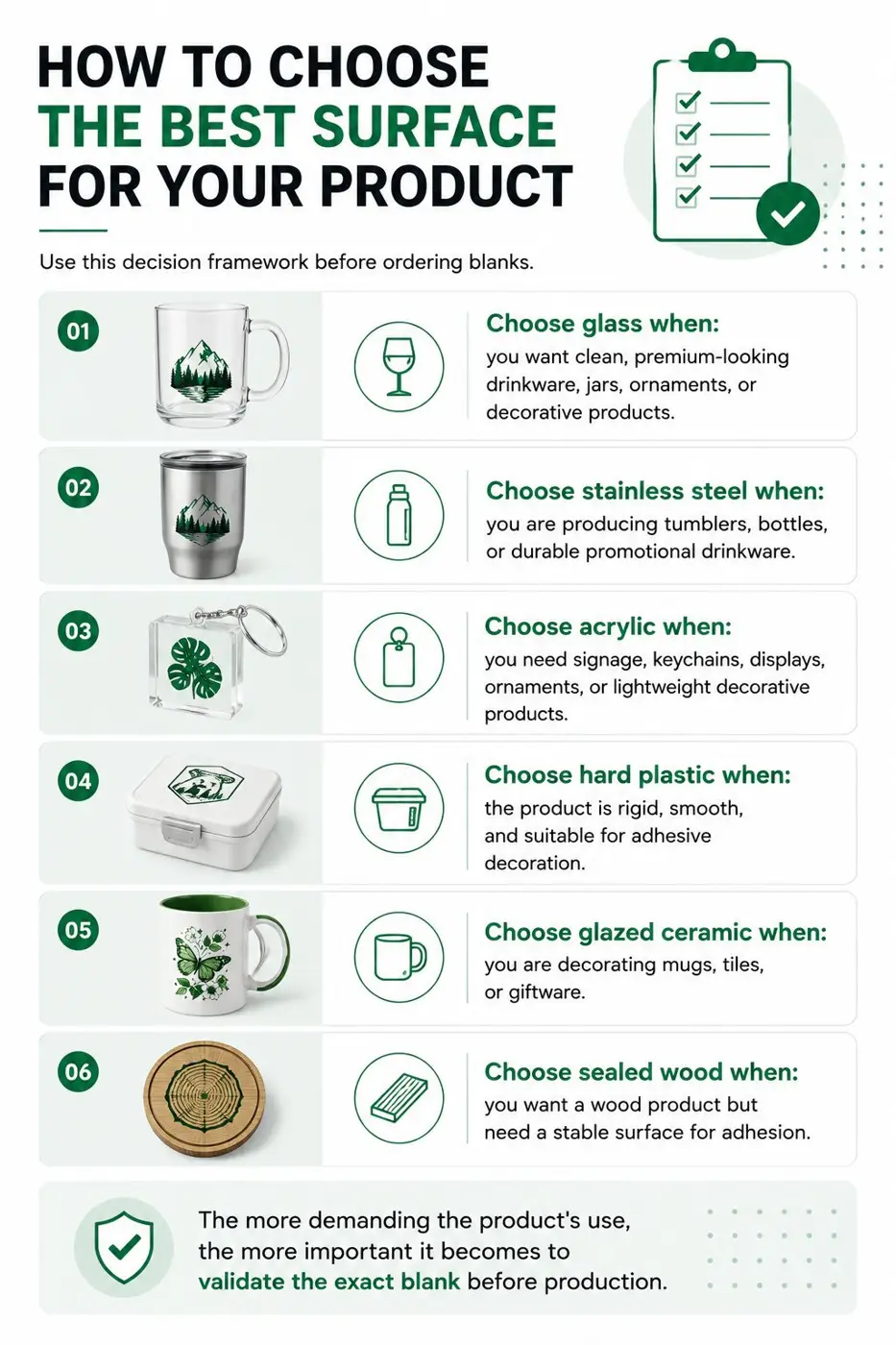
How to Choose the Best Surface for Your Product
Use this decision framework before ordering blanks.
Choose glass when: you want clean, premium-looking drinkware, jars, ornaments, or decorative products.
Choose stainless steel when: you are producing tumblers, bottles, or durable promotional drinkware.
Choose acrylic when: you need signage, keychains, displays, ornaments, or lightweight decorative products.
Choose hard plastic when: the product is rigid, smooth, and suitable for adhesive decoration.
Choose glazed ceramic when: you are decorating mugs, tiles, or giftware.
Choose sealed wood when: you want a wood product but need a stable surface for adhesion.
The more demanding the product's use, the more important it becomes to validate the exact blank before production.
Why Surface Testing Matters for Businesses
For hobby projects, a failed transfer may mean losing one blank. For a business, the same failure multiplied across 100 or 1,000 products becomes a margin problem.
A reliable UV DTF workflow therefore treats substrate selection as part of quality control.
Businesses should maintain records of:
-
Blank supplier
-
Product model
-
Surface finish
-
Transfer specification
-
Cleaning process
-
Application method
-
Test results
-
Customer care recommendations
This turns UV DTF from a trial-and-error process into a repeatable production workflow.
Final Thoughts
The best surfaces for UV DTF transfers are typically smooth, hard, sealed, and non-porous. Glass, stainless steel, acrylic, glazed ceramic, coated metal, and suitable hard plastics are among the strongest choices, while sealed wood can work with proper preparation. Raw wood, fabric, silicone, rubber, and heavily textured materials present greater adhesion risks.
The most reliable results come from matching the transfer to the exact blank, preparing the surface carefully, applying controlled pressure, and testing products before scaling production. For businesses, that combination protects product quality, reduces failed applications, and creates a more consistent customer experience.
FAQs
What surfaces can UV DTF transfers be applied to?
UV DTF transfers are generally suited to smooth, hard, non-porous surfaces such as glass, acrylic, stainless steel, coated metal, glazed ceramic, and suitable hard plastics. Sealed wood can also work. Always test unusual or newly sourced blanks before production.
Can UV DTF transfers be applied to glass?
Yes. Glass is one of the strongest substrate choices because it is smooth and non-porous. Proper cleaning is essential because fingerprints, dust, and oils can interfere with adhesion.
Can UV DTF transfers be applied to metal?
Yes. Stainless steel, aluminum, coated metal, and other smooth finished metals can be suitable. The finish matters, so painted, anodized, and powder-coated products should be tested individually.
Can UV DTF transfers be applied to plastic?
Many rigid, smooth plastics can accept UV DTF transfers, but plastic formulations vary. Low-energy plastics, oily surfaces, rubberized coatings, and textured plastics may require additional testing or may be poor candidates.
Can UV DTF transfers be applied to acrylic?
Yes. Smooth acrylic is a popular application surface for signs, keychains, ornaments, and decorative products. Remove protective film from the application area and clean the acrylic before application.
Can UV DTF transfers be applied to wood?
Sealed, painted, varnished, or otherwise finished wood is generally a better candidate than raw wood. Porous unfinished wood can produce inconsistent adhesion.
Can UV DTF transfers be applied to ceramic mugs?
Yes, especially when the ceramic has a smooth glazed finish. Test the exact mug and intended cleaning method before selling products with specific durability claims.
Are tumblers good for UV DTF transfers?
Yes. Stainless-steel and compatible coated tumblers are among the most popular UV DTF applications. Curved surfaces require slower, controlled application to reduce wrinkles and trapped air.
Do UV DTF transfers require a heat press?
No. UV DTF transfers are designed for cold application to compatible hard surfaces. Pressure is used to establish contact between the adhesive and substrate rather than relying on a heat press.
What is the most important factor when choosing a UV DTF surface?
Surface condition is critical. A smooth, clean, dry, sealed surface generally provides a more predictable application than a porous, oily, rough, or chemically incompatible surface.
How do I reduce UV DTF adhesion problems?
Start with the correct blank, clean it thoroughly, avoid touching the application area, apply the transfer gradually with firm pressure, and test the finished product before commercial production.
Are UV DTF transfers suitable for commercial products?
Yes, they can be useful for drinkware, promotional products, packaging, accessories, signage, and other hard goods. Commercial sellers should validate the exact blank, transfer, application process, and expected customer use before scaling.