
August 21, 2026 · Connor McDonnell
Best Practices for Ordering Wholesale DTF Transfers
Ordering wholesale DTF transfers can help apparel businesses, print shops, resellers, and clothing brands reduce production costs while keeping custom designs flexible. But placing a large order involves more than finding the lowest price per transfer.
Artwork quality, transfer sizing, gang-sheet efficiency, garment compatibility, supplier consistency, turnaround time, and quality control can all affect your actual cost and final product quality.
Whether you're placing your first bulk order or regularly purchasing DTF transfers in bulk, following a structured process can help you avoid waste, delays, and costly reprints.
Here are the best practices to follow before, during, and after your next wholesale DTF transfer order.
Short Answer
The best way to order wholesale DTF transfers is to prepare 300 DPI artwork, choose accurate transfer sizes, optimize gang sheets, test samples on actual garments, compare total costs and supplier quality, confirm turnaround times, and inspect bulk orders upon arrival. A sample-to-bulk workflow helps minimize waste, defects, and production delays.
1. Start With the Right Artwork for Wholesale DTF Transfers
The quality of your artwork directly affects the quality of the finished transfer. Before uploading designs, make sure your files meet your supplier's specifications.
Use High-Resolution, Print-Ready Files
PNG files with transparent backgrounds are commonly used for DTF artwork. A resolution of 300 DPI is generally recommended when creating production-ready graphics because it helps preserve sharp edges and fine details.
Avoid sending:
-
Low-resolution images
-
Blurry graphics
-
Unnecessary backgrounds
-
Extremely thin lines
-
Very small text
-
Poorly removed backgrounds
You should also confirm the supplier's accepted file formats and artwork requirements before submitting a large order.
Check Transparency, Details, and Colors
DTF printing can reproduce detailed and colorful graphics, but extremely fine or partially transparent elements may not produce the expected result.
If your design contains gradients, shadows, distressed effects, or very small details, test the artwork first. This is particularly important for business logos where brand consistency matters.
Colors can also appear different on a monitor compared with the physical transfer. If you're producing branded apparel, request a sample and confirm the color before committing to a large quantity.
Confirm Design Dimensions
Don't use one transfer size for every application. A full-front graphic, left-chest logo, sleeve design, and youth-shirt graphic may all require different dimensions.
Determine your intended placement before ordering and communicate the required dimensions clearly.
A few minutes spent checking artwork can prevent dozens or hundreds of unusable transfers later.
2. Reduce Costs by Optimizing Wholesale DTF Transfers on Gang Sheets
One of the biggest opportunities for businesses ordering DTF transfers in bulk is improving how designs are arranged on gang sheets.
What Is Gang Sheet Printing?
Gang sheet printing allows multiple designs to be placed together on a single sheet of DTF film. Instead of printing each graphic separately, you can use the available print area for several designs.
This can be particularly useful when you have:
-
Multiple logo variations
-
Repeating designs
-
Left-chest graphics
-
Sleeve graphics
-
Small promotional designs
-
Different customer orders
-
Seasonal artwork
The goal is to maximize usable space without making the designs difficult to cut apart.
Pack Designs Efficiently
Avoid leaving large areas of unused film when creating a gang sheet. At the same time, don't place graphics so close together that cutting becomes difficult.
For recurring orders, group similar designs together and identify which graphics are ordered most frequently.
For example, if you regularly sell three shirt designs in several sizes, organizing those graphics efficiently on a gang sheet may help reduce wasted print area and simplify production.
Businesses looking to improve their gang-sheet strategy can explore Gang Sheet Printing for more information about organizing multiple designs efficiently.
Calculate the Real Cost Per Transfer
Don't judge a wholesale order only by the advertised sheet price.
Calculate your effective cost by considering:
-
Total gang-sheet price
-
Number of usable transfers
-
Shipping
-
Minimum order requirements
-
Setup fees
-
Rush charges
-
Potential waste
-
Damaged or unusable transfers
A slightly higher-priced supplier may ultimately be less expensive if its transfers have fewer defects and arrive reliably.
3. Always Test Wholesale DTF Transfers Before Placing a Large Order
Testing is one of the most important steps when working with a new supplier.
A transfer may look excellent on a website or screen but behave differently when pressed onto your specific garments.
Order a Sample or Small Test Run
Before committing to hundreds or thousands of transfers, order a sample or small production quantity.
Use this opportunity to evaluate:
-
Print clarity
-
Color accuracy
-
Opacity
-
Adhesion
-
Hand feel
-
Stretchability
-
Peel performance
-
Wash durability
If you are ordering for customers, don't rely solely on your own visual inspection. Test the transfer under the same production conditions you will use for actual orders.
Test on Your Actual Garments
DTF transfers work across many apparel materials, but application requirements can vary depending on the fabric.
Test the transfer on the actual garment types you plan to decorate. This is particularly important when working with polyester, blends, performance fabrics, or garments with specialty finishes.
A successful test should confirm that the transfer adheres properly without damaging or discoloring the garment.
Confirm Pressing Requirements
Ask your supplier for recommended:
-
Temperature
-
Pressure
-
Pressing time
-
Peel method
-
Repress instructions
-
Cooling requirements
Your supplier's recommended settings should be treated as the starting point. Test them on your equipment and garment before beginning full production.
Follow a Simple Approval Workflow
A reliable purchasing process can look like this:
Sample → garment test → wash test → approve → small production run → bulk order
This approach may take slightly longer at the beginning, but it can save considerable time and money when ordering at scale.
4. Compare Wholesale DTF Transfer Suppliers Beyond Price
Price matters, but it shouldn't be the only factor when deciding where to buy wholesale DTF transfers.
The lowest advertised price can become expensive if you experience inconsistent quality, delayed orders, excessive defects, or poor customer support.
Evaluate Print Quality and Consistency
Ask potential suppliers about their quality-control process.
Look for consistent:
-
Color reproduction
-
Print sharpness
-
White underbase coverage
-
Powder application
-
Curing
-
Film quality
If you're producing hundreds of identical garments, consistency is especially important. A transfer that looks excellent on one shirt but differs noticeably on another can create customer complaints and rework.
Compare Turnaround Times
Ask exactly how long the supplier needs to produce and ship your order.
Don't confuse production time with delivery time. A supplier may have a short production window but require additional shipping time.
Before ordering, confirm:
-
Production turnaround
-
Shipping method
-
Estimated delivery time
-
Weekend and holiday policies
-
Rush-order availability
-
Order cutoff times
Reliable turnaround becomes increasingly important as your order volume grows.
Review Minimum Order Quantities
Some wholesale suppliers offer better pricing at higher volumes, while others may have minimum order requirements.
Compare the price tiers against your actual demand.
Ordering 5,000 transfers simply to unlock a lower unit price doesn't make sense if you only expect to use 1,000 in the foreseeable future.
Unused transfers can tie up cash and create storage problems.
Understand Replacement and Quality Policies
Before placing a large order, understand what happens when something goes wrong.
Ask how the supplier handles:
-
Misprinted transfers
-
Missing quantities
-
Incorrect sizes
-
Color discrepancies
-
Damaged transfers
-
Shipping damage
-
Production defects
A clear replacement policy can make a significant difference when you're managing customer deadlines.
For businesses with recurring high-volume requirements, Bulk and Wholesale DTF Printing can provide a more scalable option than treating every order as an isolated purchase.
5. Build a Smarter Process for Ordering DTF Transfers in Bulk
Once you've identified a reliable supplier, create a repeatable ordering process.
A standardized workflow reduces mistakes and makes it easier to manage growing order volumes.
Step 1: Finalize Your Artwork
Review every design before submission.
Confirm:
-
Resolution
-
File format
-
Transparency
-
Dimensions
-
Color requirements
-
Placement
-
Important details near edges
Don't wait until the order is being processed to discover that the artwork needs to be changed.
Step 2: Determine Transfer Sizes and Quantities
Create a list of the designs you need and their intended applications.
Separate designs by placement and size instead of automatically ordering the same dimensions for every garment.
Estimate demand based on actual sales or production requirements whenever possible.
Step 3: Optimize Your Gang Sheets
Arrange designs efficiently while leaving enough space for cutting.
If you frequently reorder the same designs, save standardized gang-sheet layouts. This can make future orders faster and reduce manual preparation.
A Wholesale Gang Sheets Buying Guide can also help businesses understand how to evaluate sheet sizes and purchasing options.
Step 4: Approve Samples
Test your designs on actual garments before approving the production order.
Document the successful pressing settings so your production team can repeat the process consistently.
Step 5: Place the Bulk Order
Before submitting payment, confirm the final:
-
Quantity
-
Design sizes
-
Gang-sheet layout
-
Price
-
Shipping cost
-
Production time
-
Delivery estimate
If anything looks different from the approved sample, stop and clarify it before production begins.
Step 6: Inspect the Shipment
Don't immediately put a large shipment into storage without checking it.
Inspect the transfers for:
-
Scratches
-
Powder clumping
-
Curing problems
-
Color inconsistencies
-
Incorrect quantities
-
Damaged film
-
Incorrect designs
Early inspection makes it easier to resolve problems before the transfers are needed for customer orders.
Step 7: Track Supplier Performance
For ongoing bulk DTF transfer orders, track supplier performance over time.
Useful metrics include:
-
On-time delivery rate
-
Defect rate
-
Replacement frequency
-
Effective cost per usable transfer
-
Customer complaints
-
Order consistency
This gives you a much better picture of supplier value than price alone.
6. Know When to Buy Wholesale DTF Transfers vs. Use a Full-Service Solution
Buying wholesale DTF transfers for businesses makes sense when you have predictable demand and the equipment, staff, and workflow to apply transfers efficiently.
When Buying in Bulk Makes Sense
Wholesale purchasing can be a good fit when you:
-
Have recurring apparel orders
-
Already operate a heat-press workflow
-
Need multiple designs regularly
-
Want to control application in-house
-
Can store transfers properly
-
Can take advantage of volume pricing
For example, a print shop producing hundreds of garments each month may benefit from purchasing transfers in larger quantities rather than ordering individual pieces as needed.
When a Production Partner May Be Better
A full-service production partner may make more sense when your business is growing but you don't want additional production workload.
This can be useful when you:
-
Have increasing order volume
-
Need recurring production
-
Want to reduce internal labor
-
Run an apparel brand
-
Serve multiple customers
-
Need white-label production support
For businesses exploring this model, White-Label Production Services can help support recurring apparel production while allowing the business to focus more heavily on sales, design, and customer acquisition.
Likewise, businesses that need one-off or highly customized graphics can explore Custom DTF Transfers based on their specific production needs.
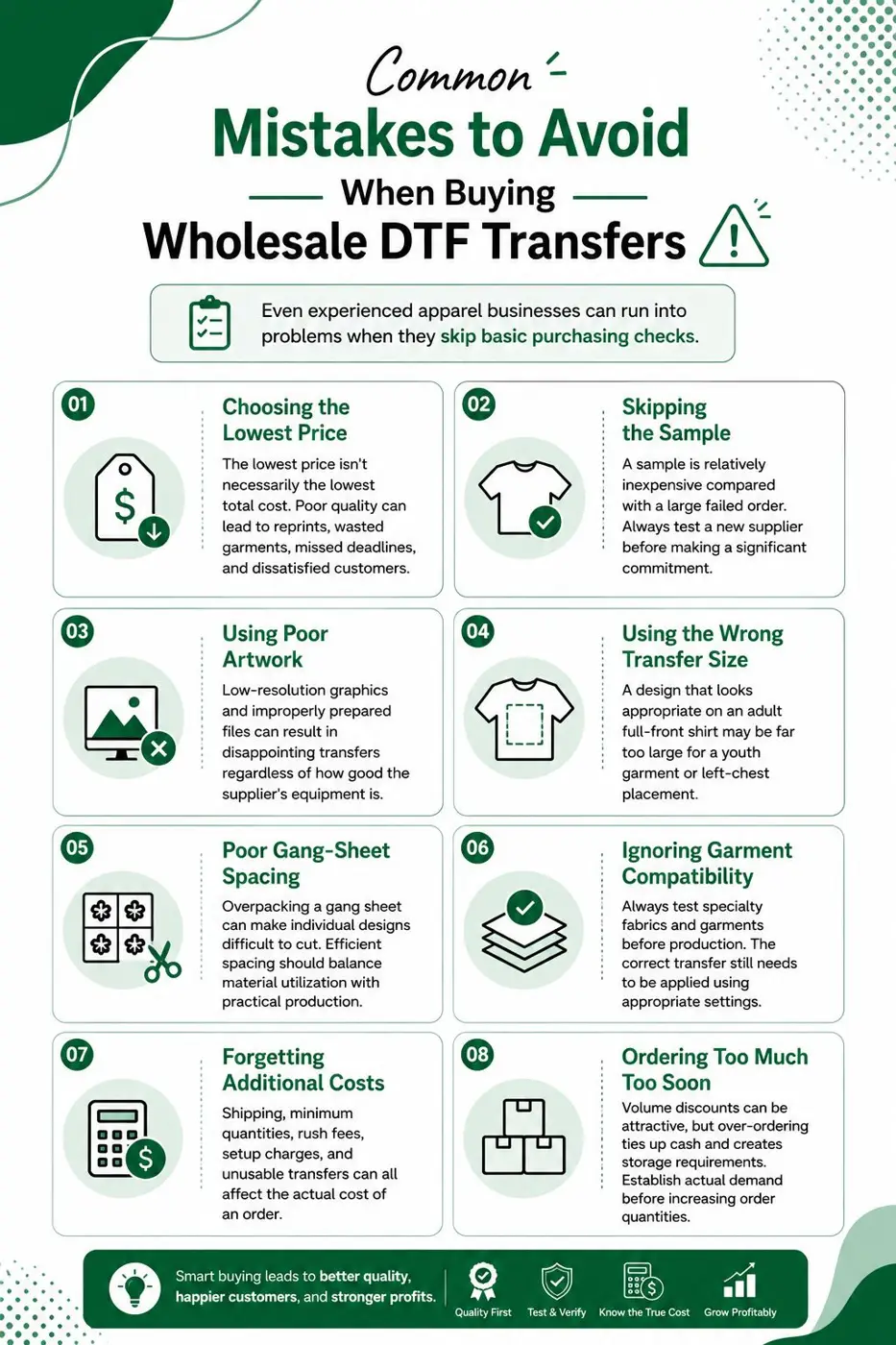
7. Common Mistakes to Avoid When Buying Wholesale DTF Transfers
Even experienced apparel businesses can run into problems when they skip basic purchasing checks.
Choosing the Lowest Price
The lowest price isn't necessarily the lowest total cost. Poor quality can lead to reprints, wasted garments, missed deadlines, and dissatisfied customers.
Skipping the Sample
A sample is relatively inexpensive compared with a large failed order. Always test a new supplier before making a significant commitment.
Using Poor Artwork
Low-resolution graphics and improperly prepared files can result in disappointing transfers regardless of how good the supplier's equipment is.
Using the Wrong Transfer Size
A design that looks appropriate on an adult full-front shirt may be far too large for a youth garment or left-chest placement.
Poor Gang-Sheet Spacing
Overpacking a gang sheet can make individual designs difficult to cut. Efficient spacing should balance material utilization with practical production.
Ignoring Garment Compatibility
Always test specialty fabrics and garments before production. The correct transfer still needs to be applied using appropriate settings.
Forgetting Additional Costs
Shipping, minimum quantities, rush fees, setup charges, and unusable transfers can all affect the actual cost of an order.
Ordering Too Much Too Soon
Volume discounts can be attractive, but over-ordering ties up cash and creates storage requirements. Establish actual demand before increasing order quantities.
8. Wholesale DTF Transfers: Final Quality-Control Checklist
Before submitting your next order, run through this checklist:
-
Artwork is high resolution and production-ready
-
Background transparency is correct
-
Design dimensions are confirmed
-
Transfer placement is finalized
-
Gang sheets are efficiently arranged
-
A sample has been tested
-
Garment compatibility has been confirmed
-
Pressing instructions are documented
-
Wash durability has been evaluated
-
Total landed cost has been calculated
-
Minimum order requirements are understood
-
Volume pricing has been reviewed
-
Production and shipping timelines are confirmed
-
Replacement policies are understood
-
The incoming shipment will be inspected before production
This process gives you a consistent framework for managing everything from small wholesale purchases to large recurring orders.
Conclusion: Make Every Wholesale DTF Transfer Order Count
Successful wholesale DTF transfers purchasing isn't simply about finding the lowest price. The better approach is to evaluate the entire process—from artwork preparation and gang-sheet optimization to sampling, supplier quality, turnaround, and post-delivery inspection.
A reliable workflow looks like this:
Prepare artwork → determine sizes → optimize gang sheets → test samples → compare suppliers → place a controlled bulk order → inspect the shipment → track supplier performance.
For businesses that regularly produce custom apparel, this process can reduce waste, improve consistency, and make bulk purchasing easier to manage.
The right supplier should deliver more than an attractive price. Consistent print quality, dependable turnaround, clear policies, and scalable production support can ultimately have a greater impact on your profitability and customer experience.
If you're ready to scale your apparel production, evaluate your current ordering process and look for opportunities to make every transfer, sheet, and bulk order work more efficiently.
Frequently Asked Questions About Wholesale DTF Transfers
What should I look for when buying wholesale DTF transfers?
Focus on print quality, consistency, pricing, turnaround time, garment compatibility, sampling options, customer support, and replacement policies. The supplier should also provide clear artwork and application requirements.
Are wholesale DTF transfers cheaper than ordering individually?
They can be. Larger orders and efficient gang-sheet layouts may reduce the effective cost per transfer. However, compare the total landed cost rather than the advertised unit price alone.
How many DTF transfers should I order in bulk?
The right quantity depends on your sales volume, recurring designs, available storage, and supplier pricing tiers. If you're testing a new supplier, start with a small production run before committing to a much larger order.
Are gang sheets a good option for wholesale DTF transfer orders?
Yes, gang sheets can be useful when you have multiple designs that can share the same print area. Proper spacing and layout are important so the transfers can be separated easily after printing.
Should I test DTF transfers before placing a wholesale order?
Yes. Test the transfer on the actual garment and evaluate adhesion, appearance, application, stretch, and wash performance. Sampling can reveal issues before they affect a large production run.